Personal Matter Leave in Malaysia: A Practical Guide for Employers to Manage Urgent Staff Absences
Every employee encounters unexpected situations that require immediate attention — a family emergency, a government appointment, or a personal issue that cannot be postponed. These cases often fall outside the scope of annual, sick, or compassionate leave.
This is where personal matter leave comes in — a flexible arrangement that allows employees to manage private, non-medical affairs without risking disciplinary action or pay loss. But how should Malaysian employers handle it fairly and effectively? Let’s explore in detail.
What Is Personal Matter Leave?
Personal matter leave is a company-provided benefit that allows employees to attend to urgent personal obligations, such as family emergencies or government appointments, that cannot be delayed.
Unlike statutory leaves, it is not mandated under Malaysian employment law but is instead a discretionary policy created by employers to support staff in balancing personal and work commitments.
Providing personal matter leave helps build a workplace culture of trust, empathy, and flexibility — qualities that modern employees highly value.
Some companies refer to it as personal leave, special leave, or emergency leave. Regardless of the name, its purpose remains the same: giving employees short-term flexibility to handle personal issues responsibly without affecting overall productivity.
Is Personal Matter Leave Legal in Malaysia?
Under the Employment Act 1955, there is no legal requirement for employers to provide personal matter leave. However, companies in Malaysia are free to include it as part of their internal HR policy or employment benefits.
Once the leave policy is documented in an employment contract or staff handbook, it becomes legally binding. Employers should therefore clearly define:
-
Whether it is paid or unpaid
-
The number of days allowed per year
-
The approval process and notice period
Offering this leave voluntarily can enhance your company’s employer brand, showing compassion and understanding — important factors in retaining top talent.
How to Calculate Personal Matter Leave
Since personal matter leave is not governed by law, each company can set its own rules. Common practices among Malaysian employers include:
-
1–3 paid days per year as part of discretionary benefits
-
Combining it with Emergency or Special Leave for simplicity
-
Hourly or part-time calculation based on hours missed (if unpaid)
Example:
If an employee is entitled to 2 days of paid personal matter leave and takes a day off for a court appointment, that day should not affect their pay. Any additional leave beyond the limit can be treated as unpaid leave.
How to Handle Employee Requests for Personal Matter Leave
Personal matter leave requests can be unpredictable. A professional and structured approach ensures fairness and consistency.
1. Establish Clear Internal Policies
Define personal matter leave in your HR policy or handbook. Specify eligibility, entitlement, and pay status to avoid confusion.
2. Request and Approval Process
Employees should apply in advance through the company’s HR system, email, or official communication channel. For emergencies, verbal or text notifications are acceptable, followed by formal confirmation later.
HR or supervisors should review requests promptly to avoid uncertainty.
3. Documentation Requirements
For recurring or extended absences, employers may request simple supporting documents such as government letters or appointment slips. This maintains fairness without invading privacy.
4. Handling Last-Minute or Frequent Requests
If an employee frequently applies for personal leave, HR should have a one-on-one discussion to understand the underlying cause rather than issue immediate warnings. This demonstrates empathy while maintaining accountability.
Common Situations Covered by Personal Matter Leave
Personal matter leave typically applies to short-term, urgent matters such as:
-
Attending court or government appointments (e.g., immigration, LHDN)
-
Managing childcare or family emergencies
-
Handling household or property issues (e.g., urgent repairs)
-
Settling personal financial affairs (e.g., bank or notary visits)
-
Fulfilling personal obligations like examinations or wedding registration
These situations usually last from a few hours to one working day and should be managed flexibly.
Can Employers Reject Personal Matter Leave Requests?
Yes. Employers have the right to approve or reject personal matter leave requests since it is a discretionary benefit, not a statutory entitlement.
However, rejections must be handled fairly and professionally. Employers should:
-
Assess requests objectively based on operational needs
-
Offer alternatives such as annual leave or half-day unpaid leave
-
Communicate decisions clearly and respectfully
Avoid arbitrary or inconsistent handling, as it can lead to employee dissatisfaction or claims of unfair treatment.
How Personal Matter Leave Differs from Other Leave Types
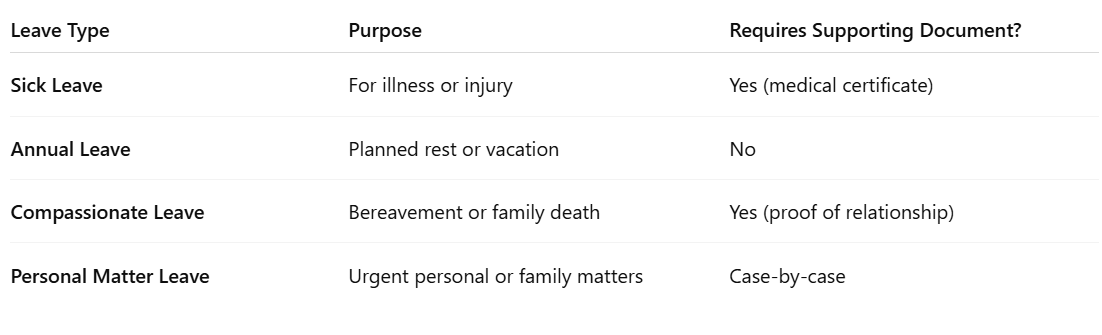
Personal matter leave fills the gap between other categories — providing short, flexible relief for non-medical emergencies.
When to Grant Personal Matter Leave
Employers generally approve this leave for situations that:
-
Are urgent and cannot be postponed, and
-
Do not qualify for other leave types.
Typical examples include legal appointments, urgent family responsibilities, or unexpected home issues. Most companies allow half-day or one-day applications for flexibility.
Policy Considerations for Employers
Before implementing personal matter leave, employers should prepare clear internal guidelines to prevent misuse.
Key policy elements include:
-
Eligibility: Who can apply (full-time, contract, or part-time)
-
Duration: Annual entitlement (e.g., 1–3 days)
-
Approval Process: Supervisor or HR authorisation required
-
Documentation: Optional proof for repeated or long absences
-
Paid or Unpaid: State clearly in the policy
-
Tracking: Maintain proper records for payroll and compliance
Documenting these details in your staff handbook ensures transparency and consistency.
Best Practices for Employers
To manage personal matter leave efficiently:
-
Offer a limited number of days to prevent misuse.
-
Maintain consistent approval standards across departments.
-
Communicate decisions clearly and professionally.
-
Simplify administration by integrating it with annual or emergency leave.
-
Encourage employees to notify managers early to minimise disruption.
How to Record Personal Matter Leave
Proper recordkeeping ensures payroll accuracy and compliance. Here’s how HR can manage it:
1. Classify the Leave Correctly
-
Paid → mark as Personal Matter Leave (Paid)
-
Unpaid → record as Unpaid Leave
-
Combined → tag under Emergency Leave if merged
2. Update Payroll & HR Systems
Modern HR software such as Pandahrms allows HR teams to record, approve, and sync leave data automatically into payroll — eliminating manual errors and ensuring compliance.
3. Maintain Records for Audit
Keep digital copies of all requests and approvals. This helps protect the company during audits or disputes.
4. Review Patterns Periodically
Frequent requests may signal personal challenges or work-life imbalance. HR should review and address issues proactively.
Frequently Asked Questions
1. Is personal matter leave required by Malaysian law?
No. It’s not covered under the Employment Act 1955 and remains a company-driven benefit.
2. Is it paid or unpaid?
That depends on company policy. Employers should define this clearly in contracts or handbooks.
3. Can an employer reject personal matter leave?
Yes. Approval is based on company policy and operational requirements.
4. How to calculate unpaid personal leave deductions?
Deduct wages proportionally. For instance, an employee earning RM200 daily would have RM200 deducted for one unpaid leave day.
5. Are part-time or contract staff entitled to this leave?
It depends on internal policy. Some employers extend the benefit to all employees for fairness.
Streamline Leave Management with Pandahrms
Managing different leave types — including personal matter leave — can be time-consuming if done manually. With Pandahrms, employers can automate the entire process:
-
Customise and track internal leave types
-
Streamline approval workflows
-
Integrate leave data with payroll
-
Generate reports instantly
Empower your HR team with smarter tools to simplify leave management and maintain compliance.