As the year-end approaches, many HR teams begin reviewing remaining annual leave balances — and one common question always comes up:
“If an employee resigns, do we need to pay out their unused annual leave?”
The answer is yes, if the employee is covered under the Employment Act 1955.
A senior HR professional once explained it simply:
Unused annual leave is not a bonus. It is a legal entitlement — and must be compensated if not taken upon resignation.
This article breaks down what employers in Malaysia must know about leave encashment, how it works, and how to prepare for it in your HR and payroll processes.
What Is Leave Encashment?
Leave encashment refers to the payment in lieu of unused annual leave when an employee resigns, retires, or their employment contract ends.
This is not an optional company benefit — it is a statutory requirement for employees protected under the Employment Act 1955.
Who Is Eligible for Leave Encashment?
Under the Employment Act 1955, leave encashment applies to:
-
Employees earning RM4,000 and below, OR
-
Employees regardless of salary if they fall under the EA categories such as manual workers, domestic employees, etc.
While the Act mandates leave encashment for these categories, many companies extend the same practice to all employees for fairness and consistency.
When Must Employers Pay Out Unused Annual Leave?
Employers are legally required to pay for unused annual leave when:
-
The employee resigns
-
The employee is terminated
-
The contract ends or is not renewed
This compensation must be included in the final salary (Final Payroll / FNF – Final Settlement).
What Deductions Apply to Leave Encashment?
Encashed leave is treated as wages, therefore HR must apply:
-
EPF contributions
-
SOCSO contributions
-
EIS contributions
-
PCB (if taxable for that employee)
This ensures compliance with Malaysian statutory regulations.
How to Calculate Leave Encashment
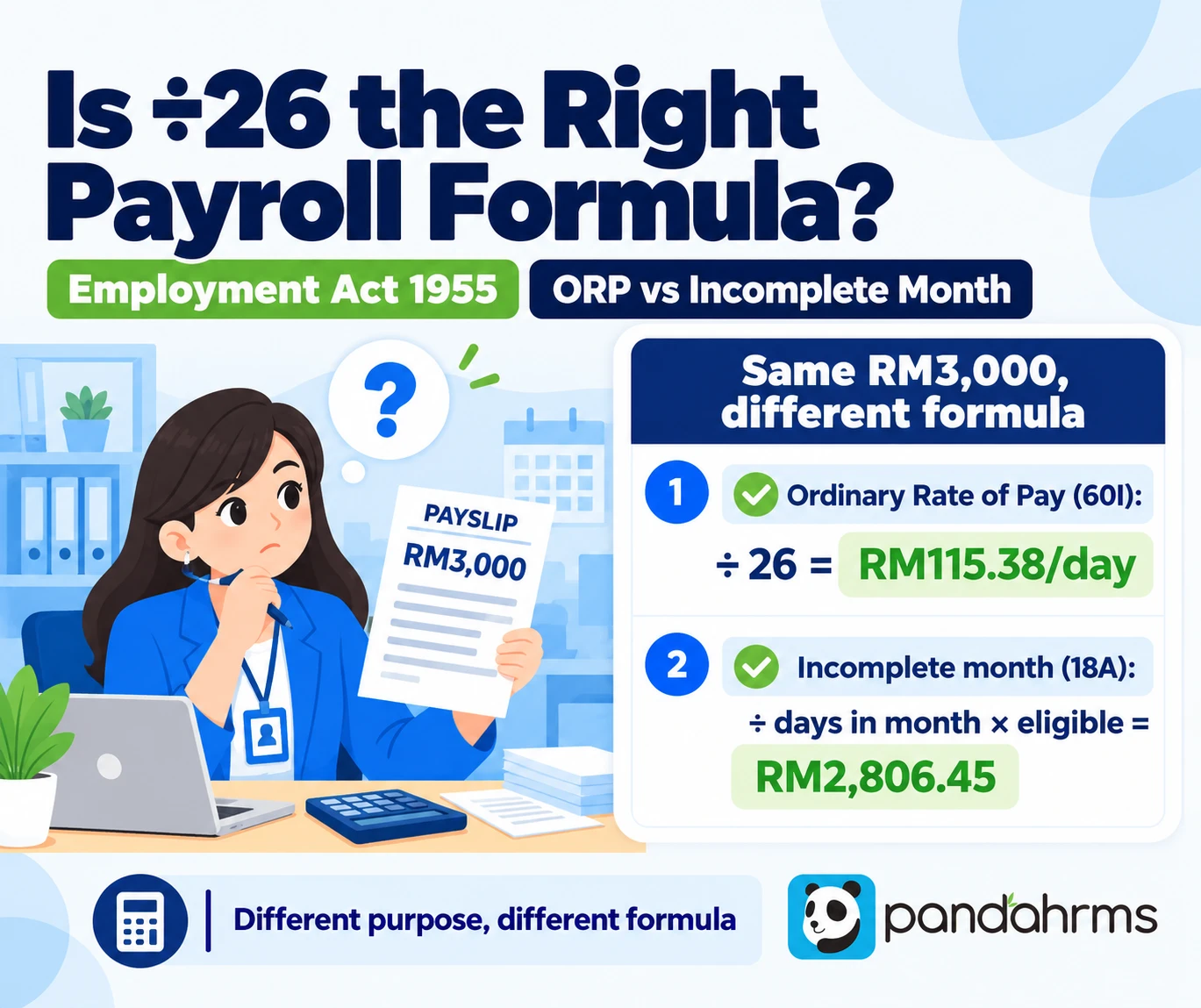
The calculation is based on the employee’s ordinary rate of pay.
Formula:
(Number of unused annual leave days) × (Daily wage rate)
Daily Wage Rate = Monthly Salary ÷ 26
Note: The Employment Act uses 26 working days as the standard divisor.
Example Calculation
Employee monthly salary: RM3,000
Unused annual leave: 5 days
-
Daily wage = RM3,000 ÷ 26 = RM115.38
-
Leave encashment = 5 days × RM115.38 = RM576.92
This amount will then be added to the employee’s final salary, minus statutory deductions.
Should Employees Use Their Annual Leave Before Resigning?
Legally, employees can request to clear their annual leave before their last working day — but employers are not obligated to approve if business operations are affected.
If leave cannot be taken, encashment is mandatory for eligible employees.
For HR, early planning helps:
-
Avoid sudden operational disruptions
-
Prevent a large accumulation of leave encashment payouts
-
Ensure fair and transparent processes
Common Employer Mistakes (That HR Should Avoid)
❌ Not paying out leave for EA-covered employees
❌ Using the wrong divisor (e.g., dividing by 30 days)
❌ Forgetting EPF/SOCSO/EIS contributions
❌ Miscalculating based on average income instead of ordinary wages
❌ Not recording leave balance accurately
These mistakes can lead to disputes, back-pay orders, or compliance risks.
How Pandahrms Helps Employers Manage Leave Accurately
Managing leave balances manually — especially during year-end and resignation cases — can lead to errors.
Pandahrms automates the entire leave process, including:
✓ Real-time leave balance tracking
✓ Automatic encashment calculations
✓ Built-in compliance with Malaysian labour laws
✓ Seamless integration with payroll for accurate final salary
✓ Custom leave policies for different employee groups
This ensures HR teams stay compliant, transparent, and efficient — without manual headaches.
Final Thoughts
Leave encashment is a legal responsibility, not a discretionary benefit.
By understanding the rules and implementing a reliable HR system, employers can:
-
Stay compliant with the Employment Act 1955
-
Ensure fair treatment for employees
-
Avoid financial and operational surprises during year-end or resignations
A well-managed leave process builds trust and reduces disputes — benefiting both HR and employees.