
Many employees in Malaysia notice something on their payslip and immediately ask HR:
“Why is my PCB deduction different every month?”
“Did the payroll system calculate my tax incorrectly?”
In most cases, the answer is no — the calculation is correct.
PCB (Potongan Cukai Bulanan) is designed to be a dynamic tax deduction, meaning the amount deducted can change depending on income fluctuations and statutory deductions.
For employers and HR teams, understanding this calculation is important to avoid payroll confusion and ensure compliance with tax reporting requirements.
This guide explains:
-
What PCB is in Malaysia
-
Why PCB deductions can change every month
-
How income variations affect PCB calculations
-
Why accurate payroll systems are important
What Is PCB in Malaysia?
PCB (Potongan Cukai Bulanan) is the Monthly Tax Deduction deducted from an employee’s salary by the employer.
This system is regulated by the Inland Revenue Board of Malaysia (LHDN).
The purpose of PCB is to allow employees to pay income tax progressively throughout the year, rather than paying a large amount when filing their annual tax return.
In practice, employers deduct a portion of the employee’s salary every month and remit it to LHDN as part of the employee’s tax obligations.
PCB Is Not a Fixed Amount
One common misunderstanding is that PCB should remain the same amount every month.
For example, some employees assume:
“If my salary is RM4,000, my PCB should always be RM120.”
However, this is not how the system works.
PCB is calculated based on several variables, including:
-
Estimated annual income
-
Income changes in a particular month
-
Statutory deductions such as EPF or SOCSO
-
Any previous tax deductions already made
Because these factors change throughout the year, PCB is recalculated regularly by the payroll formula.
Why PCB Can Change Every Month
There are several reasons why employees may see different PCB amounts in their monthly payslips.
1. Changes in Monthly Income
PCB calculations are affected when an employee’s income changes during the year.
Examples include:
-
Overtime payments (OT)
-
Bonuses
-
Allowances
-
Commissions
-
Incentives
If an employee receives additional income in a particular month, the payroll system may estimate that the employee’s annual income will be higher.
As a result, the PCB deduction for that month may increase.
2. Adjustment Based on Annual Tax Estimation
PCB calculations are designed to ensure that the estimated annual tax is gradually paid throughout the year.
If earlier months had lower deductions, the payroll system may increase PCB later in the year to ensure the correct tax amount is collected before year-end.
This is why employees sometimes notice that:
-
PCB is lower at the beginning of the year
-
PCB increases later in the year
This adjustment helps reduce the risk of large tax payments during annual tax filing.
3. Impact of Statutory Contributions
Statutory deductions can also affect PCB calculations.
For example:
-
EPF (Employees Provident Fund) contributions
-
SOCSO contributions
-
EIS contributions
-
Zakat payments
These deductions influence the employee’s chargeable income, which then affects the monthly PCB amount.
In the payroll formula:
-
EPF contributions are treated as recurring deductions
-
SOCSO and EIS are treated as non-recurring deductions
Because SOCSO and EIS are deducted monthly but treated as non-recurring in the formula, the annual chargeable income gradually decreases over time, causing PCB to change slightly each month.
Simple Example of PCB Fluctuation
Consider this simplified scenario:
Monthly salary: RM5,000
EPF contribution: RM200
SOCSO / EIS deduction: RM20
In the PCB formula:
-
EPF is treated as a recurring deduction
-
SOCSO / EIS are treated as non-recurring deductions
This means the estimated annual chargeable income gradually decreases every month, which may cause PCB to adjust slightly.
Example progression:
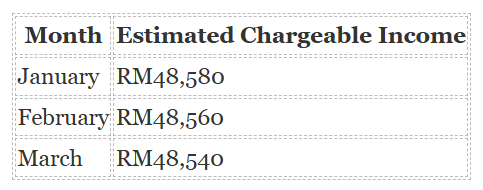
As the estimated annual income changes, the PCB deduction may fluctuate slightly.
PCB Is Only a Prepaid Tax
It is important for both employers and employees to understand that:
PCB is not the final tax amount.
Instead, it is a prepaid tax deducted monthly by the employer.
The final tax calculation happens when the employee submits their income tax return through e-Filing.
At that point:
-
If PCB deducted is higher than the actual tax, the employee may receive a tax refund
-
If PCB deducted is insufficient, the employee may need to pay additional tax
Why Accurate Payroll Systems Matter
Calculating PCB manually using spreadsheets can be complicated.
Several variables affect the final amount, including:
-
Monthly income fluctuations
-
Bonuses or overtime payments
-
Statutary deductions
-
Tax relief eligibility
If payroll calculations are done manually, the risk of calculation errors or compliance issues increases.
Using a structured HR and payroll system helps employers:
✔ Calculate PCB automatically based on LHDN formulas
✔ Ensure payroll records remain accurate
✔ Reduce payroll errors
✔ Maintain compliance with Malaysian tax regulations
Simplify Payroll and PCB Calculations with Pandahrms
Managing payroll manually can be time-consuming for HR teams, especially when income and deductions change frequently.
With Pandahrms, employers can:
-
Automate payroll calculations
-
Ensure accurate PCB deductions
-
Track employee remuneration and statutory contributions
-
Maintain organised payroll records for compliance
This helps HR teams reduce payroll complexity while ensuring smooth payroll operations.
Conclusion
PCB deductions in Malaysia are not fixed amounts.
They can change from month to month because the calculation considers annual income estimates, statutory deductions, and income fluctuations such as bonuses or overtime.
For employers, ensuring accurate PCB calculations is important to avoid payroll confusion and maintain tax compliance.
By implementing a reliable payroll system like Pandahrms, businesses can simplify payroll management while ensuring that monthly tax deductions are calculated correctly.