Payroll Compliance in Malaysia Is a Legal Obligation — Not an Admin Task
Payroll compliance in Malaysia is not just about paying salaries on time.
It is a regulated statutory responsibility that requires employers to:
- Deduct employee contributions accurately
- Submit payments to multiple government agencies
- File statutory reports within strict deadlines
Missing even a single deadline can result in:
- Financial penalties and interest charges
- Audit exposure and compliance investigations
- Legal action or prosecution
For HR and payroll teams, managing multiple monthly deadlines can quickly become complex — especially without a structured system.
This guide provides a complete, practical breakdown of payroll deadlines and penalties in Malaysia for 2026, helping employers stay compliant and avoid costly mistakes.
What Are the Payroll Deadlines in Malaysia?
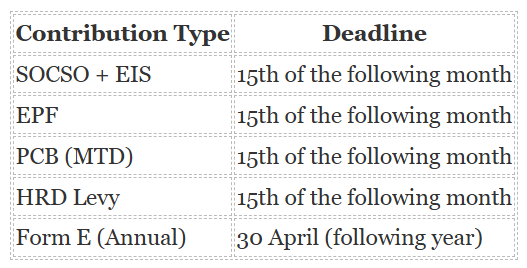
Most statutory payroll contributions in Malaysia must be submitted:
By the 15th of the following month
This applies to:
- EPF
- SOCSO
- EIS
- PCB (MTD)
- HRD Levy
Exception:
- Form E (annual employer declaration) → 30 April (following year)
Quick Summary Table: Malaysia Payroll Deadlines (2026)
SOCSO & EIS Deadlines and Penalties
Deadline
Employers must submit contributions to:
- Social Security Organisation (SOCSO)
- Employment Insurance System (EIS)
By the 15th of the following month
If the deadline falls on a public holiday, payment must be made before the last working day.
Penalties for Late Payment
Late SOCSO/EIS payments may result in:
- 6% per annum interest (calculated daily)
- Minimum charge of RM5 per month
Under the Employees’ Social Security Act 1969:
- Fines up to RM10,000
- Imprisonment up to 2 years
- Possible prosecution
Real Scenario
If SOCSO is submitted late for 3 months:
- Interest accumulates daily
- Penalty compounds monthly
- Employer may be flagged for compliance review
EPF Deadlines and Penalties
Deadline
Contributions to the Employees Provident Fund must be submitted:
By the 15th of the following month
Penalties for Late Submission
Late EPF payments will incur:
- Interest based on EPF dividend rate + 1%
- Minimum charge of RM10 (rounded up)
If delayed beyond one month:
- Additional dividend charges apply
- Credited directly into employee accounts
Compliance Risk Example
If EPF is underpaid:
- Employer must top up the difference
- Additional dividend must still be paid
- Risk of enforcement action increases
PCB (Monthly Tax Deduction) & Form E Deadlines
PCB Deadline
PCB must be submitted to Lembaga Hasil Dalam Negeri Malaysia by:
15th of the following month
Penalties for Late PCB Submission
Employers may face:
- Fines between RM200 – RM20,000
- Imprisonment up to 6 months
- Or both
If PCB is not deducted:
- The unpaid amount becomes a debt to the Government
Additional Penalties
- 10% penalty on unpaid tax after 30 April
- Additional 5% penalty after 60 days
Form E Annual Deadline
30 April (following year)
Form E is a mandatory employer declaration summarising:
- Employee remuneration
- PCB deductions
- Workforce data
Must be submitted together with CP8D
HRD Levy Deadlines and Penalties
Who Must Pay?
Under Human Resource Development Corporation:
- Employers with 10 or more employees (in covered sectors)
- Must contribute 1% of monthly wages
Deadline
15th of the following month
Penalties
Non-compliance may result in:
- Fines up to RM20,000
- Imprisonment up to 2 years
- 10% annual interest (daily calculation)
Common Payroll Compliance Risks in Malaysia
Many employers face recurring issues such as:
❌ Missing statutory deadlines
❌ Incorrect contribution calculations
❌ Incomplete or inconsistent payroll records
❌ Over-reliance on manual spreadsheets
Business Impact
These mistakes can lead to:
- Financial penalties
- Audit exposure
- Employee disputes
- Reputational damage
HR Compliance Checklist (2026)
To stay compliant, employers should implement the following:
1. Maintain a Payroll Calendar
Track all key deadlines — especially the 15th of every month
2. Keep Accurate Payroll Records
Maintain:
- Payslips
- Employee registers
- Contribution reports
- Tax filings
3. Automate Payroll Processes
Reduce risk by automating:
- EPF, SOCSO, PCB calculations
- Submission file generation
- Reporting accuracy
4. Stay Updated with Authorities
Monitor updates from:
- Social Security Organisation
- Employees Provident Fund
- Lembaga Hasil Dalam Negeri Malaysia
- Human Resource Development Corporation
Why Payroll Software Is Critical for Compliance in 2026
Manual payroll processes increase the risk of:
- Missed deadlines
- Calculation errors
- Inconsistent reporting
A structured payroll system helps employers:
- Automate statutory calculations
- Ensure timely submissions
- Maintain audit-ready records
- Reduce compliance risk
How Pandahrms Helps Employers Stay Compliant
Pandahrms enables organisations to:
- Automate EPF, SOCSO, PCB, and HRD calculations
- Generate submission-ready statutory files
- Centralise payroll data
- Reduce manual errors and administrative workload
This is especially critical for:
- SMEs scaling operations
- Companies with shift workers
- Businesses managing multiple pay structures
FAQs: Payroll Deadlines Malaysia
1. What happens if I miss payroll deadlines in Malaysia?
Employers may face interest charges, fines, and potential legal action depending on the statutory body.
2. Can EPF or SOCSO be paid late?
Yes, but penalties and interest will apply immediately.
3. What is the PCB submission deadline?
PCB must be submitted by the 15th of the following month.
4. Is Form E mandatory?
Yes. All employers must submit Form E annually, even if they have no employees.
5. How can employers avoid payroll penalties?
By tracking deadlines, maintaining accurate records, and using payroll software.
Conclusion: Payroll Compliance Requires Accuracy and Consistency
Payroll compliance in Malaysia involves multiple statutory obligations with strict deadlines.
Employers must:
- Meet submission deadlines consistently
- Ensure accurate calculations
- Maintain proper documentation
Failure to comply can lead to serious financial and legal consequences.
Simplify Payroll Compliance with Pandahrms
Managing payroll deadlines manually is time-consuming and risky.
Pandahrms helps employers:
- Automate payroll and statutory submissions
- Reduce compliance risks
- Improve operational efficiency
Book a 35-minute demo with Pandahrms to streamline your payroll and compliance processes.