Introduction: Labour Day 2026 — Are Employers Fully Compliant?
Labour Day in Malaysia is not just a public holiday — it is a statutory compliance requirement that directly impacts payroll, employee entitlements, and HR operations.
In 2026, Labour Day falls on Friday, 1 May, creating a long weekend across all states. While many businesses close, employers in sectors such as retail, F&B, logistics, and healthcare may still require employees to work.
This is where compliance risks arise.
Common employer mistakes include:
- Incorrect public holiday pay calculation
- Failure to provide replacement leave
- Misunderstanding overtime rates
- Poor payroll documentation
These errors can lead to:
- Legal penalties
- Employee disputes
- Payroll inconsistencies
This guide explains everything employers need to know about Labour Day 2026 in Malaysia.
Labour Day Malaysia 2026: Key Facts
- Date: Friday, 1 May 2026
- Type: Nationwide Public Holiday
- Law: Employment Act 1955
- Coverage: Applicable to employees under the Act
Because it falls on a Friday, most employees will enjoy a 3-day weekend, increasing workforce planning considerations for employers.
What Is Labour Day and Why It Matters
Labour Day, also known as Workers’ Day or May Day, is observed annually on 1 May to recognise the contributions of workers and promote fair labour practices.
In Malaysia, it is one of the mandatory paid public holidays that employers must provide under the law.
For employers, this means:
- It is not optional
- It must be included in annual public holiday lists
- It directly affects payroll calculations
Mandatory Public Holiday Under Malaysian Law
Under Section 60D(1) of the Employment Act 1955, Labour Day is one of the five compulsory paid public holidays.
What This Means for Employers
Employers must:
- Provide a paid day off for eligible employees
- Pay employees who are required to work
- Ensure compliance with statutory pay rates
Failure to comply may result in enforcement action by labour authorities.
Public Holiday Pay Rules for Labour Day 2026
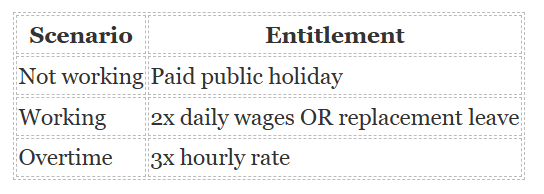
If Employee Does NOT Work
Employees are entitled to:
✔ Full day paid holiday (no salary deduction)
If Employee Works on Labour Day
Employers must provide:
✔ At least 2 days’ wages at the ordinary rate of pay
OR
✔ A replacement paid day off
Overtime on Labour Day
If employees work beyond normal hours:
✔ Overtime must be paid at minimum 3x hourly rate
Summary of Pay Entitlements
What If Labour Day Falls on a Rest Day or Non-Working Day?
This is a common area of confusion.
If Labour Day Falls on:
Rest Day (e.g. Sunday)
✔ Replace with next working day
Non-working day (e.g. Saturday for Mon–Fri employees)
✔ Employee is entitled to a replacement paid holiday
Employers must ensure correct substitution to remain compliant.
Compliance Risks Employers Must Avoid
Labour Day is a high-risk period for payroll errors.
Common Mistakes
❌ Treating Labour Day as a normal working day
❌ Paying normal rate instead of 2x
❌ Ignoring overtime multiplier (3x)
❌ Not providing replacement leave
❌ Poor attendance tracking
Potential Consequences
- Labour complaints
- Financial penalties
- Legal disputes
- Reputational damage
HR & Payroll Preparation Checklist (2026)
To ensure compliance, HR teams should take the following actions:
1. Review Public Holiday Policy
- Confirm Labour Day is included
- Align with Employment Act requirements
2. Plan Workforce Scheduling
- Identify employees required to work
- Communicate schedules clearly
3. Verify Payroll Calculations
- Apply correct public holiday rates
- Ensure overtime is calculated accurately
4. Track Attendance Accurately
- Record actual working hours
- Avoid disputes and miscalculations
5. Prepare Replacement Leave
- Assign alternative off days where required
Why Labour Day Matters for Employers
Labour Day is not just about compliance — it affects business operations and employee experience.
Operational Impact
- Workforce planning challenges
- Increased labour costs
- Shift scheduling complexity
Employee Impact
- Fair compensation expectations
- Work-life balance
- Trust in employer practices
How Pandahrms Helps Employers Stay Compliant
Managing public holiday pay manually increases the risk of errors.
Pandahrms All-in-One HR System helps employers:
- Automatically calculate public holiday pay (2x / 3x rates)
- Track attendance and overtime accurately
- Manage shift scheduling and replacement leave
- Ensure compliance with Malaysian labour laws
- Reduce payroll errors and disputes
This is especially critical for:
- Retail and F&B businesses
- Shift-based operations
- Companies with large workforces
FAQs: Labour Day Malaysia 2026
1. Is Labour Day a mandatory public holiday in Malaysia?
Yes. It is one of the compulsory paid public holidays under the Employment Act 1955.
2. What if employees work on Labour Day?
They must be paid at least 2x daily wages or given a replacement day off.
3. What is the overtime rate for Labour Day?
Minimum 3x hourly rate for overtime hours.
4. What if Labour Day falls on a rest day?
It must be replaced with the next working day.
5. Can employers choose not to observe Labour Day?
No. It is a mandatory public holiday.
Conclusion: Labour Day Compliance Starts with Payroll Accuracy
Labour Day 2026 is a key compliance event for Malaysian employers.
To avoid risks, employers must:
- Apply correct public holiday pay rules
- Ensure accurate attendance tracking
- Manage replacement leave properly
- Maintain compliant payroll processes
Failure to do so can result in both financial and legal consequences.
Simplify Public Holiday Payroll with Pandahrms
Managing Labour Day payroll manually is complex and error-prone.
Pandahrms helps organisations:
- Automate payroll calculations
- Ensure compliance with labour laws
- Reduce HR workload
- Improve accuracy and transparency
Book a 35-minute demo with Pandahrms to streamline your payroll and compliance processes.