Many employers assume that once a candidate signs the offer letter, the hiring process is complete.
In reality, hiring an employee is only the beginning.
After a new employee joins your company, employers must comply with multiple legal, payroll, statutory, and tax-related requirements. Missing important registrations or deadlines can result in penalties, compliance issues, and unnecessary administrative problems later.
Whether you are hiring your first employee or expanding your workforce, this guide explains the key employer obligations every Malaysian company should complete after hiring a new employee in 2026.
Why Employee Onboarding Compliance Matters
When a new employee joins your organisation, several government agencies become involved, including:
- LHDN (Income Tax)
- EPF (KWSP)
- SOCSO (PERKESO)
- EIS
- Human Resources Department
Each agency has specific registration and reporting requirements that employers must comply with.
Failure to fulfil these obligations may lead to:
- Statutory penalties
- Late payment charges
- Audit issues
- Legal liabilities
- Payroll processing errors
A proper onboarding process helps employers remain compliant from the employee’s first day until their eventual resignation.
1. Prepare the Employment Contract
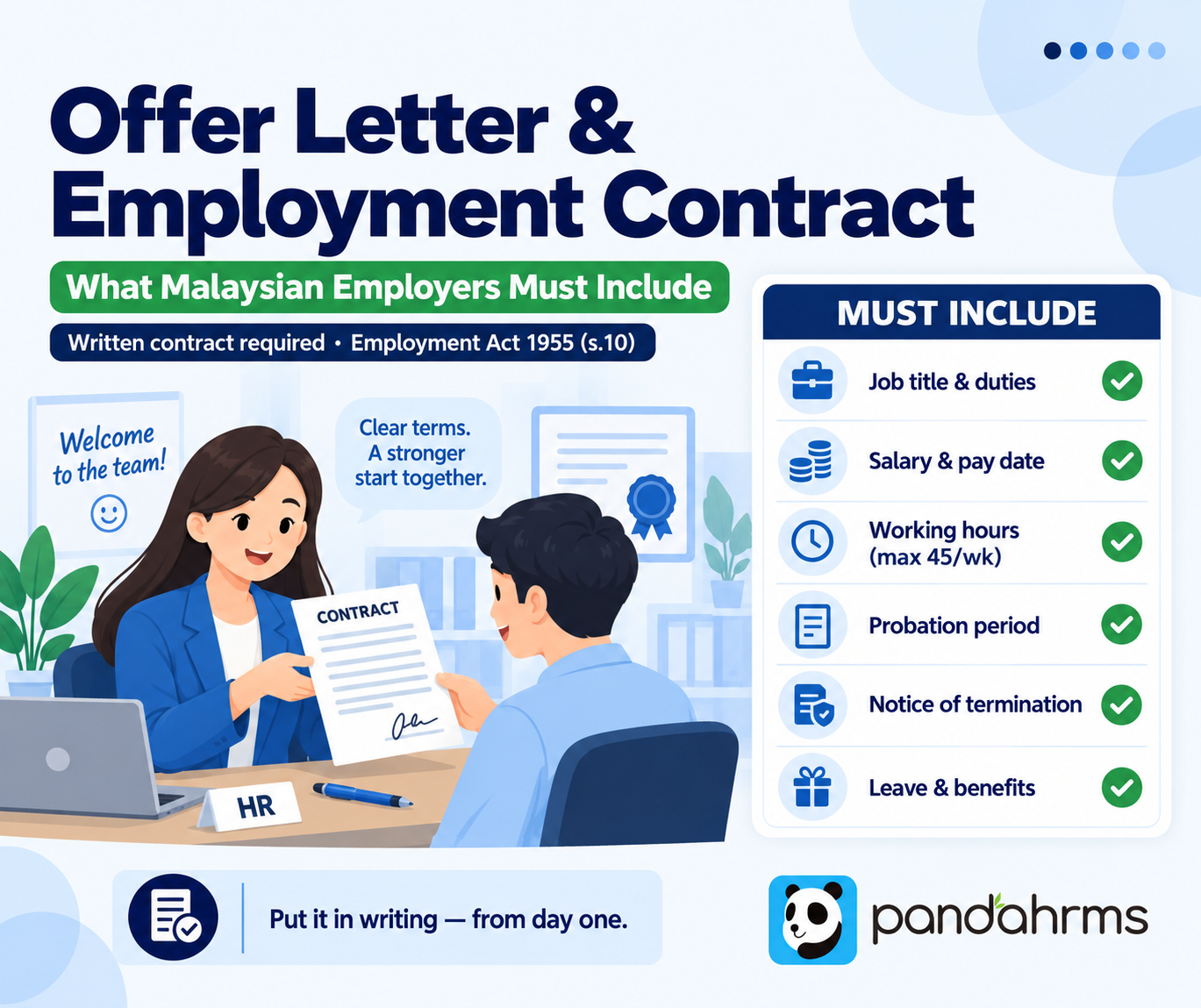
Before the employee starts work, employers should issue a written employment contract.
A well-drafted employment contract helps clarify:
- Job scope
- Salary and benefits
- Working hours
- Leave entitlement
- Probation period
- Termination terms
- Company policies
Having clear documentation reduces misunderstandings and protects both employers and employees.
Stamp Duty Requirement
Where applicable, employment agreements should be stamped within the prescribed period after execution.
Employers should verify current stamp duty requirements and ensure compliance within the applicable timeline.
2. Register for an Employer Income Tax Number (E Number)
If this is the company’s first employee, the employer should register for an Employer Income Tax Number (E Number) with LHDN.
The E Number is required for:
- PCB (Potongan Cukai Bulanan) submissions
- Form E filing
- CP8D submissions
- Employee tax administration
Without an E Number, employers cannot properly manage payroll tax obligations.
3. Register Employees with EPF (KWSP)
Employers must register eligible employees under the Employees Provident Fund (EPF).
EPF contributions are mandatory for eligible employees under the EPF Act 1991.
Why EPF Registration Is Important
EPF contributions help employees build retirement savings while ensuring employers meet statutory obligations.
Failure to register and contribute may result in:
- Outstanding contribution payments
- Dividend charges
- Late payment charges
- Enforcement action by EPF
Employers should ensure employee information is submitted promptly after employment begins.
4. Register Employees with SOCSO and EIS
Employers are also responsible for registering eligible employees under:
- SOCSO (PERKESO)
- Employment Insurance System (EIS)
SOCSO Coverage
SOCSO provides protection against:
- Workplace accidents
- Occupational diseases
- Invalidity benefits
EIS Coverage
EIS provides temporary financial assistance and employment support for eligible employees who lose their jobs.
Failure to register employees may expose employers to contribution arrears, penalties, and enforcement action.
5. Submit Form CP22 to LHDN
Many employers overlook this important tax requirement.
When a new employee joins the company, employers may be required to submit:
Form CP22
Notification of New Employee
Submission Timeline
The notification should generally be submitted within 30 days from the employee’s commencement date.
Failure to comply may result in penalties under the Income Tax Act.
6. Collect Borang TP1 and Borang TP3
Apart from statutory registrations, employers should also collect employee tax forms during onboarding.
Borang TP1
Borang TP1 allows employees to declare eligible tax reliefs for PCB calculation purposes.
Examples include:
- Lifestyle relief
- Insurance relief
- Education expenses
- Medical expenses
Borang TP3
Borang TP3 is required when an employee joins a new employer during the same tax year after working for another employer.
The form allows employers to calculate PCB more accurately by taking previous employment income into account.
Record Retention Requirement
Employers should keep TP1 and TP3 records for at least seven years as part of payroll and tax documentation requirements.
7. Process Monthly Payroll and Statutory Contributions
Employee compliance does not stop after onboarding.
Every month, employers must process:
- PCB (Monthly Tax Deduction)
- EPF contributions
- SOCSO contributions
- EIS contributions
Monthly Payment Deadline
Employers should ensure statutory payments are made within the required deadline each month.
Late payments may result in:
- Penalties
- Dividend charges
- Interest charges
- Compliance investigations
Regular payroll reviews help minimise errors and ensure statutory compliance.
8. Complete Year-End Employer Tax Responsibilities
At the end of every year, employers have additional reporting obligations.
Form EA
Form EA summarises an employee’s annual remuneration and tax-related information.
Employers should provide Form EA to employees before the end of February each year.
Form E
Form E is the employer’s annual declaration to LHDN.
Form CP8D
Form CP8D contains employee remuneration information submitted together with Form E.
Important Deadline
Form E and Form CP8D are generally due by 31 March each year.
Failure to comply may result in penalties under tax legislation.
Don’t Forget Employee Resignation Procedures
Compliance responsibilities continue even when employees leave the company.
Depending on the circumstances, employers may need to submit:
Form CP22A
Applicable when a Malaysian employee leaves employment.
Form CP21
Applicable when an employee is leaving Malaysia.
Submission Timeline
Where applicable, employers should notify LHDN at least 30 days before the employee’s departure date.
Failure to comply may expose employers to penalties and potential liability for outstanding employee tax matters.
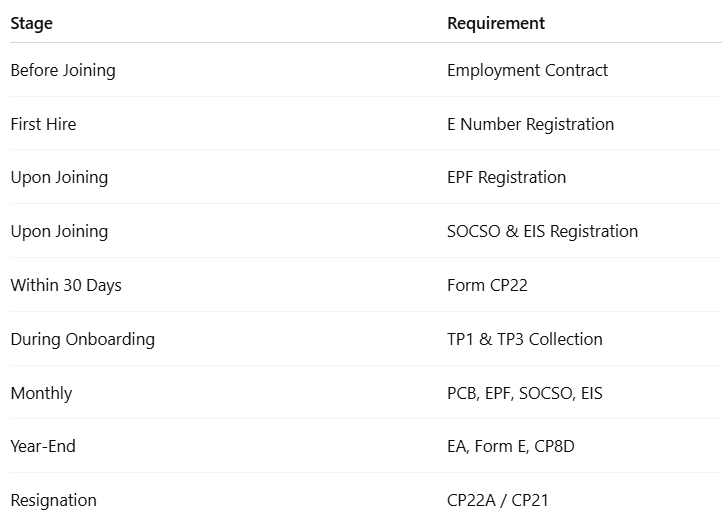
Employer Compliance Checklist Summary
Frequently Asked Questions (FAQs)
1. Is an employment contract mandatory in Malaysia?
While not all employment arrangements are legally required to be in writing, a written employment contract is strongly recommended to clearly define employment terms and responsibilities.
2. When should an employer apply for an E Number?
An employer should apply for an E Number when hiring their first employee, as it is required for payroll tax reporting and LHDN submissions.
3. How soon should employees be registered with EPF?
Employers should register eligible employees promptly after employment begins and ensure contributions are made according to EPF requirements.
4. Is SOCSO registration compulsory?
Most Malaysian employees are required to be covered under SOCSO and EIS, subject to applicable eligibility requirements.
5. What is Form CP22?
Form CP22 is a notification submitted to LHDN when a new employee joins a company.
6. What is the difference between TP1 and TP3?
TP1 allows employees to declare tax reliefs for PCB calculations.
TP3 allows employers to calculate PCB accurately when an employee has previous employment income within the same tax year.
7. How long should employers keep TP1 and TP3 records?
Employers should retain payroll and tax-related records, including TP1 and TP3 forms, for at least seven years.
8. What happens if statutory payments are made late?
Late payments may result in penalties, interest charges, dividend charges, and compliance investigations depending on the statutory body involved.
9. What documents must employers provide at year-end?
Employers are generally required to provide Form EA to employees and submit Form E and Form CP8D to LHDN.
10. What should employers do when an employee resigns?
Depending on the situation, employers may need to submit Form CP22A or Form CP21 to LHDN before the employee leaves employment.
Conclusion
Hiring a new employee involves much more than issuing an offer letter.
From registering employees with EPF and SOCSO to notifying LHDN, collecting TP1 and TP3 forms, processing payroll, and fulfilling year-end tax obligations, employers must manage multiple compliance requirements throughout the employee lifecycle.
Having a structured onboarding checklist can help employers avoid penalties, reduce payroll errors, and ensure compliance with Malaysian employment and tax regulations.
Book a Demo with Pandahrms
Managing employee onboarding, payroll, EPF, SOCSO, PCB, and tax compliance manually can be time-consuming and risky.
Book a 35-minute demo with Pandahrms to see how you can streamline employee onboarding, payroll processing, statutory submissions, and HR compliance in one platform.