Introduction: Will Employees Get a Long Weekend in June 2026?
With Wesak Day falling on Sunday, 31 May 2026, and the Birthday of His Majesty the Yang di-Pertuan Agong observed on Monday, 1 June 2026, many employers and employees are asking the same question:
Will employees also get Tuesday, 2 June 2026 off as a replacement holiday?
The answer is:
✅ Some employees will be entitled to an additional replacement holiday — depending on the company’s public holiday selection and the employee’s weekly rest day arrangement.
This clarification was recently highlighted by Ministry of Human Resources Malaysia (KESUMA).
Public Holiday Dates for June 2026
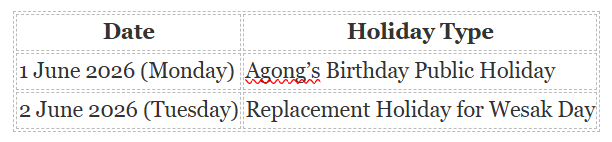
The Federal Government has officially gazetted the following holidays:
- Wesak Day — Sunday, 31 May 2026
- Birthday of the Yang di-Pertuan Agong — Monday, 1 June 2026
Under the Employment Act 1955, the Agong’s Birthday is classified as a:
- Compulsory paid public holiday
- Non-replaceable leave
This means employers in Peninsular Malaysia and Labuan must provide this holiday to eligible employees.
So, Is 2 June 2026 Also a Public Holiday?
The Answer Depends on Two Important Conditions
Employees may be entitled to Tuesday, 2 June 2026 as a replacement holiday IF:
✅ Condition 1:
The employer has selected Wesak Day as one of the company’s paid public holidays.
✅ Condition 2:
Sunday is the employee’s official weekly rest day.
If both conditions are met, then the employee is entitled to a replacement paid holiday.
Why Tuesday Becomes the Replacement Holiday
Normally, when a public holiday falls on a rest day, the replacement holiday is moved to the next working day.
However, in this case:
- Monday, 1 June 2026 is already occupied by the Agong’s Birthday public holiday.
As a result:
➡️ The replacement holiday for Wesak Day moves to:
Tuesday, 2 June 2026
This means eligible employees should receive:
Can Employers Change the Replacement Holiday?
Yes.
According to the Employment Act 1955:
- Employers may substitute the replacement holiday with another day
- BUT employee agreement is required
This flexibility allows businesses to manage operational needs while remaining compliant with labour law requirements.
Important Reminder for HR & Payroll Teams
Public holiday management becomes more complex when:
- Holidays overlap with rest days
- Replacement leave applies
- Employees work during public holidays
- Different shift patterns exist
HR teams must ensure:
- Correct leave allocation
- Accurate payroll calculations
- Proper OT/public holiday pay computation
- Compliance with Employment Act requirements
Failure to manage replacement holidays properly may result in:
- Payroll disputes
- Employee dissatisfaction
- Compliance risks
What Happens If Employees Work on Public Holidays?
Employees who are required to work during public holidays may be entitled to:
- Public holiday pay
- Overtime rates
- Replacement leave
This depends on:
- Employment Act coverage
- Salary threshold
- Employment contract terms
- Company policy
Employers should ensure calculations are handled accurately to avoid payroll errors.
Why HR Systems Matter During Public Holiday Seasons
Managing replacement holidays manually can quickly become confusing, especially for companies with:
- Multiple branches
- Shift workers
- Hybrid work arrangements
- Different rest day schedules
Without a proper HR system, businesses risk:
- Incorrect leave balances
- OT miscalculations
- Payroll inconsistencies
- Compliance issues
Simplify Public Holiday & Payroll Management with Pandahrms
With Pandahrms, businesses can:
- Automate public holiday calculations
- Manage replacement leave accurately
- Calculate OT and holiday pay automatically
- Track employee attendance and shifts
- Ensure compliance with Malaysian labour laws
Reduce HR workload and avoid payroll mistakes during complex holiday periods with smarter HR automation.
Conclusion
Whether employees receive an extra holiday on 2 June 2026 depends on:
- The company’s selected public holidays
- The employee’s weekly rest day arrangement
For HR teams and employers, this serves as another reminder that proper leave management and payroll compliance are essential — especially during overlapping public holiday periods.
Frequently Asked Questions (FAQ)
1. Is 2 June 2026 automatically a public holiday for all employees?
No. Employees are only entitled to the replacement holiday on 2 June 2026 if:
- The employer has selected Wesak Day as one of the company’s paid public holidays; and
- Sunday is the employee’s official rest day.
2. Is the Agong’s Birthday a compulsory public holiday?
Yes. Under the Employment Act 1955, the Birthday of the Yang di-Pertuan Agong is a compulsory paid public holiday for private sector employees in Peninsular Malaysia and Labuan.
3. Can employers replace the replacement holiday with another date?
Yes. Employers may substitute the replacement holiday with another day, provided there is agreement between the employer and employee.
4. What if employees are required to work on 1 June or 2 June 2026?
Employees who work on public holidays may be entitled to:
- Public holiday pay
- Overtime payment
- Replacement leave
This depends on the Employment Act coverage, company policy, and employment contract terms.
5. Does this apply to shift workers and hybrid employees?
Yes. However, eligibility depends on:
- The employee’s scheduled rest day
- Shift arrangement
- Company holiday policy
HR teams should verify schedules carefully to avoid payroll or leave calculation errors.
6. Why is public holiday payroll management important for HR?
Improper handling of replacement holidays can lead to:
- Payroll disputes
- Incorrect OT calculations
- Compliance risks
- Employee dissatisfaction
This becomes more challenging for businesses managing multiple branches, rotating shifts, or hybrid workforces.
7. How can Pandahrms help manage replacement holidays and public holiday payroll?
With Pandahrms, companies can:
- Automate public holiday and replacement leave calculations
- Track shifts and attendance accurately
- Calculate OT and holiday pay automatically
- Reduce payroll errors and compliance risks
This helps HR teams manage complex holiday schedules more efficiently and accurately.