Annual leave is a key employment benefit that allows employees to take time off from work for rest, leisure, and personal reasons while still receiving their regular salary. In Malaysia, annual leave entitlements are regulated by labor laws and individual employment contracts.
For HR departments, managing annual leave can be a time-consuming task, involving the calculation of entitlements, tracking leave balances, and occasionally resolving disputes over leave. Here’s everything you need to know about annual leave in Malaysia.


Annual Leave Entitlement in Malaysia
Under Section 60E of the Employment Act 1955 (EA), employees are entitled to paid annual leave based on their length of service:- 8 days for every 12 months of continuous service if employed for less than two years.
- 12 days for every 12 months of continuous service if employed for two years or more but less than five years.
- 16 days for every 12 months of continuous service if employed for five years or more.
Prorating Annual Leave for an Incomplete Service Year
When an employee has not completed a full 12 months of service during the year in which their contract terminates, their annual leave entitlement should be prorated. This means that the leave is calculated based on the actual time worked within that year. Any fraction of a day less than half is disregarded, while a fraction of a day that is half or more is rounded up to a full day. For instance, new joiners or departing employees will have their leave prorated accordingly. If an employee joins mid-year and is entitled to 8 days of leave annually, they would receive 4 days of leave for that year. To prorate annual leave, you can use a straightforward calculation based on the number of days worked in a year compared to the total days in the year (usually 365 days). Here’s how it works: Prorated Leave Entitlement = (Number of Days Worked / Total Days in a Year) x Annual Leave EntitlementExample 1: Prorating Annual Leave for New Employees
Suppose an employee is hired on July 1st, with an annual leave entitlement of 12 days. To calculate their prorated leave for the year:- Number of Days Worked (from July 1st to December 31st) = 184 days
- Total Days in a Year = 365 days
- Prorated Leave Entitlement = (184 / 365) x 12 = 6 days
Example 2: Prorating Annual Leave for Departing Employees
If an employee resigns or leaves the company on September 15th and has an annual leave entitlement of 12 days, you can calculate their prorated leave as follows:- Number of Days Worked (from January 1st to September 15th) = 259 days
- Total Days in a Year = 365 days
- Prorated Leave Entitlement = (259 / 365) x 12 = 8.52 days
What Can Employees Do with Unused Leave?
Employees must use their annual leave within the 12-month period. If unused leave remains at the end of the year, the following options may be available:- Carry Forward – Unused annual leave can be carried forward to the next year, depending on the employer’s policy.
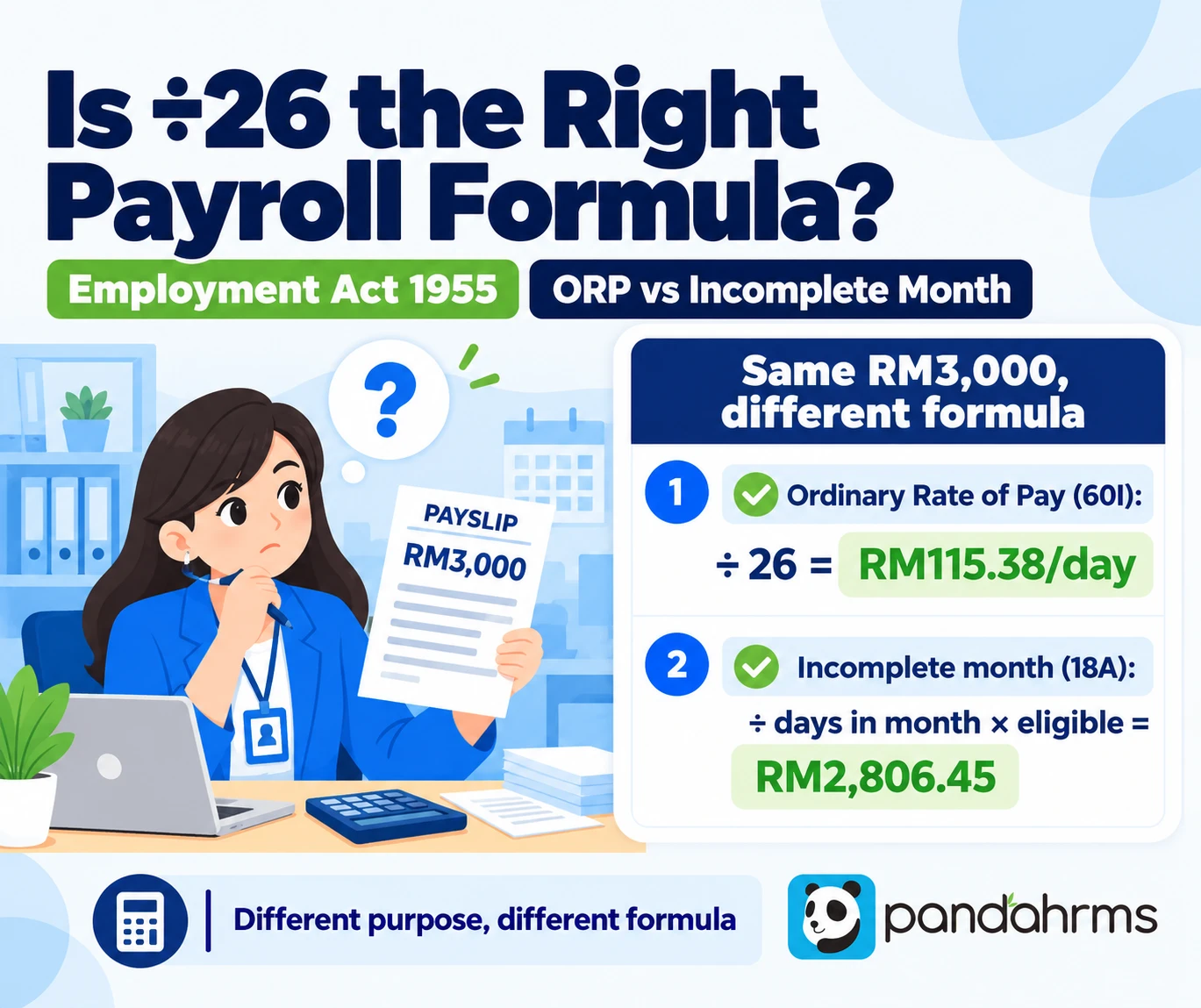
- Encashment– Alternatively, the employer may pay the employee for the unused annual leave. This payment should be made at the employee’s ordinary rate of pay.
Resigned Employees and Annual Leave
When employees resign with unused annual leave, there are two common options:1. Offset the Notice Period
The unused annual leave days can be used to offset the employee’s notice period. For example, if an employee resigns with a 30-day notice period and has 7 days of unused leave, their last working day can be moved up by 7 days.2. Encash Remaining Leave
Alternatively, the company may offer to encash the remaining annual leave balance. Employees on a monthly rate of pay receive their monthly wages without any reduction during the month in which they take annual leave.
Both options depend on company policies and what is stipulated in the employment contract or employee handbook.