Malaysia Employment Contract Stamp Duty Guide 2025–2026: What Every Employer & HR Must Know
Stamp duty for employment contracts has existed for decades, but starting from 2025, the Inland Revenue Board of Malaysia (LHDN) is intensifying enforcement under the new Stamp Duty Audit Framework. Many employers only learned about this requirement recently — leading to confusion, misinformation, and unnecessary panic.
In this guide, Pandahrms breaks down the real rules, what changes in 2025 and 2026, and the exact steps employers should take to remain compliant.
Why This Issue Suddenly Became Big in 2025
Although RM10 stamping for employment contracts has always been part of the Stamp Act 1949, enforcement used to be minimal. This changed because LHDN audit findings (2023–2024) revealed widespread non-compliance among SMEs.
To fix this, LHDN introduced:
✔ A nationwide audit on employment contracts
✔ Mandatory stamping requirement enforcement beginning 1 January 2025
✔ A grace period throughout 2025 (penalty waiver)
✔ Full strict enforcement starting 1 January 2026
This sudden shift caused many employers to panic — and misinformation began spreading online, including claims that employers must “re-stamp” when employees resign or pay RM10 twice. These claims are not true.
Understanding Stamp Duty for Employment Contracts
What is Stamp Duty?
Stamp duty is a small government tax (RM10) paid to LHDN to legally validate certain documents, including employment contracts, which fall under the category of service agreements.
Once stamped, the contract becomes:
-
Legally enforceable
-
Valid for court use
-
Compliant with LHDN’s requirements
Updated LHDN Rules (2025 – 2026)
1. Contracts Signed Before 1 January 2025
✔ Exempted from RM10 stamp duty
✔ No penalties
✔ No action required
(But employers may stamp voluntarily for clean records.)
2. Contracts Signed Between 1 January – 31 December 2025
✔ Must be stamped (RM10)
✔ Penalties waived if stamped by 31 Dec 2025
✔ Applies even if employee has resigned
This is a transitional year designed to help employers regularise existing documents.
3. Contracts Signed From 1 January 2026 Onward
Strict enforcement begins.
Stamping requirements:
-
RM10 per contract
-
Must be stamped within 30 days of signing
-
Digital stamping via MyStamp or STAMPS portal
Penalties under the Stamp Act 1949:
-
31 days – 3 months late: RM50
-
> 3 months late: RM100
No more waivers beyond 2025.

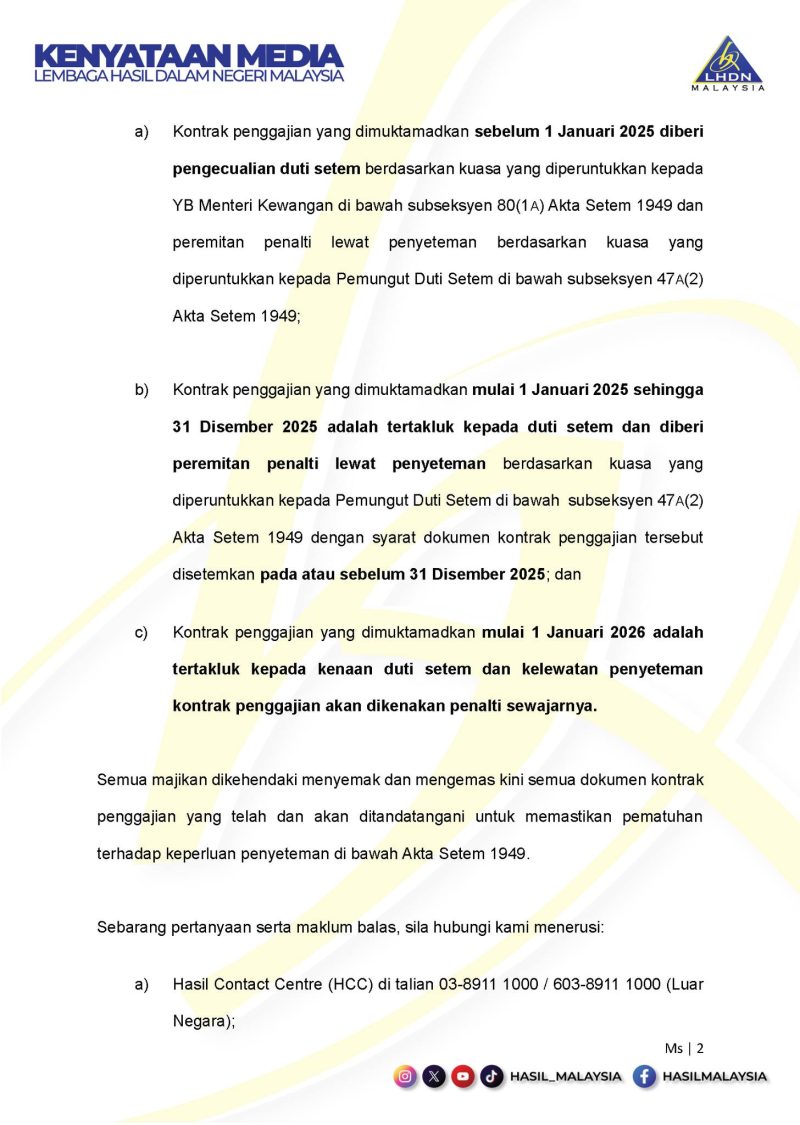
Sumber: Kenyataan Media LHDNM – Pengecualian Penggenaan Duti Setem Untuk Kontrak Penggajian Yang Dimuktamadkan Sebelum 1 Januari 2025, 6 Jun 2025.
Clarifying the Recent Misinformation
A recent Facebook post claimed that employers must re-stamp an employment contract and pay another RM10 if the employee resigns after just a few days. This has caused a lot of confusion — especially because many companies only recently learned about the RM10 stamp duty, the 30-day deadline, and the stricter enforcement starting on 1 January 2026.
Here’s what’s actually happening:
✔ What is true:
-
Employment contracts do need to be stamped because they fall under “service agreements.”
-
RM10 stamp duty applies to each contract.
-
LHDN is doing more audits, especially for contracts signed between 2023–2025.
-
From 2026 onward, stamping must be done within 30 days, with no more penalty waivers.
✘ What is misunderstood:
-
You do NOT need to stamp the contract again when an employee resigns — even if they leave after 5 days.
-
The Stamp Act does not require a second stamp duty for termination.
-
You do not need to notify LHDN when the employee leaves.
-
And no — employers will not be arrested — but LHDN can impose penalties if contracts are not stamped properly.
In short, the rule is very simple:
👉 Stamp once when the contract is signed.
👉 Stamp within 30 days (strict from 2026).
👉 No stamping is needed when the employee resigns.
This misunderstanding mostly happened because audits and enforcement have increased — leading to panic, sudden awareness, and rumours spreading online.
Why Employers Must Take This Seriously
Starting 2026, LHDN will enforce:
-
System-based detection of unstamped contracts
-
Mandatory employer self-assessment
-
Audit verification of HR documentation
-
Penalties for every unstamped contract
Unstamped contracts may also be rejected as evidence in court during disputes.
What Employers & HR Should Do Now (2025 – 2026)
1. Stamp all 2025 contracts before 31 December 2025
Avoid penalties. RM10 per contract only.
2. Implement an internal compliance SOP
Add stamping to onboarding checklist.
3. Use the LHDN MyStamp or STAMPS portal
Upload → Pay RM10 → Download digital stamped copy.
4. Train HR staff
Ensure they understand deadlines, penalties, and documentation procedures.
5. Prepare for 2026
From 1 January 2026:
✔ 30-day stamping rule becomes mandatory
✔ No more penalty waivers
✔ Audits become stricter
Frequently Asked Questions (FAQ)
1. Is stamping compulsory for all employment contracts?
Yes — full-time, part-time, contract-based, fixed-term, and internship agreements.
2. Do I need to re-stamp when the employee resigns?
No. Stamping is only required once.
3. How much is the stamp duty?
RM10 per contract for most employment agreements.
4. Can I stamp old contracts?
Yes — and if signed in 2025, penalties are waived if stamped by 31 Dec 2025.
5. Who pays the stamp duty?
The employer.