Introduction: Understanding EPF Contributions Is Essential for Every Employer
Every employer in Malaysia is legally required to make monthly Employees Provident Fund (EPF) contributions for eligible employees.
Whether you’re running payroll for five employees or five hundred, understanding the latest EPF (KWSP) contribution rates, payment deadlines, and contribution rules is essential for maintaining payroll compliance.
Incorrect EPF calculations may result in late payment charges, penalties, and unnecessary payroll issues.
This guide explains everything employers and HR professionals need to know about EPF contribution rates in 2026, including who must contribute, contribution percentages, payment deadlines, and common payroll questions.
What Is EPF (KWSP)?
The Employees Provident Fund (EPF), or Kumpulan Wang Simpanan Pekerja (KWSP), is Malaysia’s mandatory retirement savings scheme.
Each month:
- Employees contribute a percentage of their salary.
- Employers contribute an additional statutory amount.
- The combined contributions are credited into the employee’s EPF account to build long-term retirement savings.
The obligation is governed under the EPF Act 1991.
Who Must Contribute to EPF?
EPF contributions are compulsory for most employees working under a Contract of Service.
This generally includes:
- Permanent employees
- Contract employees
- Part-time employees
- Temporary employees
- Employees on probation
- Company directors receiving remuneration
- Employees returning to work after retirement
- Employees aged up to 75 years
- Foreign workers employed legally in Malaysia (subject to applicable contribution rates)
Whether wages are paid monthly, weekly, or daily does not affect the employer’s obligation to contribute.
EPF Contribution Rates 2026
Malaysian Citizens & Permanent Residents
Monthly Salary RM5,000 and Below
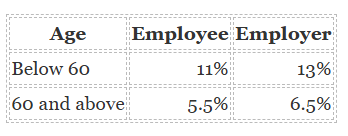
Monthly Salary Above RM5,000
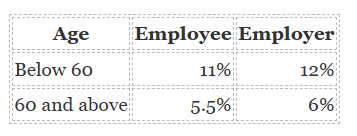
Senior Citizens (Age 60 and Above)
For eligible employees aged 60 years and above:
- Employee contribution: 0%
- Employer contribution: 4%
The applicable contribution category depends on the employee’s circumstances under the EPF contribution schedule.
Foreign Workers
Since 1 October 2025, EPF contributions have become mandatory for foreign workers legally employed in Malaysia.
Current statutory contribution:
- Employee: 2%
- Employer: 2%
This applies regardless of monthly salary.
What Payments Are Subject to EPF?
Many employers mistakenly assume EPF is calculated using only basic salary.
In reality, EPF is generally calculated based on wages, which include many forms of cash remuneration.
Common payments subject to EPF include:
- Basic salary
- Bonuses
- Fixed allowances
- Commission
- Incentives
- Salary arrears
- Maternity leave wages
- Paid leave wages
- Payment for unused annual leave
- Other contractual remuneration
What Payments Are NOT Subject to EPF?
Some payments are excluded from EPF calculations, including:
- Overtime payments
- Service charges
- Gratuity
- Retrenchment benefits
- Retirement benefits
- Temporary lay-off benefits
- Travelling allowances
- Travelling concessions
Understanding the difference helps employers avoid payroll errors.
When Must Employers Pay EPF?
Employers must pay monthly EPF contributions on or before the 15th of the following month.
For example:
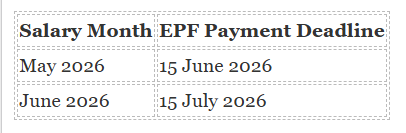
Late payment may result in penalties and enforcement action.
What Happens If Employers Fail to Contribute?
Employers are legally required to make EPF contributions for eligible employees.
Failure to comply may result in:
- Monetary fines
- Imprisonment
- Late payment charges
- Legal proceedings
- Asset seizure
- Travel restrictions
- Bankruptcy proceedings
Payroll compliance is therefore not only an HR responsibility—it is also a legal obligation.
How Employees Can Check Their EPF Contributions
Employees can verify their monthly EPF contributions through:
- KWSP i-Akaun
- EPF contribution statements
- EPF branches and self-service kiosks
Employees should compare the EPF deduction shown on their payslip with the contribution credited into their EPF account.
Common Payroll Mistakes Employers Should Avoid
Some of the most common EPF payroll errors include:
- Using incorrect contribution rates
- Missing the monthly payment deadline
- Calculating EPF using the wrong wage components
- Applying incorrect rates for employees aged 60 and above
- Incorrect EPF calculations for foreign workers
- Payroll data entry errors
Reviewing payroll regularly helps minimise compliance risks.
How Pandahrms Simplifies EPF Payroll Compliance
Managing statutory payroll manually can be time-consuming and prone to errors.
With Pandahrms, employers can:
✔ Automatically calculate EPF contributions
✔ Manage employee payroll in one platform
✔ Generate statutory payroll reports
✔ Track employee salary changes
✔ Integrate EPF, SOCSO, EIS, PCB, and other statutory deductions
✔ Reduce manual payroll errors and improve compliance
By automating payroll calculations, HR teams can save time while ensuring statutory obligations are met accurately every month.
Conclusion
EPF contributions remain one of the most important statutory obligations for Malaysian employers.
Understanding the latest contribution rates, payment deadlines, and payroll rules helps businesses remain compliant while protecting employees’ retirement savings.
Whether your workforce includes local employees, foreign workers, senior employees, or part-time staff, keeping payroll records accurate is essential for avoiding penalties and maintaining smooth payroll operations.
Frequently Asked Questions (FAQ)
Is EPF compulsory for probation employees?
Yes. Employees on probation are entitled to EPF contributions if they are employed under a Contract of Service.
When is the EPF payment deadline?
EPF contributions must be paid on or before the 15th of the following month.
Is EPF calculated based on basic salary only?
No. EPF is generally calculated based on wages, which include many types of contractual cash payments.
Do foreign workers contribute to EPF?
Yes. Eligible foreign workers are required to contribute according to the prescribed EPF rates.
Can employees contribute more than 11%?
Yes. Employees may voluntarily increase their EPF contribution by applying through KWSP.