A company in Malaysia recently made headlines — for all the wrong reasons.
HR allegedly sent out a circular requiring employees to give 3 days’ advance notice before taking medical leave (MC). Within an hour, the circular was retracted after an employee’s sarcastic reply exposed just how absurd the rule was.
“I’m planning to take MC this Friday. Reason of illness: Don’t know yet. But I’m taking MC regardless.”
It became a viral moment. But underneath the humour is a serious compliance issue: many Malaysian employers don’t actually know what the law says about MC.
If you’re managing staff in Malaysia, here’s what you need to know.
What Does the Employment Act 1955 Say About MC?
Medical leave entitlement in Malaysia is governed by the Employment Act 1955 (EA 1955), which applies to employees earning RM 4,000 and below per month, as well as all manual workers regardless of salary.
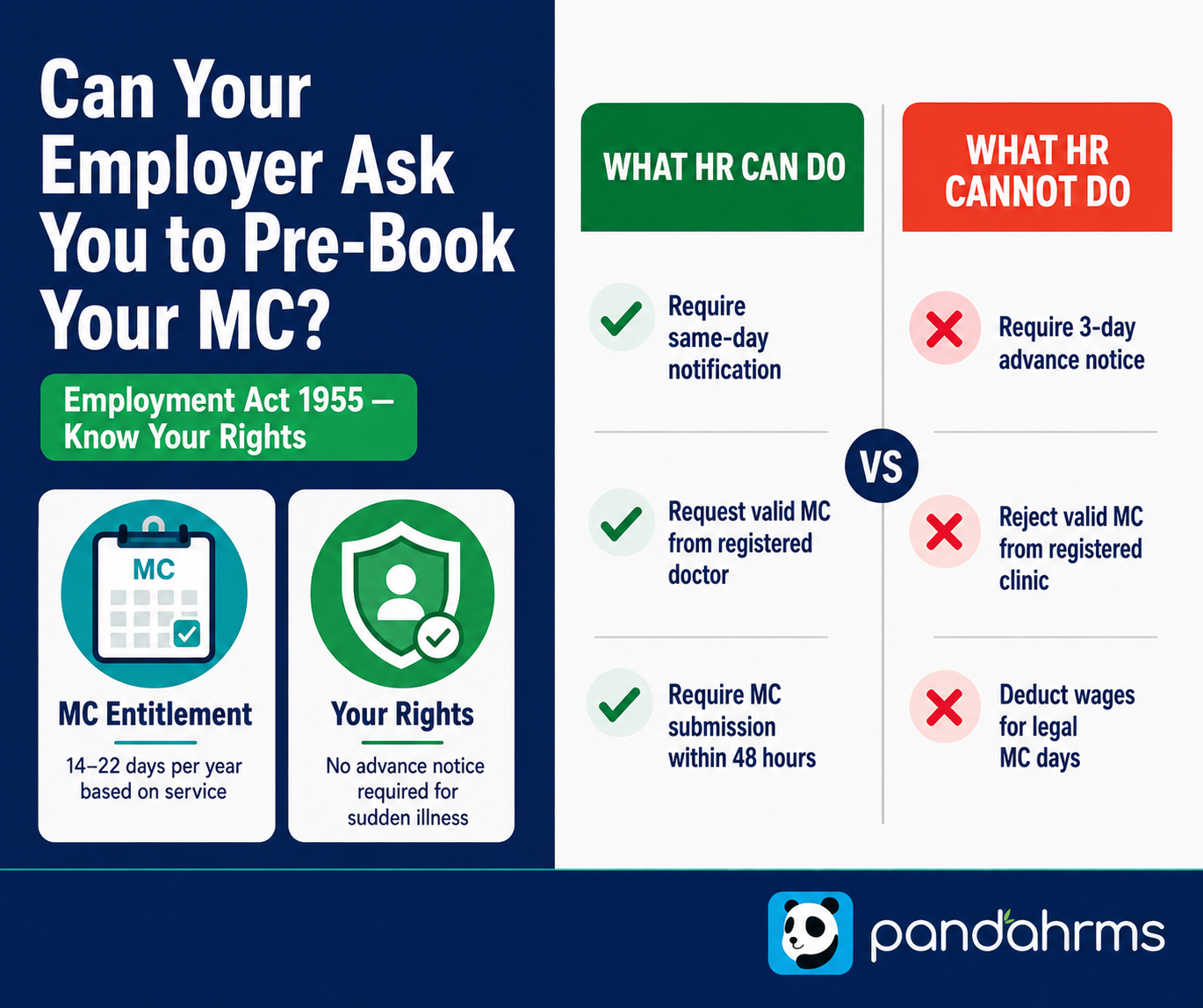
Under Section 60F of the Employment Act, employees are entitled to paid sick leave based on their length of service:
- Less than 2 years: 14 days
- 2 years to less than 5 years: 18 days
- 5 years or more: 22 days
If hospitalisation is required, employees are entitled to 60 days of hospitalisation leave per year, inclusive of the above sick leave days.
Key point: These are minimum entitlements under the law. Employers can offer more — but never less.
Can an Employer Require 3 Days’ Notice Before Taking MC?
No. This is not legally enforceable.
Medical leave exists precisely because illness is unpredictable. Requiring an employee to notify the company 3 days before falling sick is not only impractical — it contradicts the very purpose of sick leave.
The Employment Act does not require employees to give advance notice before taking MC for unexpected illness. What it does require:
- The employee must be examined by a registered medical practitioner or medical officer
- The employee must obtain a valid medical certificate (MC) from that practitioner
- The employee must inform the employer as soon as reasonably possible that they will not be attending work
There is no provision in the EA 1955 requiring 3 days’ advance notice for unplanned sick leave.
What Can Employers Legitimately Require?
✅ Allowed:
- Require employees to notify their direct supervisor or HR on the same day they will be absent
- Require a valid MC from a registered doctor or government clinic
- Require an MC if the absence falls on a Monday or Friday
- Set a process for submitting MC documentation (e.g., within 48 hours of returning)
- For planned medical appointments, request advance notice since the employee already knows the date
❌ Not allowed:
- Requiring 3 days’ advance notice for unexpected illness
- Refusing to accept a valid MC from a registered practitioner
- Deducting wages for legitimate MC days within entitlement
- Treating MC absences as unauthorised leave without proper investigation
- Disciplining an employee for taking MC they are legally entitled to
The Difference: Planned vs Unplanned Medical Leave
Unplanned MC (sudden fever, accident, emergency) — employee cannot predict this. No advance notice can reasonably be required.
Planned medical appointments (surgery, chemotherapy, specialist follow-up, blood test) — the employee knows in advance. It is reasonable to ask them to inform the company when the appointment is confirmed.
A good MC policy distinguishes between these two scenarios — not applies a blanket “3 days’ notice” rule to both.
What Happens If Employers Get This Wrong?
Enforcing an unlawful MC policy exposes your company to:
- Employee complaints to the Labour Department (JTKSM)
- Industrial Court claims for unfair dismissal
- Reputational damage — as this viral incident showed
How Many MC Days Has Your Employee Used This Year?
This is where many HR teams struggle — especially in companies managing leave manually with spreadsheets or WhatsApp.
Pandahrms automates leave tracking — including sick leave — so your HR team can see each employee’s MC balance, history, and supporting documents in one place. No spreadsheets, no guessing.
Building a Compliant MC Policy: A Quick Checklist
- Sick leave entitlement matches or exceeds EA 1955 minimums (14/18/22 days)
- Policy does not require advance notice for unplanned illness
- Employees are required to notify their superior on the day of absence
- Valid MC from a registered practitioner is required upon return
- MC submission deadline is clear (e.g., within 48 hours of returning)
- Planned medical appointments are handled separately with prior notification requirement
- Policy applies consistently to all employees regardless of seniority
- HR team tracks MC usage and can identify trends
Frequently Asked Questions
Q: Can an employer reject an MC from a private clinic?
Under the EA 1955, a valid MC must be issued by a registered medical practitioner or medical officer. Private clinic MCs are valid. Employers cannot selectively reject certain clinics without legitimate grounds.
Q: What if an employee takes MC on a public holiday?
MC on a public holiday does not consume a sick leave day — the public holiday is observed as normal.
Q: Can employers discipline employees for taking too many MCs?
If an employee has valid MCs for all absences, the absences are legitimate. However, if absences form a clear pattern, the employer can investigate — but must follow due process including a domestic inquiry before taking disciplinary action.
Q: Does the EA 1955 apply to all employees in Malaysia?
The EA 1955 directly covers employees earning RM 4,000/month and below, and all manual workers. Employees above RM 4,000 may have different entitlements based on their employment contract — but their contract cannot provide less than the statutory minimum.
Q: What if an employee doesn’t have a valid MC but says they were sick?
Without a valid MC, the absence may be treated as unpaid leave or unauthorised absence, depending on your company policy.
The Bottom Line
MC policies aren’t just about controlling absenteeism. They’re about understanding what the law requires — and building processes that protect both your employees and your business.
A policy that requires employees to predict their illness 3 days in advance isn’t just impractical. It’s unlawful, and it damages trust.
If you’re managing this manually right now, Pandahrms can help you automate the entire leave workflow — MC tracking, entitlement calculation, approval flows, and documentation — all in one system built for Malaysian SMEs.
Want to see how Pandahrms handles leave management? Book a free demo at https://pandahrms.com/contact and we’ll walk you through it.