Malaysia’s Budget 2027 — a record RM459.8 billion, tabled on 9 October 2026 — carries a lot that lands directly on the HR and payroll desk: a higher minimum wage, new wage benchmarks, lower personal income tax, wider EPF and SOCSO coverage, training support, and a payroll-compliance condition that’s easy to miss. Here’s the employer’s cheat sheet to Budget 2027, with the figures verified against the Budget announcement.
1. Minimum Wage Rising to RM2,000 (from June 2027)
The headline for employers: the minimum wage goes up from RM1,700 to RM2,000 a month, from June 2027, benefiting over four million workers. MSMEs with annual sales below RM50 million are exempted for now, to give smaller businesses time to adjust. For the full breakdown of who pays, who’s exempt and how to prepare, see our dedicated guide: Minimum Wage RM2,000 from June 2027.
2. New Wage Benchmarks: RM2,500 and RM3,400
Budget 2027 pushes wage floors up beyond the statutory minimum:
- A RM2,500 monthly minimum is planned for semi-skilled workers and graduates, as part of reforms to the worker income framework.
- Government-linked companies (GLCs/GLICs) will raise their living wage benchmark from RM3,100 to RM3,400 a month, affecting around 230,000 workers.
The direction is clear — pay expectations across the board are climbing, and private employers were urged to follow. It’s worth reviewing your own pay bands now so you’re not caught flat-footed. (See our guide on salary increments.)
3. Lower Personal Income Tax = More Take-Home Pay
Budget 2027 cuts personal income tax for the middle band — reduced rates and higher relief thresholds that give up to RM1,600 in additional disposable income to about five million taxpayers. For employers, the practical effect is on the payroll: affected employees will have slightly lower monthly tax deductions (PCB/MTD) and a bit more take-home pay, so your payroll needs to apply the updated PCB schedule once it takes effect. (For why PCB differs between employees, see Same salary, different PCB.)
4. Pay Wages Through the Bank — or Lose the Deduction (from YA 2028)
This one is easy to overlook but matters at tax time. From year of assessment 2028, non-MSME companies may claim a tax deduction on wage expenses only if wages are paid through bank accounts, in line with the payment methods allowed under the Employment Act 1955 (MSMEs are exempt from this condition). It’s aimed at keeping payroll traceable and properly documented — so if you’re still paying anyone in cash, now is the time to move everyone to proper bank payroll, or those wages may not be deductible.
5. Wider EPF & SOCSO Coverage for Self-Employed and Gig Workers
Budget 2027 extends social protection well beyond traditional employees, with the government co-funding contributions:
| Group | Incentive |
|---|---|
| Self-employed (17 non-mandatory sectors) | 70% PERKESO (SOCSO) matching contribution, for ~200,000 people |
| Gig workers (e-hailing / p-hailing) | 35% SOCSO matching — rising to 50% if the platform also contributes |
| E-hailing / p-hailing drivers (EPF) | EPF matching of up to RM600 a year (lifetime limit RM6,000) |
If you engage contractors or gig workers, it’s worth understanding how these schemes work — social protection is steadily becoming the norm across all types of work. (See our guides on which wages are subject to SOCSO & EIS and the new combined PERKESO contribution file format.)
6. Training & Upskilling Support
There’s real money behind workforce development that employers can tap:
- HRD Corp gets RM3 billion to fund 3 million training opportunities, including continuing professional development.
- PTPK (Skills Development Fund) receives RM500 million for training financing.
- Training-expense tax deductions are available for qualifying spend up to 31 December 2030.
If upskilling is on your roadmap, these are incentives worth building into your 2027 training budget.
7. MediAsas: a Medical-Insurance Subsidy for Small SMEs
Budget 2027 introduces MediAsas, a government-designed basic medical insurance plan launching in January 2027 (expected to cost around RM60–65 a month). To help smaller employers offer it, SMEs with fewer than 75 employees get a RM200 per-employee subsidy on the first-year premium, capped at 50 employees per company — covering up to 200,000 workers in the first year. EPF members under 55 can also pay MediAsas premiums from their Akaun Sejahtera.
What Budget 2027 Means for Employers
- Budget for higher wages — the RM2,000 minimum (if you’re not an exempt MSME), plus upward pressure from the RM2,500 and RM3,400 benchmarks.
- Update payroll for the new PCB when the tax cuts take effect, so deductions and take-home pay are right.
- Pay everyone through the bank to protect your wage-expense deduction.
- Know the SOCSO/EPF schemes for contractors and gig workers you engage.
- Plan training around HRD Corp and the extended tax deduction.
- Small SMEs: look into MediAsas — the RM200 first-year premium subsidy for your staff (companies with fewer than 75 employees).
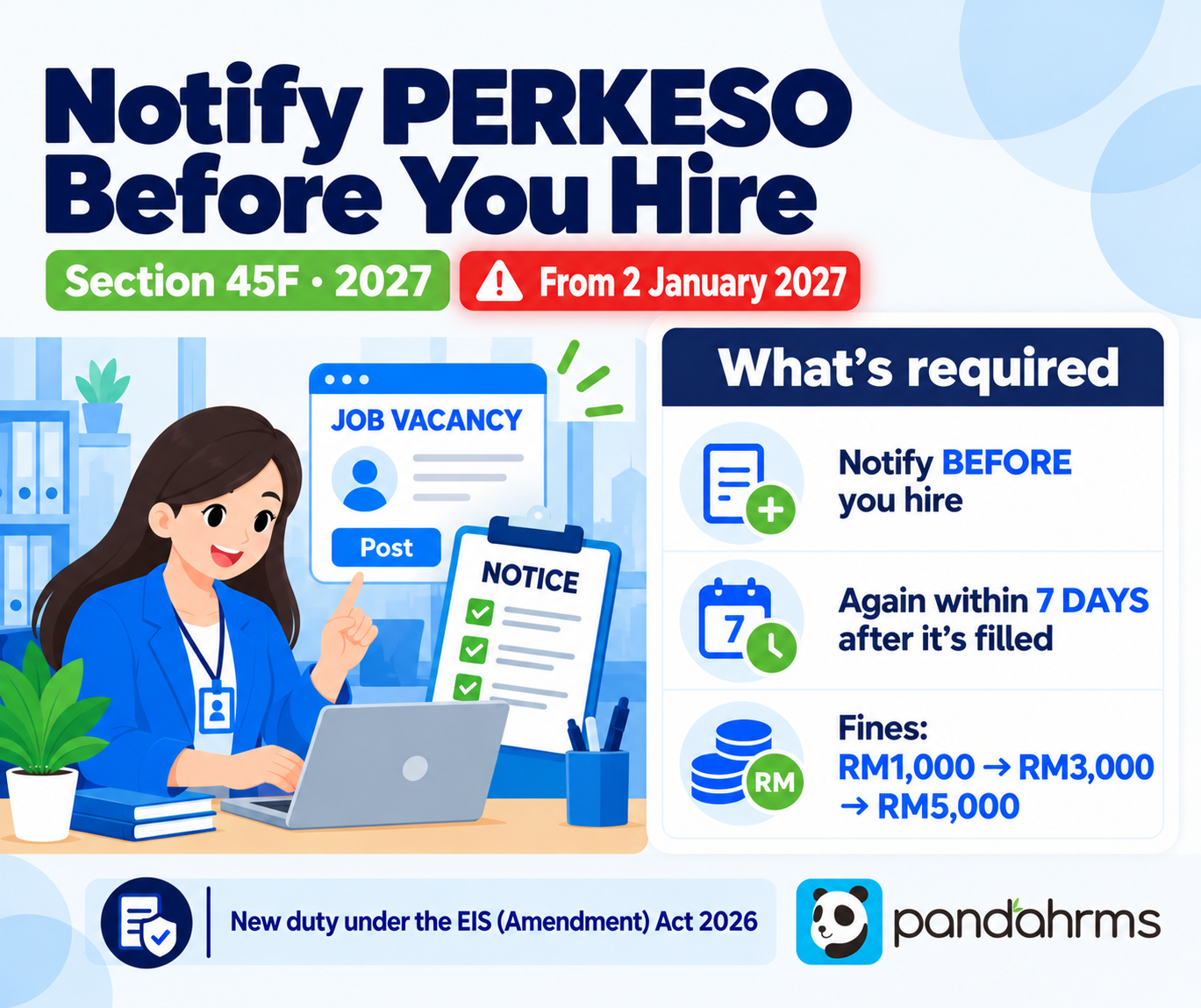
- Track the other 2027 compliance changes too — such as the new Section 45F duty to notify PERKESO of job vacancies from 2 January 2027.
Where Pandahrms Helps
Most of Budget 2027’s employer impact shows up in one place: the monthly pay run. Pandahrms lets you update the minimum wage across affected staff, applies the correct EPF, SOCSO, EIS and PCB automatically (including when the new tax schedule kicks in), and generates bank payment files so every salary is paid through the bank — keeping your wage-expense deduction clean. Instead of reworking spreadsheets each time a rule changes, you update the figure once and every payslip stays compliant.
Final Thoughts
Budget 2027 is, for HR, a year of rising wage floors, a bit more take-home pay for employees, and wider social protection — with a few compliance catches (bank-paid wages, the new PCB schedule, the MSME minimum-wage line). None of it is hard on its own; the work is keeping payroll accurate as each change lands. Get your systems and pay bands ready now, and 2027 becomes a smooth transition rather than a scramble.
Frequently Asked Questions (FAQs)
- What is the new minimum wage under Budget 2027?
RM2,000 a month, up from RM1,700, from June 2027 — with MSMEs (annual sales below RM50 million) exempted for now. - Does Budget 2027 lower income tax?
Yes — rate cuts and higher relief thresholds give up to RM1,600 in additional disposable income to about five million taxpayers, which means slightly lower monthly PCB for affected employees. - What are the new wage benchmarks?
A planned RM2,500 minimum for semi-skilled workers and graduates, and a GLC/GLIC living wage raised from RM3,100 to RM3,400 a month. - Why do we have to pay wages through the bank?
From year of assessment 2028, non-MSME companies can claim a tax deduction on wage expenses only if wages are paid through bank accounts, in line with the Employment Act 1955. MSMEs are exempt from this condition. - What support is there for gig and self-employed workers?
A 70% PERKESO matching contribution for self-employed people in 17 sectors, 35% (up to 50%) SOCSO matching for gig workers, and EPF matching of up to RM600 a year (RM6,000 lifetime) for e-hailing/p-hailing drivers. - What is the MediAsas subsidy for SMEs?
SMEs with fewer than 75 employees receive a RM200 per-employee subsidy on the first-year MediAsas premium, capped at 50 employees per company. MediAsas is a basic medical insurance plan launching in January 2027.
Source: Malaysia Budget 2027 (Belanjawan 2027), tabled on 9 October 2026, as reported by national media (e.g. The Star, Human Resources Online). Figures are Budget announcements; exact scope, rates and effective dates will be confirmed in the relevant gazetted orders and Finance Act. This article is general information, not legal or tax advice.