“I’m leaving today.”
Few things throw an employer off balance like a staff member handing in a resignation and expecting to walk out the same day — long before their notice period is up. Suddenly you’re juggling questions: Can they even do that? Do I still have to pay them? Can I claim anything back? What about their unused leave and the laptop they still have?
The situation feels chaotic, but the rules are actually quite clear. Here’s a calm, practical guide to your rights and responsibilities as a Malaysian employer when an employee resigns without serving notice — and the offboarding steps that protect your business.
What Counts as “Resigning Without Notice”?
Resigning without notice (sometimes called immediate resignation) is when an employee ends their employment without serving the notice period required by their contract — for example, quitting on the spot when the contract requires one month’s notice.
It’s different from a normal resignation, where the employee works out their full notice, and different from absconding, where the employee simply stops turning up without formally resigning. Here, the employee has resigned — they just haven’t given the required notice.
Can an Employee Legally Resign Without Notice?
In practical terms, yes — you cannot force someone to keep working against their will. If an employee decides to leave immediately, they can physically walk out.
But “walking out” doesn’t mean “walking away from all obligations.” Leaving without serving notice usually puts the employee in breach of their contract’s notice term — and that breach comes with a cost, which is where your rights as an employer come in.
The Key Law: Section 13 and Indemnity in Lieu of Notice
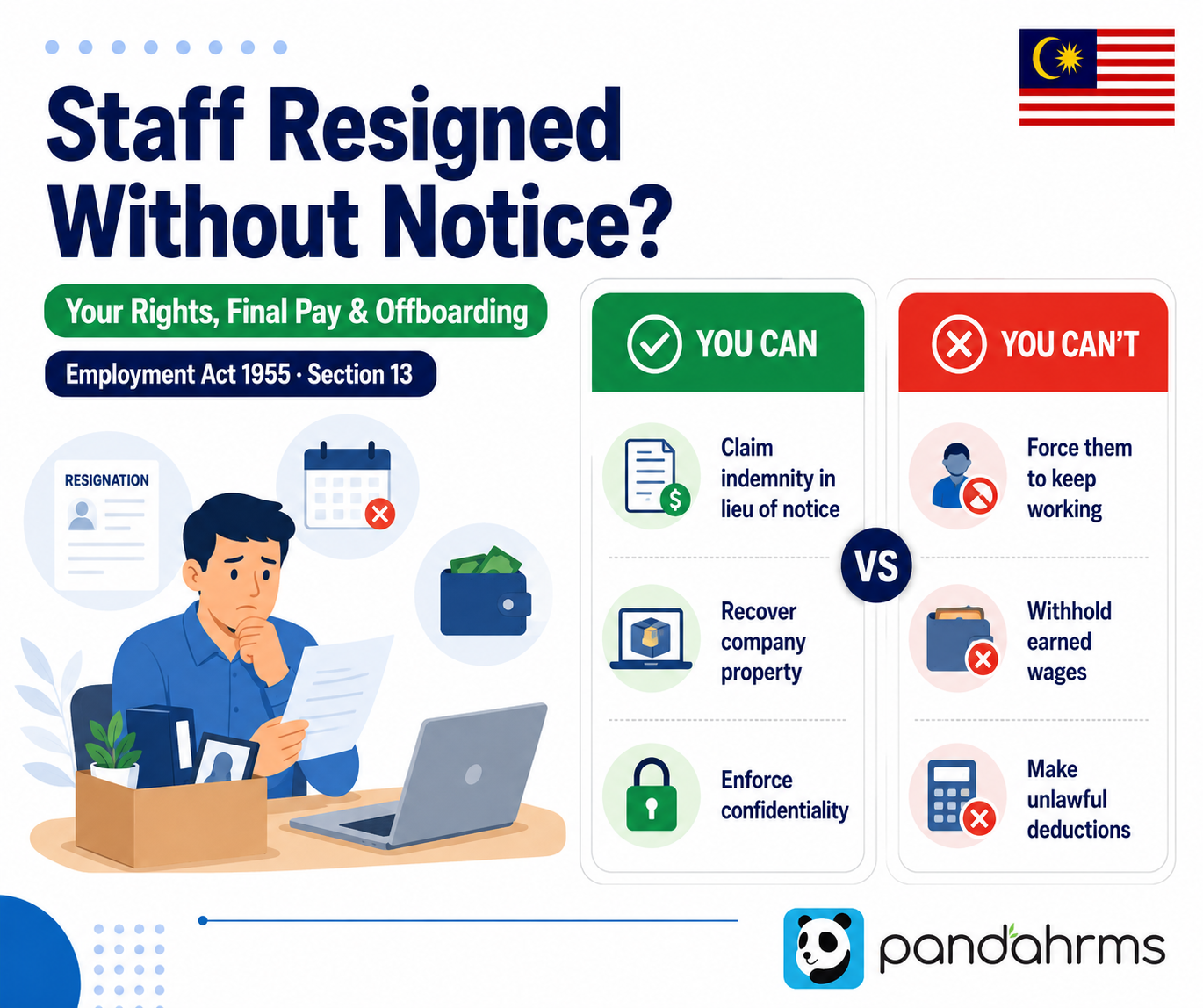
The governing provision is Section 13 of the Employment Act 1955. It says that either party can terminate the contract without notice — provided they pay the other party an indemnity in lieu of notice, equal to the wages the employee would have earned during the notice period.
In plain terms:
If your employee resigns without serving notice, they are generally liable to pay you an indemnity equal to their wages for the un-served notice period — unless your contract or a mutual agreement says otherwise.
So a same-day exit isn’t “free” for the employee. The notice period still has a monetary value, and the law lets the employer recover it.
Your Rights as the Employer
When an employee leaves without notice, you generally have the right to:
| Right | What it means |
|---|---|
| Claim indemnity in lieu of notice | Recover wages equal to the un-served notice period (Section 13), often set off against their final pay. |
| Recover company property | Require the return of laptops, phones, access cards, documents, and any other company assets. |
| Enforce confidentiality & restrictive terms | Rely on confidentiality clauses and any valid restrictive covenants in the contract. |
| Withhold clearance-dependent items | Complete proper clearance before releasing items that are conditional on it — while still paying lawful earned wages. |
The indemnity is the big one: it’s your main financial protection against an abrupt exit.
Your Responsibilities as the Employer
Your rights come with duties. You must still:
- Pay all earned wages up to the last day worked — salary, approved overtime, and any earned allowances.
- Pay for unused annual leave the employee is entitled to be paid out (leave encashment), per the Employment Act, contract, and company policy.
- Apply only lawful deductions. You cannot deduct arbitrary “penalties.” Deductions must be permitted under the Employment Act (Section 24) — though a genuine indemnity in lieu of notice is a recognised set-off.
- Release final pay on time and issue proper documentation.
The principle is simple: you may recover what the law allows, but you must still pay the employee everything they have genuinely earned.
How to Calculate Final Pay
Final pay for an employee who leaves mid-cycle typically involves:
- Earned salary for the days actually worked in the final month.
- Unused annual leave eligible for encashment.
- Any approved overtime or earned allowances.
- Less any lawful deductions and, where applicable, the indemnity in lieu of notice for the un-served period.
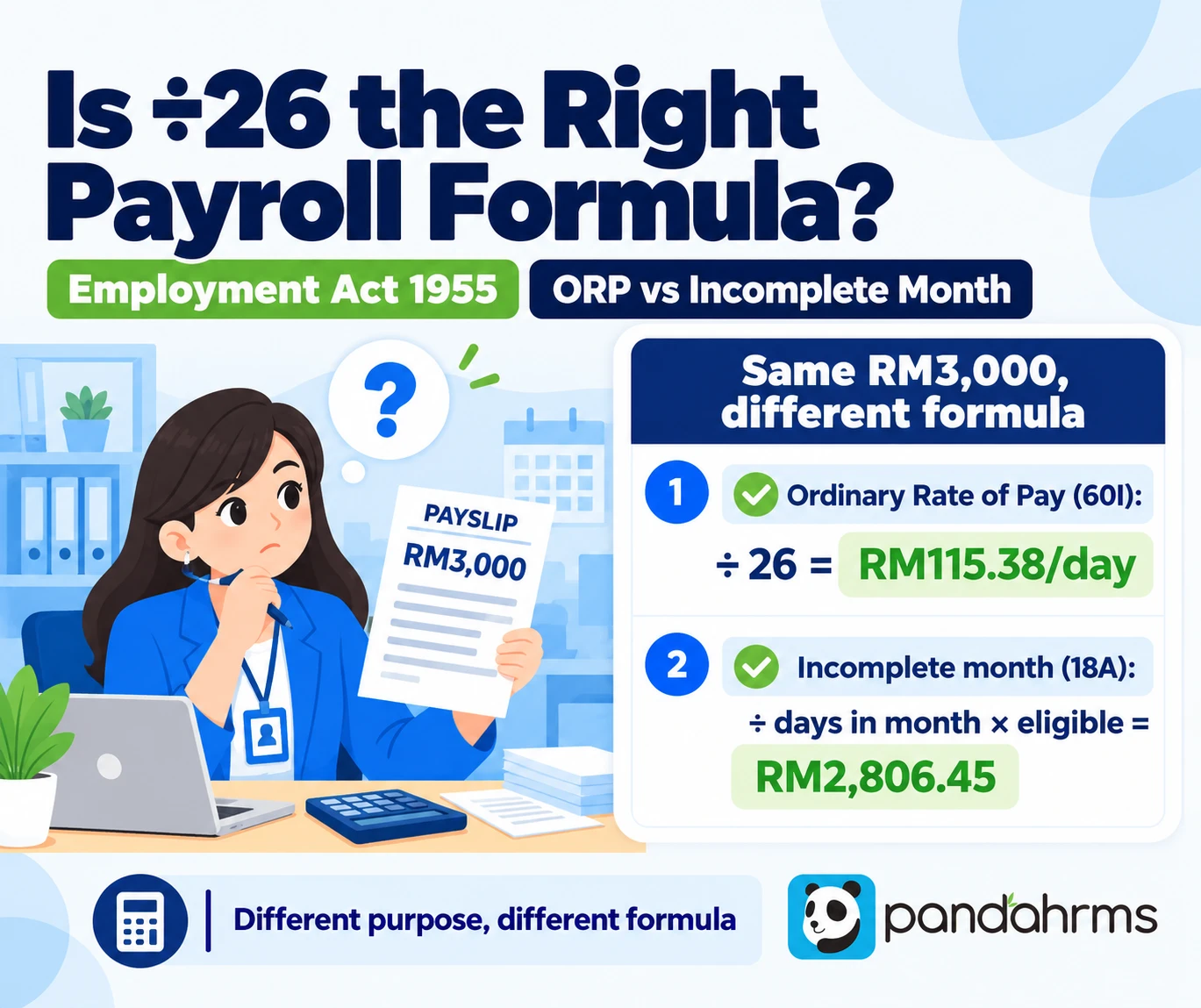
Because the employee usually leaves partway through a month, the earned salary is calculated on an incomplete-month basis. Malaysia’s Section 18A formula (introduced by the 2022 amendments) provides the standard method for prorating an incomplete month’s wages — use it to avoid disputes over the final figure.
Key principle: Recover what you’re lawfully entitled to (indemnity, property), pay what the employee has earned (wages, leave), and document every line of the final settlement.
What About Unused Annual Leave?
Unused annual leave doesn’t simply vanish when someone quits abruptly. You must review the employee’s remaining balance against the Employment Act, their contract, and your company leave policy, and pay out (encash) any leave they are entitled to be paid for. Handling this correctly is part of a lawful final settlement.
Resignation Without Notice During Probation
Probationers can also resign without notice — and the same logic applies. The notice period during probation is whatever the contract specifies (often shorter than for confirmed staff). If a probationer leaves without serving that notice, the indemnity-in-lieu principle applies to the shorter probation notice period. Check the contract to confirm the exact notice term.
The Employer’s Offboarding Checklist
When someone resigns without notice, work through a clear checklist so nothing slips:
Step 1: Review the contract
Confirm the required notice period, any indemnity clause, confidentiality, and restrictive terms.
Step 2: Calculate the final settlement
Work out earned wages (incomplete month via Section 18A), leave encashment, lawful deductions, and any indemnity in lieu of notice.
Step 3: Recover company property
Arrange the return of devices, access cards, documents, and any other assets.
Step 4: Revoke system access
Disable email, systems, and building access promptly to protect data and security.
Step 5: Complete offboarding and documentation
Issue the acceptance of resignation, finalise records, and keep written documentation of all communications and the final settlement.
Where the Right HR System Helps
An abrupt resignation is stressful precisely because so much has to be calculated and closed off at once — final pay, leave balances, incomplete-month proration, and clean records.
This is where an HR system like Pandahrms takes the pressure off. Employee records, leave balances, and payroll data sit in one place, so final pay and leave encashment can be calculated accurately (including the incomplete-month figure), and offboarding is handled consistently with a clear, documented trail. When someone walks out unexpectedly, having the numbers and records ready turns a scramble into a routine.
Settle it correctly, protect your business, and let your system keep the record straight.
Final Thoughts
An employee resigning without notice feels disruptive, but your position is stronger than it seems. You can’t force anyone to stay — but you can recover the indemnity in lieu of notice, reclaim your property, and enforce confidentiality. In return, you must pay everything the employee has genuinely earned, apply only lawful deductions, and offboard them properly.
Handle it calmly and by the book: check the contract, calculate the final settlement fairly, secure your assets, and document everything. Do that, and even a same-day exit stays clean, lawful, and dispute-free.
Frequently Asked Questions (FAQs)
Can an employee resign without notice in Malaysia?
Yes, an employee can leave immediately — you cannot force them to keep working. However, leaving without serving the contractual notice usually breaches the contract, and under Section 13 of the Employment Act 1955 the employee is generally liable to pay indemnity in lieu of the un-served notice.
What is indemnity in lieu of notice?
It is a payment equal to the wages that would have been earned during the notice period. Under Section 13, the party that terminates without notice pays it to the other — so an employee who resigns without notice generally owes the employer this amount, often set off against final pay.
Do I still have to pay an employee who resigned without notice?
Yes. You must pay all wages genuinely earned up to the last day worked, plus any unused annual leave eligible for encashment. You may apply lawful deductions and set off any indemnity in lieu of notice, but you cannot withhold earned wages as a penalty.
How is final salary calculated for a mid-month exit?
Earned salary for an incomplete month is prorated using the Section 18A formula, then combined with leave encashment and any earned overtime, less lawful deductions and any indemnity in lieu of notice.
What happens to unused annual leave when staff resign immediately?
Unused annual leave does not automatically disappear. Employers must review the balance against the Employment Act, the contract, and company policy, and pay out (encash) any leave the employee is entitled to.
Disclaimer
This article is intended for general informational purposes only and should not be regarded as legal advice. Rights and obligations on resignation depend on the specific facts, the employment contract, the applicable laws, and individual circumstances. Employers are encouraged to refer to the latest guidance from the Department of Labour (JTKSM) or consult a qualified employment adviser before acting.
Sources
- Employment Act 1955 (Act 265), Malaysia — Sections 12, 13, 18A and 24
- Employment (Amendment) Act 2022, Malaysia
- Department of Labour Peninsular Malaysia (JTKSM) guidance on termination and final payments