When business slows, restructuring happens, or a role is no longer needed, employers sometimes have to let people go. That’s a legitimate part of running a company. But retrenchment done the wrong way is one of the most common triggers for an unfair dismissal claim at the Industrial Court.
The mistake is rarely the decision to retrench — it’s how it’s carried out. Skip the process, pick the wrong people, or forget the paperwork, and a genuine cost-cutting exercise can turn into a legal liability.
Here’s how Malaysian employers should handle retrenchment properly, and how to calculate the benefits employees are entitled to.
What Is Retrenchment?
Retrenchment is the termination of employment because of genuine redundancy — the role, not the person, is no longer needed. This can happen due to:
- A downturn in business or financial difficulty.
- Restructuring or reorganisation.
- Closure of a department, branch, or the business.
- Technology or process changes that remove the need for a role.
The key word is genuine. Retrenchment must be driven by a real business need — not used as a disguised way to remove a specific employee.
The Golden Rule: Redundancy Must Be Real
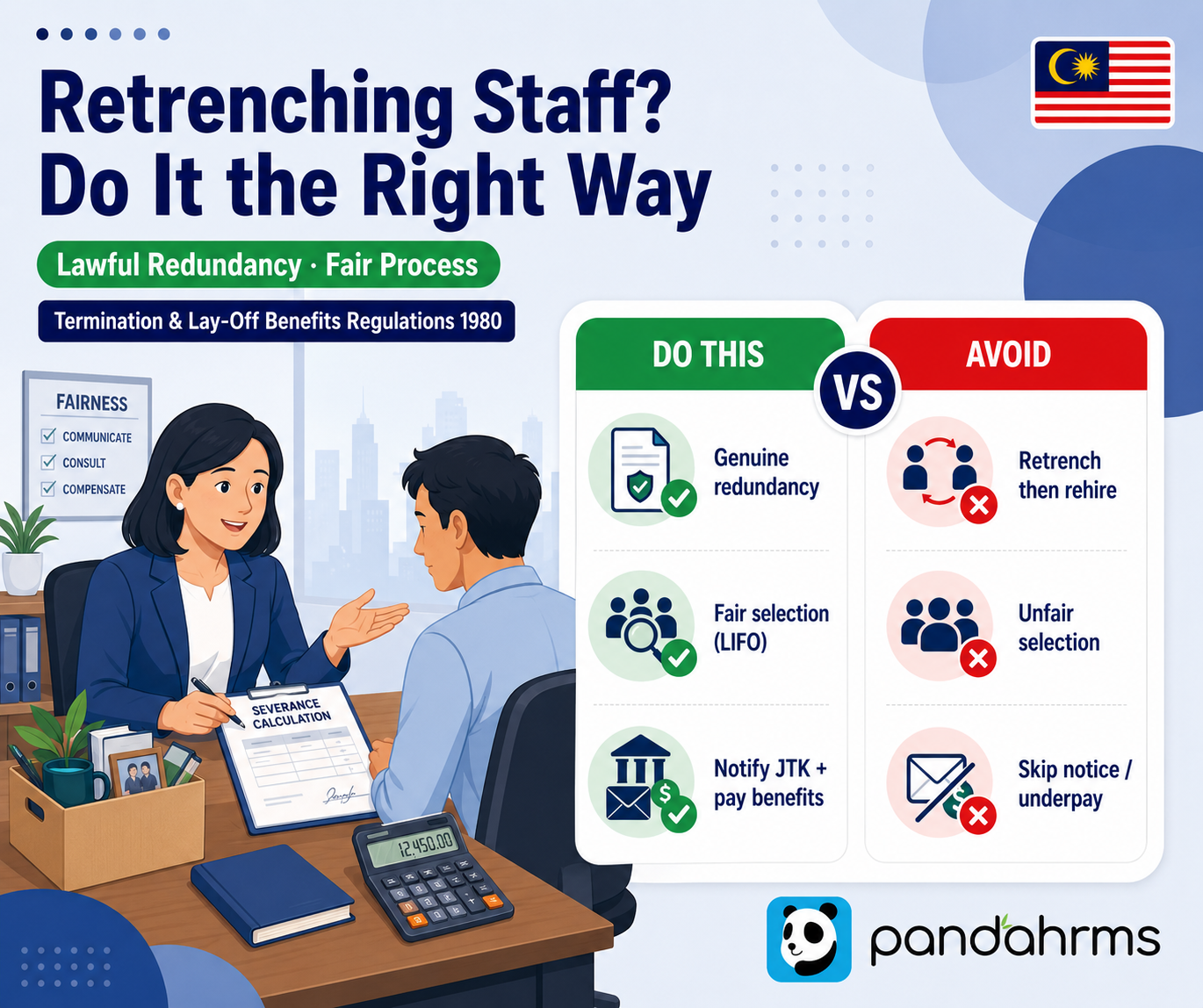
The Industrial Court looks closely at whether a redundancy is genuine. If an employer retrenches someone and then quietly hires a replacement for the same role, the “redundancy” collapses — and the dismissal can be ruled unfair.
Employers should be able to show:
- A real, documented business reason for the redundancy.
- That the specific role (or number of roles) was genuinely surplus.
- That the retrenchment was not a cover for targeting an individual.
The Proper Retrenchment Process
A defensible retrenchment follows recognised steps.
Step 1: Explore alternatives first
Before retrenching, consider options such as a hiring freeze, cutting overtime, reducing non-essential costs, redeployment, or (with consent) temporary pay adjustments. Courts expect employers to treat retrenchment as a last resort.
Step 2: Use fair, objective selection
If only some employees in a category are being cut, selection must be fair and non-discriminatory. A common accepted principle is LIFO — “Last In, First Out” (the most recently hired go first). Departing from LIFO is possible, but you should have objective, documented reasons (such as skills or performance criteria applied consistently).
Step 3: Give proper notice
Retrenched employees are entitled to their contractual or statutory notice period, or payment in lieu of notice.
Step 4: Notify the Labour Department
Employers must notify the Director General of Labour by submitting the retrenchment notification (Form PK) at least 30 days before the retrenchment takes effect.
Step 5: Pay the correct benefits
Eligible employees must receive their termination and lay-off benefits (see below), on top of any other final payments due.
How to Calculate Termination and Lay-Off Benefits
Under the Employment (Termination and Lay-Off Benefits) Regulations 1980, employees covered by the Employment Act who have been employed continuously for at least 12 months are entitled to benefits based on their length of service:
| Length of Service | Benefit Entitlement |
|---|---|
| Less than 2 years | 10 days’ wages for each year of service |
| 2 years to less than 5 years | 15 days’ wages for each year of service |
| 5 years or more | 20 days’ wages for each year of service |
Incomplete years are calculated on a pro-rata basis (to the nearest month). These are minimum entitlements — an employer may pay more under a contract, company policy, or collective agreement, but not less.
Please note: Termination and lay-off benefits are separate from notice pay and any unused annual leave payout. An employee may be entitled to all of these on retrenchment.
Common Mistakes That Lead to Claims
- Retrenching, then rehiring for the same role — the fastest way to lose an unfair dismissal case.
- Unfair or unexplained selection — cutting a specific person while keeping newer staff, with no objective basis.
- Skipping the JTK notification (Form PK).
- Underpaying or forgetting termination and lay-off benefits.
- No documentation of the business reason or the process followed.
What Retrenched Employees Are Entitled To
Whether you’re the employer making sure you’ve done right by your staff, or an employee going through it, these are the entitlements that should be in place:
- An official retrenchment letter — written confirmation of the retrenchment and its effective date.
- Correct final pay — salary up to the last day worked, plus payment for any unused annual leave.
- Termination and lay-off benefits — the 10 / 15 / 20 days’ wages per year of service set out above (for eligible employees).
- Up-to-date EPF and SOCSO — all statutory contributions paid up to the final month.
- The right to challenge — an employee who believes the retrenchment was unfair can lodge a representation with the Industrial Relations Department, which may proceed to the Industrial Court.
For employers, ticking off this list is the simplest way to show a retrenchment was handled lawfully and fairly.
Where the Right HR System Helps
A lawful retrenchment stands or falls on records and calculations — accurate service dates, correct benefit computations, and a clear trail of the process.
This is where an HR system like Pandahrms takes the pressure off. Length of service and employment history are tracked automatically, final payments and benefits can be calculated from accurate payroll data, and employee records stay organised in one place — so when you need to show that a retrenchment was handled fairly and paid correctly, the evidence is already there.
Make the hard decision fairly, and let your system get the numbers right.
Final Thoughts
Retrenchment is sometimes unavoidable — but it must be handled with care. A genuine redundancy, a fair selection process, proper notice, the Labour Department notification, and the correct benefits are what separate a lawful retrenchment from a costly Industrial Court claim.
Treat retrenchment as a last resort, document every step, and pay people what they are owed. That protects both the employees you’re letting go and the business you’re trying to save.
Frequently Asked Questions (FAQs)
- What is retrenchment in Malaysia?
Retrenchment is termination of employment due to genuine redundancy — where a role is no longer needed because of business downturn, restructuring, closure, or process changes. It must be based on a real business need, not used to target a specific employee. - How are retrenchment benefits calculated in Malaysia?
Under the Employment (Termination and Lay-Off Benefits) Regulations 1980, eligible employees with at least 12 months’ service receive 10 days’ wages per year (under 2 years), 15 days’ wages per year (2 to under 5 years), or 20 days’ wages per year (5 years or more), pro-rated for incomplete years. - Do employers have to notify the government before retrenching?
Yes. Employers must submit the retrenchment notification (Form PK) to the Director General of Labour at least 30 days before the retrenchment takes effect. - What is the LIFO principle?
LIFO — “Last In, First Out” — is a commonly accepted principle where the most recently hired employees in a category are retrenched first. Employers can depart from LIFO but should have objective, documented reasons. - Can retrenchment be an unfair dismissal?
Yes. If the redundancy is not genuine, the selection is unfair, or the process is not followed, a retrenchment can be ruled an unfair dismissal at the Industrial Court.