Merdeka Day falls on 31 August — a national public holiday, and a well-earned day off for most. But for businesses that still need staff on deck (retail, F&B, security, manufacturing, hospitality), one question comes up every year: how much do you pay someone who works on Merdeka Day?
Update (August 2026): Merdeka Day 2026 falls on Monday, 31 August, creating a 3-day long weekend (Saturday 30 – Monday 31 August). If your business runs through the long weekend, here is exactly what to pay staff who work the holiday — and how to plan coverage.
Get it wrong and you either underpay staff (a compliance risk) or overpay by guessing. Here’s exactly how to calculate overtime and public holiday pay for Merdeka Day 2026 under Malaysian law — with a worked example.
Is Merdeka Day a Public Holiday?
Yes. Merdeka Day (Hari Kebangsaan / National Day) on 31 August is one of Malaysia’s gazetted compulsory public holidays. That means employees are entitled to a paid holiday — and if they work, special pay rates apply.
The Law: Section 60D of the Employment Act 1955
Public holiday pay is governed by Section 60D of the Employment Act 1955. It sets out two things: the paid holiday itself, and the extra pay owed when an employee actually works on that holiday.
For an employee who is required to work on a paid public holiday, the law says they get their normal holiday pay plus additional wages for working — and a higher rate for any overtime.
What You Pay When Staff Work on Merdeka Day
| Situation | What you pay (Section 60D) |
|---|---|
| Employee does not work (paid holiday) | Normal day’s pay (already in a monthly salary) |
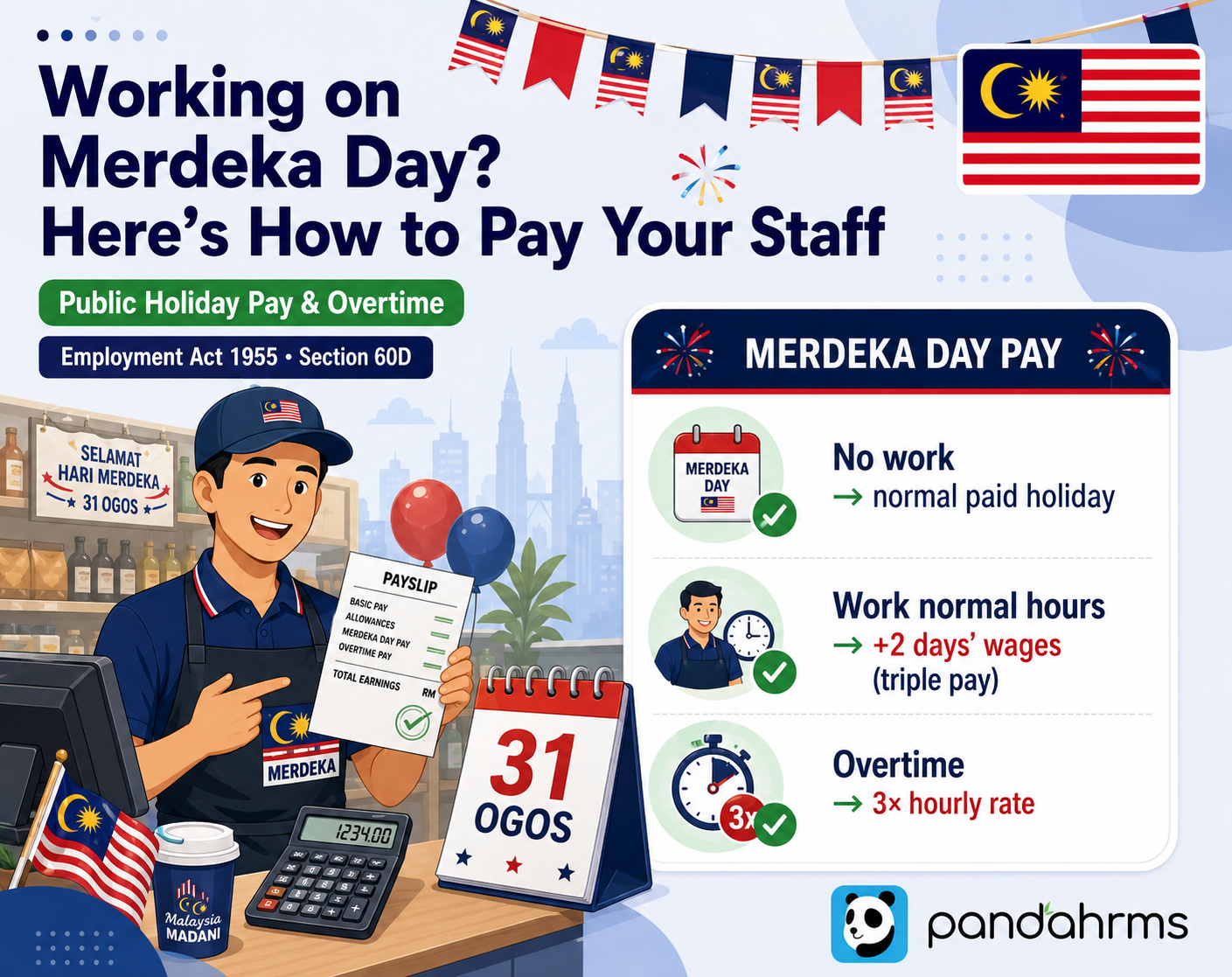
| Employee works normal hours on Merdeka | + 2 days’ ordinary wages → effectively “triple pay” for the day |
| Employee works overtime (beyond normal hours) | 3× the hourly rate for each overtime hour |
The “triple pay” idea is simple: a monthly-rated employee is already paid for the holiday (1 day), and working it earns them 2 extra days’ wages — so the day is effectively worth 3 days’ pay. Overtime hours (beyond the normal working hours) are then paid at 3 times the hourly rate.
Worked Example
Let’s take a monthly-rated employee earning RM2,600 a month, with normal working hours of 8 per day.
- Ordinary rate of pay (per day) = RM2,600 ÷ 26 = RM100
- Hourly rate = RM100 ÷ 8 = RM12.50
Now suppose they work 8 normal hours plus 2 hours of overtime on Merdeka Day:
- For working normal hours: 2 × RM100 = RM200 (on top of the holiday pay already in their salary)
- For 2 hours overtime: 3 × RM12.50 × 2 = RM75
- Total extra for the day: RM200 + RM75 = RM275
Key point: The 2 extra days’ wages apply even if the employee works less than their normal hours on the public holiday. Overtime is only for hours beyond normal working hours.
Who These Rates Apply To
These public holiday and overtime pay rates apply to employees covered by the relevant provisions of the Employment Act 1955 (generally those earning up to RM4,000 a month, plus certain categories regardless of wage). For employees outside these provisions, the terms of the employment contract apply — though many employers extend the same rates as good practice.
Common Mistakes Employers Make
- Paying only “double” instead of the effective triple pay for working normal hours on the holiday.
- Using the wrong overtime rate — public holiday OT is 3×, not the normal-day 1.5×.
- Forgetting the holiday still counts as a paid day for monthly staff even if they don’t work.
- Not keeping records of who worked and for how long.
Where Pandahrms Helps
Public holiday pay is where manual payroll slips up — wrong multipliers, missed overtime, or guesswork under time pressure. Pandahrms applies the correct public holiday and overtime rates automatically, pulls the hours worked from attendance, and calculates Merdeka Day pay accurately — so your team is paid correctly and your payroll stays compliant, without the last-minute maths.
Let your system handle the multipliers, and pay everyone right.
Final Thoughts
If your business runs on Merdeka Day, paying staff correctly is both a legal duty and a matter of fairness. The rule is straightforward: the holiday is paid, working normal hours earns 2 extra days’ wages (effectively triple pay), and overtime is paid at 3 times the hourly rate. Calculate it right, keep clear records, and Merdeka Day stays a celebration — not a payroll headache.
Frequently Asked Questions (FAQs)
- Is Merdeka Day a paid public holiday in Malaysia?
Yes. Merdeka Day (31 August) is a gazetted compulsory public holiday, so eligible employees are entitled to a paid day off — and special pay rates if they work. - How much do I pay an employee who works on Merdeka Day?
Under Section 60D of the Employment Act 1955, a monthly-rated employee who works normal hours on a public holiday is entitled to 2 extra days’ wages on top of the holiday pay — effectively triple pay for the day. - What is the overtime rate on Merdeka Day?
Overtime worked beyond normal hours on a public holiday is paid at not less than 3 times the employee’s hourly rate of pay. - How do I calculate the ordinary and hourly rate?
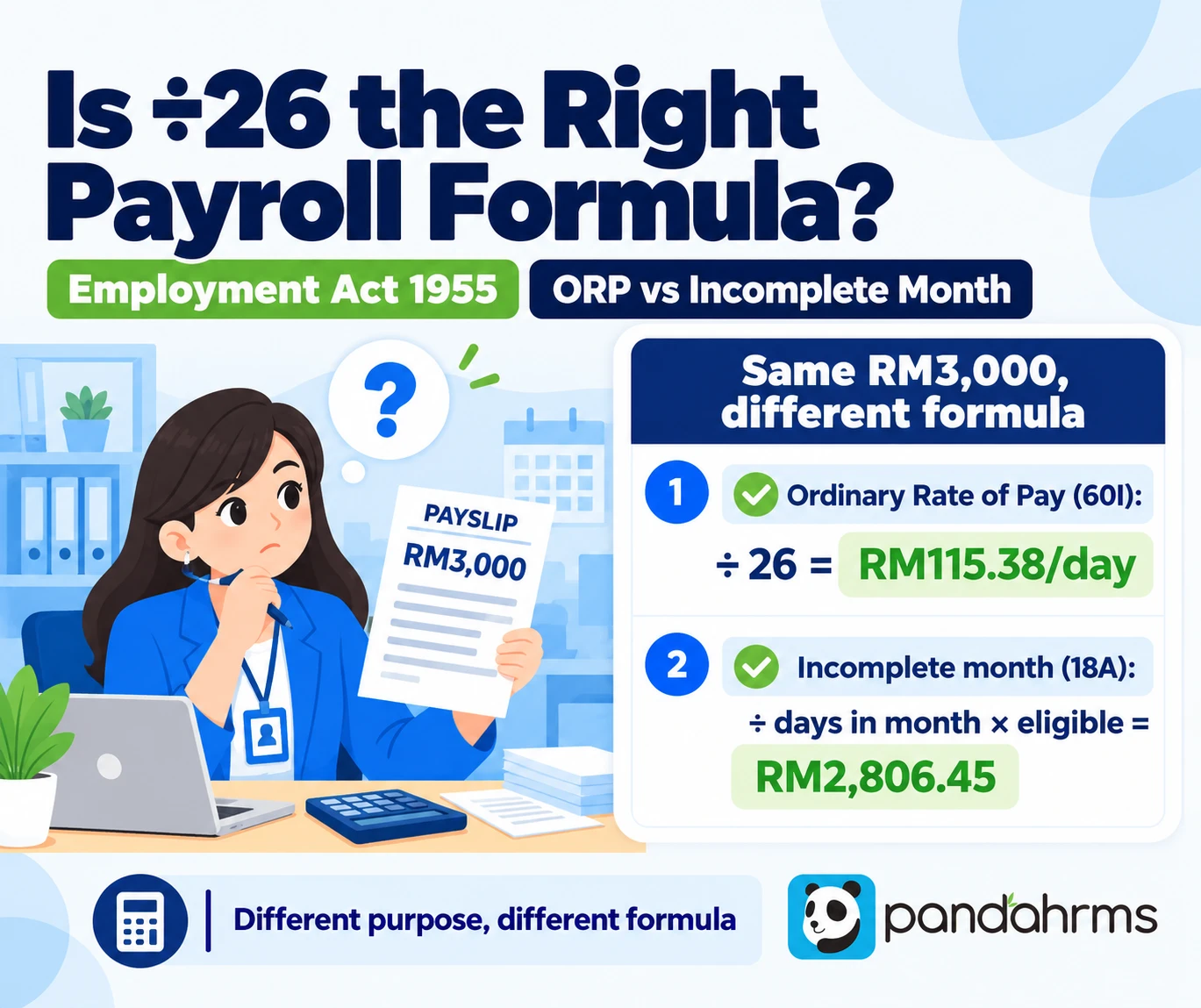
Ordinary rate of pay per day = monthly salary ÷ 26. Hourly rate = ordinary rate ÷ normal working hours per day (e.g. 8). - Do these rates apply to all employees?
They apply to employees covered by the relevant Employment Act provisions (generally those earning up to RM4,000 a month, plus certain categories). For others, the employment contract governs, though many employers apply the same rates.