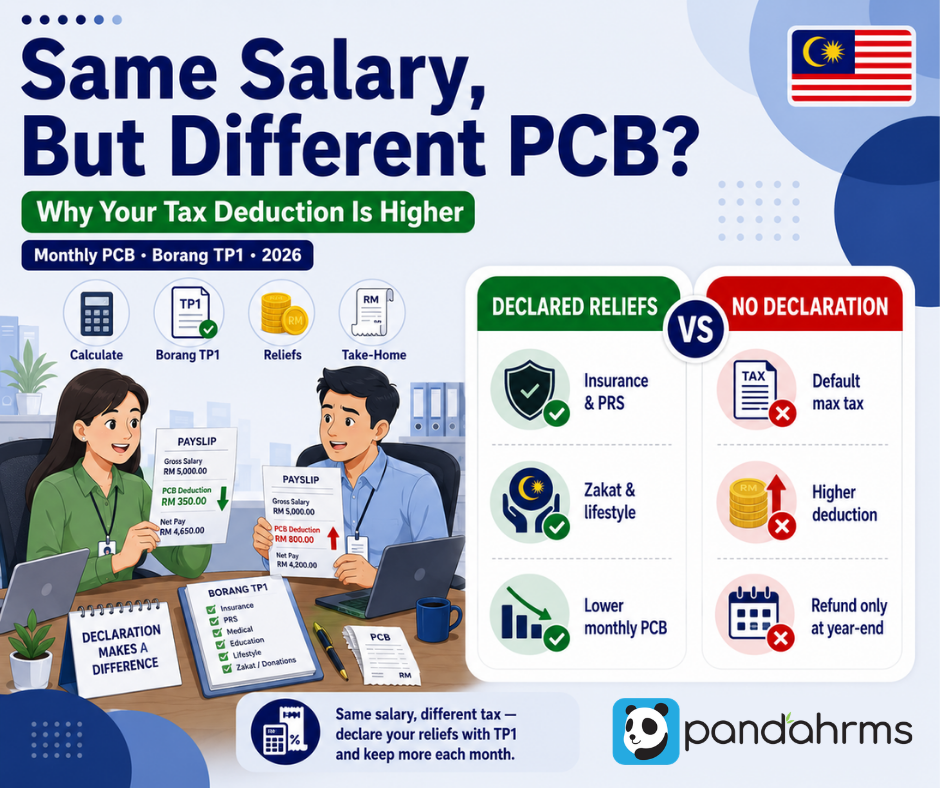
It’s a quietly frustrating moment: you glance at a colleague’s payslip — same job, same salary — and realise their monthly PCB (Potongan Cukai Berjadual / MTD) is lower than yours. Same gross pay, but they take home more. Are you being overtaxed? Is payroll making a mistake?
Almost always, the answer is no — it’s not an error, and it’s not unfair. It comes down to how PCB is actually calculated, and one thing your colleague has very likely done that you haven’t. Here’s exactly why your deduction is higher, and how to bring it back in line.
Why Two People on the Same Salary Pay Different PCB
PCB is not a flat percentage of your salary. It’s worked out from your personal tax circumstances — which means two people earning identical pay can have very different monthly deductions. The main factors:
| Factor | Effect on your PCB |
|---|---|
| Marital status | Single vs married changes your relief category |
| Working / non-working spouse | A non-working spouse adds spouse relief → lower PCB |
| Number of children | Each eligible child adds relief → lower PCB |
| Declared tax reliefs | Insurance, PRS, lifestyle, zakat — the biggest and most-missed factor |
Your marital status, spouse and children are usually captured when you join. The factor that most often explains a gap between two colleagues is the last one: declared reliefs.
The Real Reason Yours Is Higher: Undeclared Reliefs
Here’s what many employees don’t realise: HR isn’t manually calculating your tax. Payroll runs on software, and unless you have told the system about your reliefs, it computes PCB on the basic default profile — which assumes the maximum tax.
So if your colleague has declared their medical insurance, PRS contributions, and monthly zakat while you haven’t, their monthly deduction drops and yours stays high — on the very same salary. You’re not being treated unfairly; you’re simply over-deducted because the system doesn’t know about reliefs you never declared. (You’d claw it back at year-end filing — but why lend LHDN that money interest-free all year?)
Key point: A higher PCB than your colleague is rarely an error or unfairness. It almost always means they declared reliefs that you haven’t. The fix is a single form: Borang TP1.
The Fix: Borang TP1 — Declare Your Reliefs
Borang TP1 is the official form that lets you declare your eligible tax reliefs to your employer during the year, so your monthly PCB is reduced accordingly — rather than waiting until you file taxes to claim them back. You request it from HR, list your qualifying reliefs, and submit it before the payroll cut-off.
Common reliefs you can declare via TP1 include:
| Relief type | Examples |
|---|---|
| Insurance & retirement | Life insurance/takaful, medical insurance, PRS, voluntary EPF |
| Lifestyle | Books, computer/laptop, smartphone, internet, sports equipment |
| Family | Childcare fees, SSPN savings, education, parental medical care |
| Zakat | Monthly zakat, which is treated as a tax rebate |
Relief categories and limits are set by LHDN and can change each year — always check the current year’s list and caps before declaring.
A Worked Example: Same Salary, RM198 Difference
Take a married employee earning RM8,000 a month, with a non-working spouse and two children. For illustration:
- Before declaring any reliefs: monthly PCB ≈ RM454
- They then declare, via TP1: takaful/insurance, PRS contributions, and monthly zakat
- After declaring reliefs: monthly PCB drops to ≈ RM256
That’s about RM198 more in take-home pay every month — roughly RM2,300+ a year — for the exact same salary. Now imagine two colleagues in this position: one declared, one didn’t. That’s your payslip gap, explained.
When and How to Submit TP1
- Request the form from your HR or payroll department.
- List your eligible reliefs for the year, with the amounts.
- Keep your receipts — you must be able to support every relief you declare.
- Submit before the payroll cut-off so it applies to that month’s PCB.
Most employers accept TP1 submissions at least a couple of times a year. The earlier in the year you declare, the more months you enjoy the lower deduction.
Can HR Refuse to Process Your TP1?
Some employees are told HR “doesn’t do” TP1 because it adds manual work. But processing an employee’s TP1 for PCB purposes is part of an employer’s payroll obligations — it shouldn’t simply be brushed aside. A good payroll system makes it effortless, which removes the excuse entirely. If your TP1 is being ignored, it’s reasonable to ask HR to process it and to reference the official LHDN process.
For the employer’s side of these forms, see our Employer’s Guide to TP1, TP2 & TP3 Forms, and if you’re wondering why the figure shifts from one month to the next, read Why Does PCB Change Every Month in Malaysia?
Where Pandahrms Helps
TP1 only becomes a headache when payroll is manual. With Pandahrms, employees can submit their relief declarations digitally, the system applies them to PCB automatically and accurately, and HR keeps a clean record of every declaration — no spreadsheets, no “we don’t do TP1.” So your people pay the correct tax each month and take home what they’re entitled to, while payroll stays compliant with LHDN.
Make relief declarations easy, and every employee’s PCB is right the first time — no mystery gaps between colleagues.
Final Thoughts
If your PCB is higher than a colleague on the same salary, don’t assume you’re being overtaxed unfairly — it’s almost always down to reliefs they’ve declared and you haven’t. Borang TP1 is the simple, legal way to bring your monthly tax deduction in line with what you actually owe, so you keep more of your pay through the year. Gather your receipts, declare your reliefs, and stop giving LHDN an interest-free loan every month.
Frequently Asked Questions (FAQs)
- Why is my PCB higher than my colleague’s if we earn the same salary?
Because PCB is based on personal circumstances — marital status, spouse, children, and declared tax reliefs — not just salary. The most common reason yours is higher is that your colleague has declared reliefs (such as insurance, PRS or zakat) via Borang TP1 and you haven’t. - Is a higher PCB a payroll mistake?
Usually not. Payroll software calculates PCB on the information it has. If you haven’t declared your reliefs, it applies the default (maximum) tax. It’s not an error — it just means your reliefs aren’t in the system yet. - What is Borang TP1 and how does it help?
Borang TP1 is the form employees use to declare eligible tax reliefs to their employer during the year, so those reliefs are factored into the monthly PCB calculation and your deduction is reduced — instead of only claiming them back when you file taxes. - What reliefs can I declare in TP1?
Common ones include life/medical insurance and takaful, PRS, lifestyle expenses (books, computer, internet, sports), childcare and education (SSPN), parental medical care, and zakat. LHDN sets the categories and limits each year, so check the current list and caps and keep your receipts. - Can my employer refuse to process my TP1?
Processing an employee’s TP1 for PCB is part of an employer’s payroll duties and shouldn’t simply be refused. If it’s being ignored because of manual work, a proper payroll system handles it easily — ask HR to process it and reference the official LHDN process.