Malaysia’s minimum wage is back in the spotlight. The government has confirmed it is reviewing the current RM1,700 minimum wage — the rate that has applied to all employers since August 2025 — sparking the obvious question on every employer’s and employee’s mind: is the minimum wage about to go up?
Here’s what’s actually being reviewed, what it could mean for your payroll, and how employers should prepare now — before any new rate is announced.
What’s Happening: The Minimum Wage Review Explained
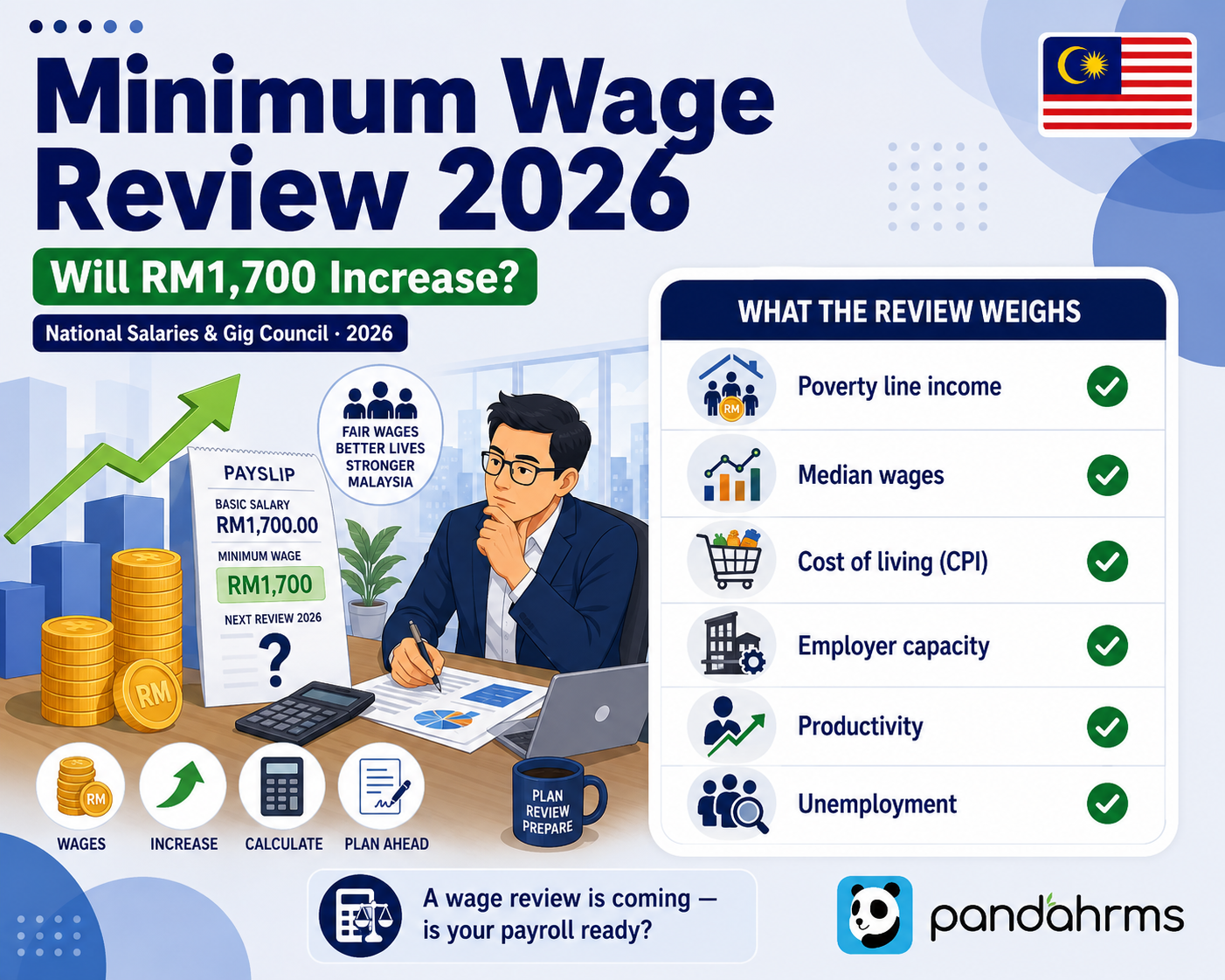
According to recent reports, the government is reviewing the RM1,700 minimum wage, with the final decision to be made by the National Salaries and Gig Council. Human Resources Minister R. Ramanan said the review will weigh basic indicators such as the poverty line income and median wages to measure workers’ basic needs against employers’ financial capacity.
Importantly, this is a review — not yet a rate change. No specific new figure and no implementation timeline have been announced. The council will assess the data before deciding whether to maintain or raise the current rate.
Key point: As of now, the minimum wage remains RM1,700. The review may result in an increase, or in the rate being held — nothing is confirmed. Employers should prepare, not panic.
Will the Minimum Wage Increase?
No one can say for certain yet — that’s exactly what the review will decide. What we do know is the direction of the conversation: the review is explicitly looking at whether RM1,700 still meets workers’ basic needs. For context, Bank Negara Malaysia’s earlier “living wage” concept estimated a single adult in Kuala Lumpur needs around RM2,700 a month — well above the current floor. That gap is part of why the pressure for a review exists.
Whether the council recommends an increase, and how big, will depend on the balance between workers’ needs and employers’ capacity to pay.
What the Review Takes Into Account
The review isn’t a random number-pick — it weighs several economic indicators:
- Poverty line income (PLI) — the income needed to meet basic needs
- Median wages — where typical earnings sit
- Employers’ financial capacity — whether businesses can absorb a rise
- Consumer price index (CPI) — cost-of-living / inflation
- Labour productivity — output relative to wages
- Unemployment rate — labour market health
What a Higher Minimum Wage Would Mean for Employers
If the rate rises, the impact goes further than just the lowest-paid staff:
- Direct cost increase — every employee below the new floor must be raised to it.
- Wage compression — staff just above the old minimum may expect adjustments too, to preserve pay differentials.
- Knock-on statutory costs — EPF, SOCSO and EIS contributions are wage-based, so they rise with salaries.
- Compliance risk — paying below the gazetted minimum is an offence, so payroll must update the moment a new rate takes effect.
How Employers Should Prepare Now
You don’t need a final figure to get ready. Smart employers act during the review window, not after:
- Audit your payroll — identify who is currently at or near RM1,700, and who would be affected by an increase.
- Model the cost impact — run “what-if” scenarios (e.g. RM1,800, RM1,900, RM2,000) to see the effect on your wage bill and statutory contributions.
- Review your wage structure — plan how you’d handle wage compression for staff just above the floor.
- Build a sustainable wage policy — as employers themselves have flagged, a clear, forward-looking pay policy beats reacting at the last minute.
Where Pandahrms Helps
A minimum wage change is a payroll event — and preparation is far easier with the right system. With Pandahrms, you can instantly identify every employee at or near the minimum wage, model the cost of different rate scenarios on your total wage bill and EPF/SOCSO/EIS contributions, and — once a new rate is gazetted — update payroll accurately and stay compliant from day one. So whether the rate rises or holds, you’re ready, not scrambling.
Know your numbers before the announcement, and a wage change becomes a plan — not a panic.
Final Thoughts
The RM1,700 minimum wage review is a reminder that wage policy in Malaysia keeps moving. Nothing has changed yet — the rate is still RM1,700 — but the direction of travel is clear enough that employers should prepare. Audit your payroll, model the scenarios, and set a sustainable wage policy now. When the National Salaries and Gig Council makes its call, you’ll be ready to act with confidence.
For the current rules, see our guides on the RM1,700 minimum wage for all employers and the Minimum Wages Order 2024.
Frequently Asked Questions (FAQs)
- Is Malaysia’s minimum wage increasing in 2026?
Not yet. The government is reviewing the current RM1,700 minimum wage, but no new rate or timeline has been announced. The rate remains RM1,700 until any change is officially gazetted. - What is Malaysia’s current minimum wage?
RM1,700 per month, which has applied to all employers since 1 August 2025. It covers all workers except domestic helpers and apprentices. - Who decides the minimum wage in Malaysia?
The review and recommendation are handled by the National Salaries and Gig Council, taking into account indicators such as the poverty line income, median wages, cost of living, productivity, and employers’ capacity to pay. - How should employers prepare for a possible increase?
Audit who is at or near the current minimum, model the cost of different rate scenarios (including the effect on EPF/SOCSO/EIS), plan for wage compression, and set a clear wage policy — so you can update payroll immediately if a new rate is announced. - Does a higher minimum wage affect statutory contributions?
Yes. EPF, SOCSO and EIS contributions are calculated on wages, so if salaries rise to meet a higher minimum, the associated statutory contributions increase too.
Sources
- Free Malaysia Today — “Kerajaan semak semula gaji minimum RM1,700” (18 August 2026): freemalaysiatoday.com
- Berita Harian — “Kajian semula gaji minimum: Majikan perlukan dasar gaji yang boleh dilaksana” (August 2026): bharian.com.my
- Utusan Malaysia — “Kadar gaji minimum disemak semula” (August 2026): utusan.com.my