“Can I work from home two days a week?”
A few years ago, that question was a favour to ask a boss. Today, it’s a statutory right to request — and Malaysian employers have a legal duty to respond properly.
Since the Employment Act 1955 amendments took effect on 1 January 2023, employees can formally apply for a Flexible Working Arrangement (FWA), and employers must handle that application within a fixed timeframe. Yet many businesses still treat these requests casually — a quick “no” in passing, or an email left unanswered for weeks. That’s a compliance gap. Here’s what the law actually requires, and how HR should handle an FWA request the right way.
What Is a Flexible Working Arrangement?
A Flexible Working Arrangement is a change to an employee’s normal working conditions in one of three areas:
- Working hours — e.g. starting and finishing earlier or later (flexi-time).
- Working days — e.g. a compressed work week.
- Place of work — e.g. working from home or a satellite location.
The key idea is flexibility in how, when, or where the work is done — without necessarily reducing the work itself.
What the Law Says: Section 60P and 60Q
The right sits in two sections of the Employment Act 1955:
| Section | What it covers |
|---|---|
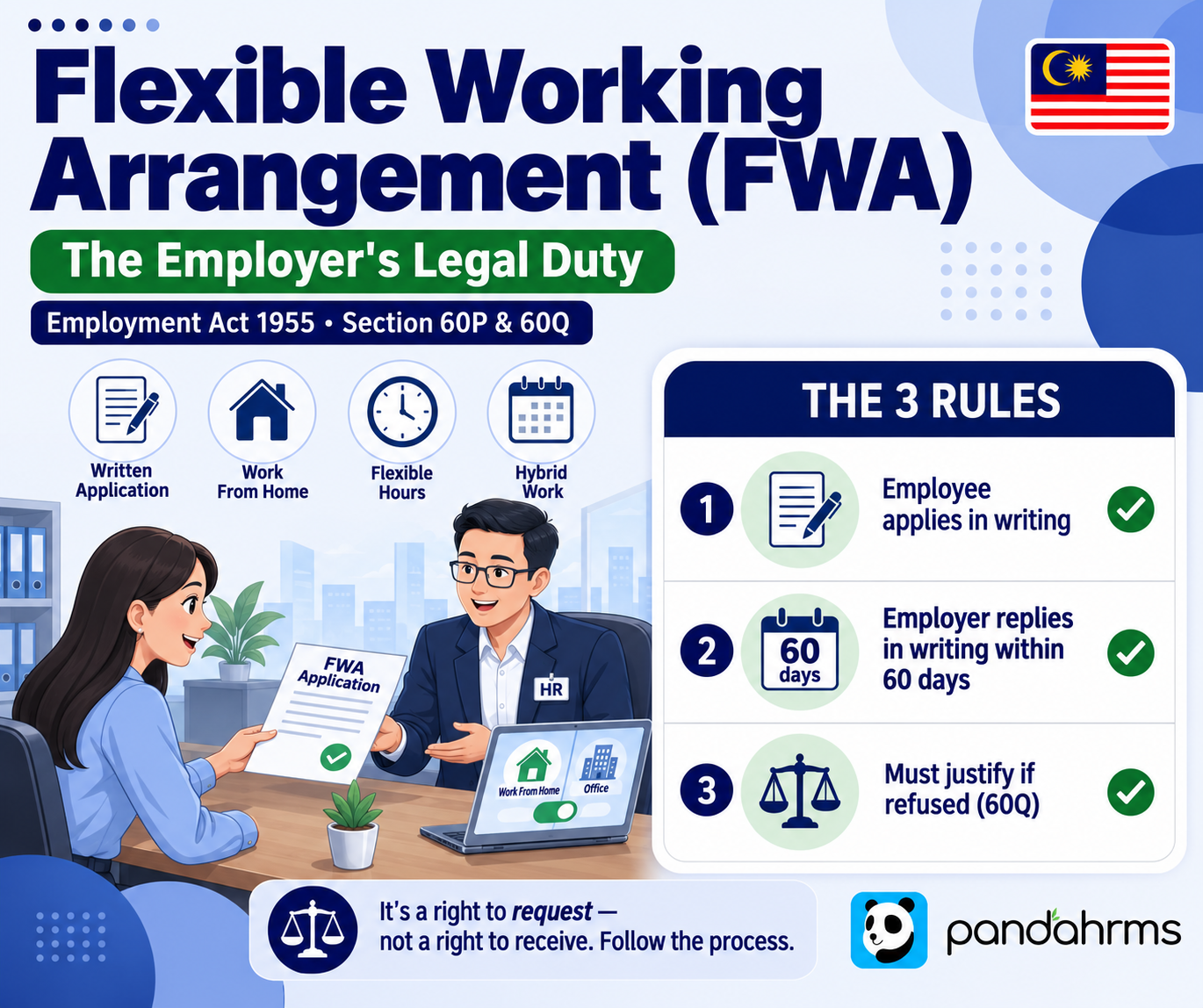
| Section 60P | An employee may apply in writing to their employer for a flexible working arrangement, to vary their hours, days, or place of work. |
| Section 60Q | The employer must approve or refuse the application within 60 days of receiving it, and if refused, must state the grounds for the refusal in writing. |
Two things employers must take away from this:
- The application must be in writing, and your response must be in writing too.
- You have a hard 60-day deadline to respond. Silence is not an option.
Important: It’s a Right to Request, Not a Right to Receive
This is the point that reassures many employers — and that HR should communicate clearly.
Section 60P gives employees the right to ask for flexible working. It does not give them an automatic right to have the request granted. The employer retains the discretion to approve or refuse, based on genuine business considerations.
What the law does require is process: that you consider the request seriously, respond within 60 days, and give reasons if you say no. In other words, you cannot simply ignore it — but you are not forced to say yes.
How Employers Should Handle an FWA Request
A clean, defensible process looks like this.
Step 1: Acknowledge the request in writing
Confirm receipt and note the date. The 60-day clock starts when you receive the written application.
Step 2: Assess it against real business needs
Consider the impact on operations, team coverage, productivity, client service, and whether the role can realistically be done flexibly.
Step 3: Decide within 60 days
Do not let the deadline slip. Approve, refuse, or propose an alternative arrangement (for example, one day from home instead of three).
Step 4: Communicate the outcome in writing
If approved, document the new arrangement and any trial period. If refused, state your grounds clearly — this is a legal requirement, not a courtesy.
Step 5: Keep the record
Retain the application, your assessment, and your written response. If a dispute arises later, this is your evidence that you followed the law.
Key principle: The safest employers are not the ones who always say yes — they are the ones who always follow the process. A refusal handled correctly is fully lawful; an ignored request is not.
When Can an Employer Refuse an FWA Request?
The law does not list rigid grounds, but a refusal should be based on genuine business reasons, such as:
- The role requires a physical or on-site presence.
- The arrangement would create unmanageable cost.
- It would harm productivity, quality, or client service.
- It would place an unfair burden on other team members or coverage.
- The business simply cannot restructure the work to accommodate it.
The grounds should be honest and specific. A vague “not suitable” is weaker than “this role requires daily in-person coverage of the front desk during operating hours.”
Common Mistakes Employers Make
- Ignoring the request or letting it drift past 60 days.
- Responding verbally only, with no written record.
- Refusing without stating grounds, breaching Section 60Q.
- Treating every request the same instead of assessing each role on its facts.
- Applying arrangements inconsistently, which can raise fairness or discrimination concerns.
FWA slip-ups are one of several everyday practices that can quietly breach the law — see our guide on 10 Common HR & Payroll Practices in Malaysia That May Be Against the Law.
Where Pandahrms Helps
Handling FWA requests well is really about process and records — logging the request, tracking the 60-day deadline, and keeping the written decision on file. This is exactly what Pandahrms is built to support: applications and approvals captured in one place, attendance and work-location rules configured for each employee, and every decision leaving a clear, dated trail — so if a request is ever questioned, you can show exactly how it was handled and when.
Handle each request fairly, and let your system keep the record straight.
Final Thoughts
Flexible working is no longer just a perk — in Malaysia, it comes with a legal process employers must follow. The good news is that the obligation is about how you respond, not what you decide. Take every FWA application seriously, respond in writing within 60 days, and give honest reasons when you refuse. Do that consistently, and you stay compliant while keeping the flexibility to run your business the way it needs to run.
Frequently Asked Questions (FAQs)
- Do Malaysian employers have to approve flexible working requests?
No. Employees have the right to apply for flexible working under Section 60P, but employers can approve or refuse based on genuine business reasons. What employers must do is respond within 60 days and give grounds if they refuse. - How long does an employer have to respond to an FWA request?
Within 60 days of receiving the written application, as required by Section 60Q of the Employment Act 1955. - Does the employee’s FWA request have to be in writing?
Yes. Section 60P requires the application to be made in writing. Employers should also give their response in writing. - What happens if an employer ignores an FWA request?
Failing to respond within 60 days, or refusing without stating grounds, breaches the Employment Act and exposes the employer to a compliance complaint. Silence is not a lawful response. - Can an employer refuse a flexible working request?
Yes, provided the refusal is based on genuine business grounds and is communicated in writing. Common grounds include operational needs, cost, productivity, or the role requiring on-site presence.