Good news for Selangor — and a quick compliance question for employers. The Selangor State Government has declared Tuesday, 1 September 2026, a special public holiday (cuti peristiwa) in conjunction with the state contingent’s success at the Sukan Malaysia (SUKMA) 2026. The announcement was made by the Selangor Menteri Besar as part of the celebrations around the SUKMA 2026 closing ceremony.
The date falls the day after National Day (Merdeka, 31 August) — so for many in Selangor it creates a welcome long weekend. But for businesses, it raises the usual questions: Is it a paid holiday? What do we pay staff who work? And does it apply to everyone? Here’s what Selangor employers need to know.
What Was Announced?
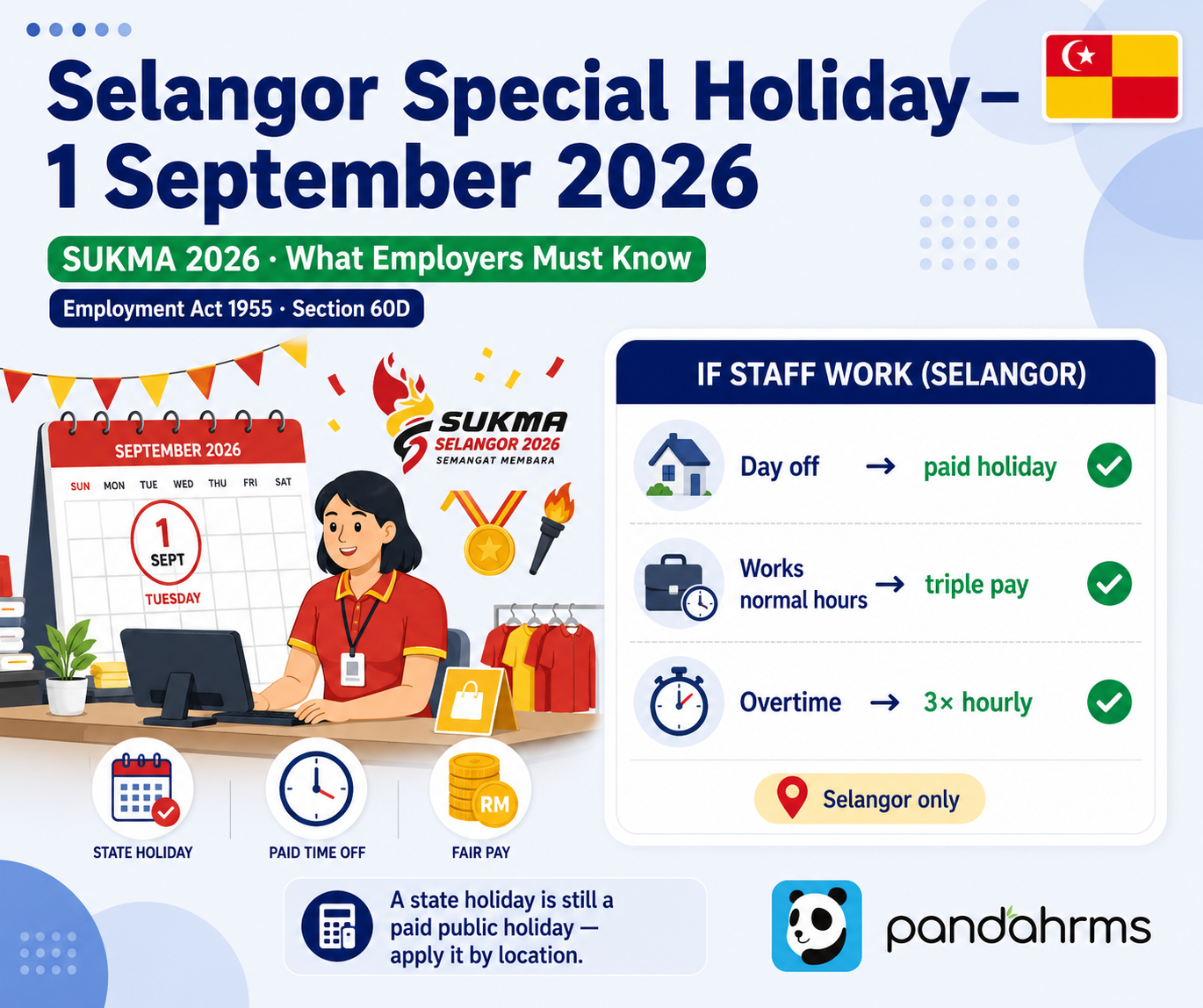
Selangor has gazetted 1 September 2026 (Tuesday) as a special one-off public holiday to celebrate the state’s achievement at SUKMA 2026. It’s an additional, ad-hoc holiday — separate from the usual gazetted public holidays — and it applies within Selangor.
Is the 1 September Special Holiday a Paid Holiday?
For employees covered by the Employment Act 1955, the short answer is yes. When a state (or the federal government) declares a special holiday under Section 8 of the Holidays Act 1951, it becomes a public holiday for that area. And under Section 60D of the Employment Act 1955, employees are entitled to a paid holiday on the gazetted public holidays and on any day declared under Section 8 of the Holidays Act 1951.
In other words, this special SUKMA holiday is a paid public holiday for eligible Selangor employees — and if they are required to work on it, public holiday pay rates apply.
Key point: A state-declared special holiday isn’t just an optional day off — for Employment Act–covered staff in Selangor, it’s a paid public holiday, with the same work-day pay rules as any other public holiday.
What You Pay Staff Who Work on 1 September
If your Selangor operations run on the day and staff are required to work, the Section 60D public holiday pay rules apply:
| Situation | What you pay (Section 60D) |
|---|---|
| Employee does not work (paid holiday) | Normal day’s pay (already in a monthly salary) |
| Employee works normal hours | + 2 days’ ordinary wages → effectively “triple pay” for the day |
| Employee works overtime (beyond normal hours) | 3× the hourly rate for each overtime hour |
For the detailed calculation, see our guide on double pay vs triple pay on public holidays.
Important: This Applies to Selangor Only
Because this is a state holiday, it applies to workplaces and employees in Selangor — not nationwide. Two practical points for HR:
- Multi-state employers: only your Selangor-based employees are entitled to this holiday. Staff in other states follow their own state calendar.
- Check your workforce location so you apply the holiday (and any holiday pay) to the right people.
For the full state-by-state picture, see our Malaysia Public Holidays 2026 guide for all states.
A Long Weekend for Selangor
With Merdeka Day on Monday, 31 August and this special holiday on Tuesday, 1 September, many Selangor employees will enjoy an extended break running from the weekend straight through to Tuesday. Expect bridging leave requests and plan coverage early if your business needs to stay open.
What Employers Should Do
- Recognise 1 September as a paid holiday for eligible Selangor employees.
- Decide staffing early — if you need people working, communicate the public holiday pay rates upfront.
- Apply it by location — only Selangor staff are entitled; don’t apply it blanket across other states.
- Plan for bridging leave around the Merdeka + special-holiday long weekend.
- Keep clear records of who worked and the pay applied.
Where Pandahrms Helps
Ad-hoc and state-specific holidays are exactly where payroll gets messy — especially for employers with staff across different states. With Pandahrms, you can configure holidays by state and employee location, so a Selangor-only special holiday is applied to the right people automatically, the correct public holiday pay is calculated for anyone who works, and every record stays clean. So a last-minute declared holiday becomes a quick update, not a payroll scramble.
Set holidays by location, and let the system handle who gets what.
Final Thoughts
Selangor’s special holiday for SUKMA 2026 is a well-earned celebration — and for employers, a simple compliance reminder. Treat 1 September as a paid public holiday for eligible Selangor staff, apply the correct pay to anyone who works, and apply it by location. Handle it right, and it stays a celebration rather than a payroll headache.
Frequently Asked Questions (FAQs)
- Is 1 September 2026 a public holiday in Selangor?
Yes. The Selangor State Government has declared Tuesday, 1 September 2026, a special one-off public holiday (cuti peristiwa) in conjunction with the state’s success at SUKMA 2026. It applies within Selangor. - Is the special holiday paid?
For Employment Act–covered employees in Selangor, yes. A holiday declared under Section 8 of the Holidays Act 1951 is a paid public holiday under Section 60D of the Employment Act 1955. - What do I pay staff who work on 1 September?
Under Section 60D, a monthly-rated employee who works normal hours on a public holiday is entitled to 2 extra days’ wages on top of the holiday pay — effectively triple pay — and overtime is paid at 3 times the hourly rate. - Does this holiday apply to employees outside Selangor?
No. It is a Selangor state holiday, so only workplaces and employees in Selangor are entitled to it. Employees in other states follow their own state holiday calendar. - Do employers have to give the day off?
Eligible Selangor employees are entitled to the paid holiday. Employers that need staff to work may require it, but must then pay the applicable public holiday rates.
Sources
- Sinar Harian — “Selangor umum cuti peristiwa 1 September ini sempena kejayaan SUKMA 2026”: sinarharian.com.my
- Employment Act 1955 (Act 265), Malaysia — Section 60D (public holidays)
- Holidays Act 1951, Malaysia — Section 8 (power to declare special public holidays)