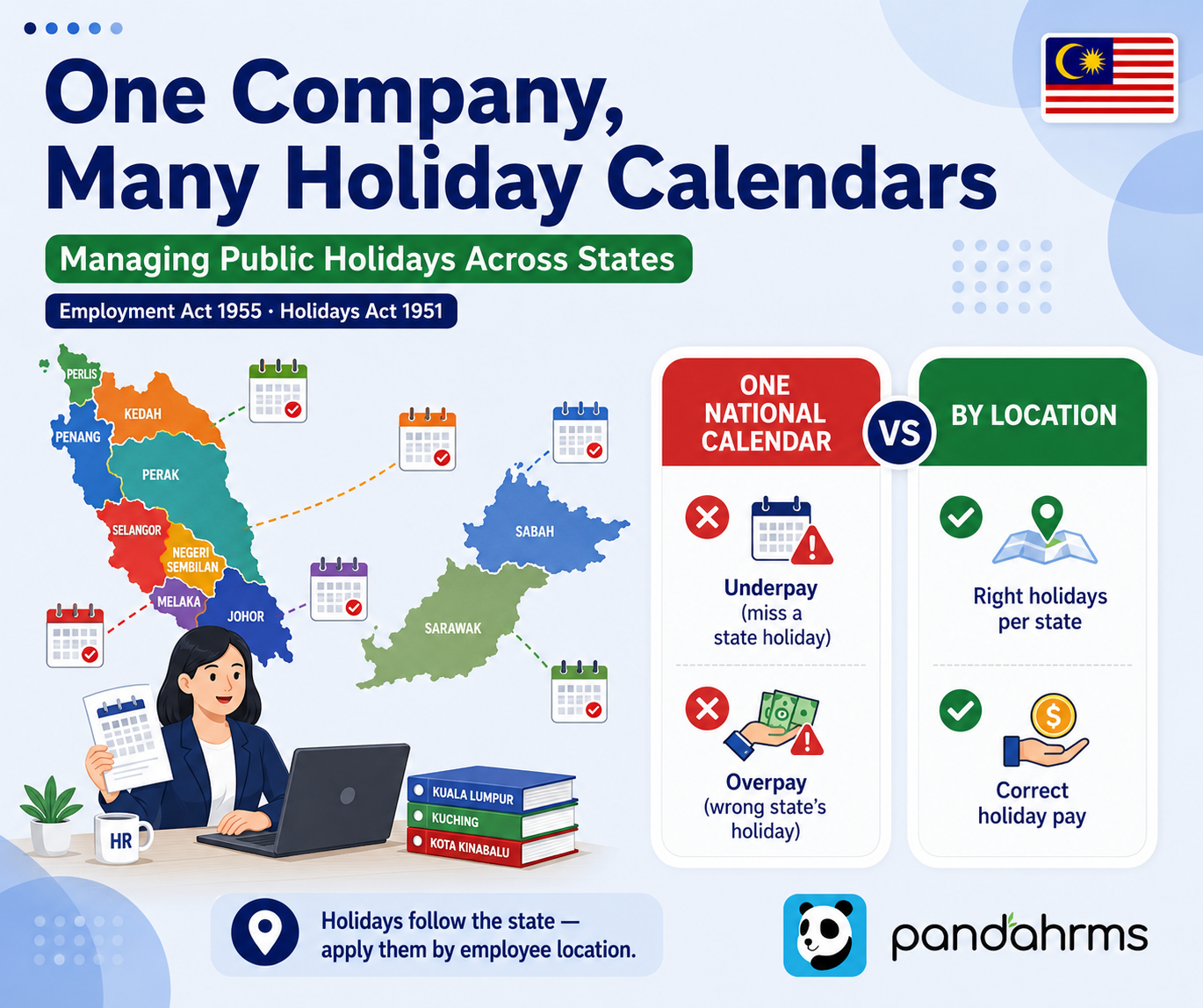
Here’s a scenario every growing Malaysian business runs into: your Selangor team gets a state holiday off, but your Penang and Johor staff don’t. Your Sarawak employees celebrate Gawai; your KL office works as normal. One company — and suddenly you’re juggling several different public holiday calendars at once.
Get it wrong and you either shortchange employees or overpay them. Here’s why holidays differ by state, the two costly mistakes to avoid, and how to manage multiple calendars cleanly.
Why Public Holidays Differ by State in Malaysia
Malaysia’s public holidays are not uniform nationwide. There are federal holidays that apply everywhere (like Merdeka Day and Hari Raya), but many holidays are state-specific — declared by each state government. Thaipusam, the various Rulers’ birthdays, Gawai in Sarawak, and Kaamatan in Sabah are all observed in some states and not others. States can also declare special one-off holidays under Section 8 of the Holidays Act 1951 (as Selangor did for its SUKMA 2026 success).
Key principle: An employee’s public holiday entitlement is not set by where your company is headquartered — it’s set by the state where the employee actually works.
The Two Costly Mistakes of a Single Calendar
Many employers run one national holiday list for everyone. That creates two opposite — and expensive — errors:
| Mistake | What goes wrong |
|---|---|
| Underpayment | Staff miss a state holiday they’re entitled to (or the holiday pay for working it) — a compliance breach |
| Overpayment | A state holiday is applied to staff in a state that doesn’t observe it — paying for days or premiums you didn’t owe |
And because it’s usually reconciled by hand each payroll run, it’s slow and error-prone.
Examples of State-Specific Holidays
- Thaipusam — observed in some states (e.g. Selangor, Penang, KL) but not all.
- Rulers’ / Governors’ birthdays — different dates in different states.
- Gawai Dayak (Sarawak) and Pesta Kaamatan (Sabah/Labuan).
- Special declared holidays — e.g. Selangor’s special holiday on 1 September 2026 for SUKMA. See our guide: Selangor’s 1 September 2026 special holiday.
For the full year-by-state list, see our Malaysia Public Holidays 2026 guide for all states.
How Entitlement Is Determined
The rule to remember: entitlement follows the employee’s place of work. A worker based in Selangor is entitled to Selangor’s holidays; a worker based in Johor follows Johor’s. For employees covered by the Employment Act 1955, a gazetted or Section 8–declared holiday in their state is a paid public holiday — and if they work it, the Section 60D public holiday pay rates apply (see our guide on double pay vs triple pay).
How to Manage Multiple Holiday Calendars
- Map employees to their work state. Know exactly which state each employee is based in.
- Maintain a holiday list per state/branch — not one national list for everyone.
- Set it once, apply automatically. Configure each location’s holidays so payroll applies the right days (and the right holiday pay) without manual reconciliation.
- Handle ad-hoc declarations quickly. When a state declares a special holiday, update only that state’s calendar.
- Keep clear records of who was entitled to what and the pay applied.
Where Pandahrms Helps
Managing several holiday calendars by hand is exactly where errors and wasted hours creep in. With Pandahrms, you can configure public holidays by state, branch, or employee location, so each person automatically gets the holidays they’re entitled to — and payroll applies the correct public holiday pay for anyone who works. A last-minute state declaration becomes a quick update to one calendar, not a company-wide scramble.
Set holidays by location once, and let the system apply the right days to the right people.
Final Thoughts
In Malaysia, public holidays follow the state, not the head office. For any employer with staff across more than one state, a single national calendar is a compliance risk in both directions. Map your people to their work state, keep a holiday list per location, and automate the rest — and multiple calendars stop being a headache.
Frequently Asked Questions (FAQs)
- Are public holidays the same across all Malaysian states?
No. Some are federal (nationwide), but many are state-specific — declared by each state government. Entitlement depends on the state where the employee works. - Which state’s holidays does an employee follow?
The state where the employee is based/works, not where the company is headquartered. A Selangor-based employee follows Selangor’s holiday calendar. - What happens if I apply the wrong state’s holidays?
Two risks: underpayment (missing a holiday or holiday pay an employee is entitled to, a compliance breach) or overpayment (paying for a holiday that doesn’t apply in that state). - Do employees get paid for state public holidays?
For Employment Act–covered employees, a gazetted or Section 8–declared public holiday in their state is a paid holiday, with Section 60D pay rates if they are required to work. - How can I manage different holiday calendars across states?
Map each employee to their work state, keep a separate holiday list per state or branch, and use a system that applies the correct holidays and pay automatically — rather than reconciling a single national calendar by hand.