Most employees glance at their payslip, check the net figure, and move on. But that little document carries real legal weight — and many Malaysian employers still issue payslips that are incomplete, unclear, or missing entirely. So what does the law actually require, and what must a proper payslip show?
Here’s what every employer needs to know about payslips in Malaysia.
Is a Payslip Legally Required in Malaysia?
Yes. Employers are required to provide employees with a payslip (an itemised pay statement) for each pay period. Under the Employment Act 1955, wages must be properly paid and accounted for, and giving each employee a written breakdown of their earnings and deductions is part of that obligation. A verbal “your pay is banked in” is not enough — employees are entitled to see how their pay was calculated.
Key point: A payslip isn’t a courtesy — it’s a record employees are entitled to. Not providing clear, itemised payslips is a compliance gap, and it’s the number-one source of avoidable pay disputes.
What Must an Itemised Payslip Include?
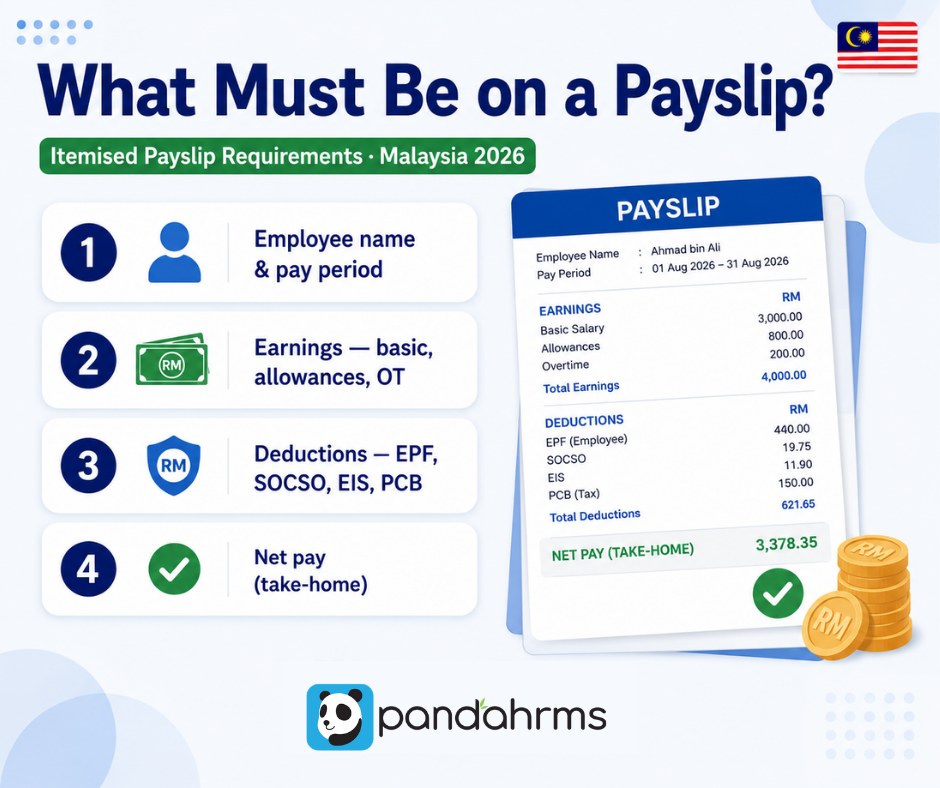
A proper payslip should clearly show the full breakdown of pay and deductions, so an employee can understand exactly how their net salary was reached:
| Section | What it should show |
|---|---|
| Employee & period | Name, the pay period, and pay date |
| Earnings | Basic salary, allowances, overtime, bonuses/commissions |
| Statutory deductions | EPF, SOCSO, EIS, and PCB (monthly tax deduction) |
| Other deductions | Any authorised deductions (e.g. advances) — each clearly itemised |
| Net pay | The final take-home amount, plus the employer’s statutory contributions for transparency |
Why Payslips Matter More Than You Think
- Transparency & trust. Employees can see exactly what they earned and why — no guessing.
- Dispute prevention. Most “where did my money go?” arguments disappear when the breakdown is clear (see our guide on why two colleagues on the same salary can have different PCB).
- Proof of income. Employees need payslips for loans, rentals, visas, and credit applications.
- Compliance & audit. Clear pay records protect you if a deduction or payment is ever questioned.
Common Payslip Mistakes Employers Make
- Not issuing payslips at all — just banking the salary with no statement.
- Lumping everything into one figure instead of itemising earnings and deductions.
- Unexplained deductions that appear without a clear label.
- Wrong statutory figures — incorrect EPF, SOCSO, EIS, or PCB amounts.
- Handwritten or inconsistent slips that are easy to dispute and hard to audit.
Where Pandahrms Helps
Compliant payslips are exactly what a proper payroll system should handle automatically. With Pandahrms, every payslip is generated with a full itemised breakdown — earnings, EPF/SOCSO/EIS/PCB, other deductions, and net pay — calculated correctly and delivered digitally to each employee. No manual spreadsheets, no missing deductions, no disputes over unclear figures. Your team sees exactly how they were paid, and your records stay audit-ready.
Give every employee a clear, accurate payslip — automatically.
Final Thoughts
A payslip is more than a formality — it’s a record your employees are entitled to and a protection for your business. Issue one every pay period, itemise the earnings and deductions clearly, get the statutory figures right, and keep the format consistent. Do that, and payslips stop being a source of disputes and become a sign of a well-run payroll.
Frequently Asked Questions (FAQs)
- Is it compulsory to give employees a payslip in Malaysia?
Yes. Employers are required to provide employees with a payslip (an itemised pay statement) for each pay period, showing how their wages and deductions were calculated. - What must a payslip include?
Employee name and pay period, earnings (basic salary, allowances, overtime, bonuses), statutory deductions (EPF, SOCSO, EIS, PCB), any other authorised deductions itemised, and the net pay. - Can a payslip be digital?
Yes. A digital or electronic payslip is acceptable, as long as it is accurate, itemised, and accessible to the employee. - What if my employer doesn’t give me a payslip?
You’re entitled to one. Raise it with your employer first; if unresolved, you can refer the matter to the Department of Labour (JTK), as clear pay records are part of an employer’s obligations. - Do payslips need to show employer contributions?
It’s good practice to show the employer’s EPF, SOCSO and EIS contributions too, for full transparency — even where the focus is on the employee’s earnings and deductions.