
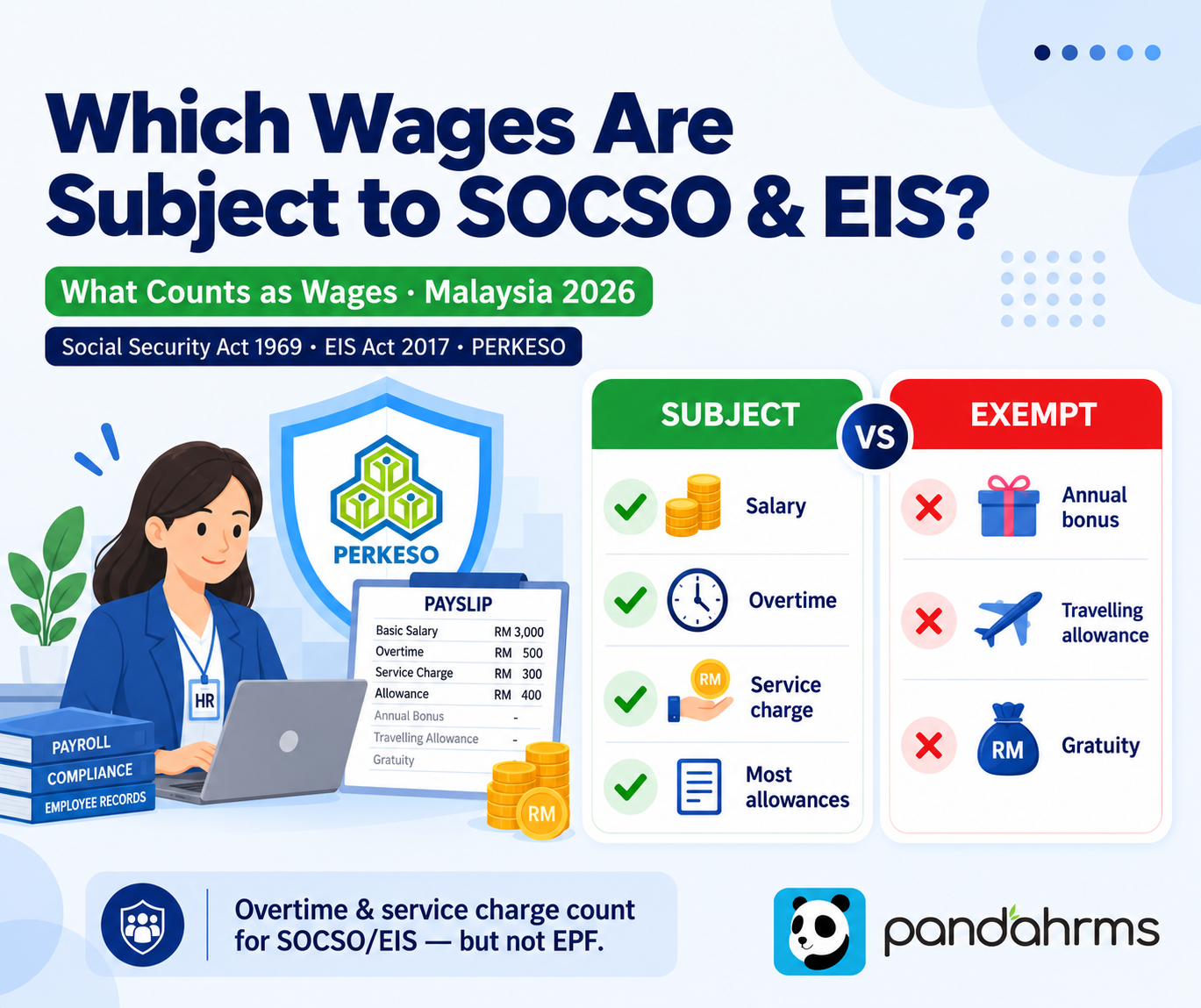
You already know SOCSO and EIS are deducted every month — but do you know which parts of an employee’s pay they’re actually calculated on? It’s a common payroll trap, because the rules are different from EPF. Apply the wrong wage base and you either under-contribute (a compliance risk) or over-contribute (wasted cost).
Here’s exactly which wages are subject to SOCSO and EIS in Malaysia — and how it differs from EPF.
The Legal Basis (and Why It’s Not the Employment Act)
First, a quick but important clarification: SOCSO and EIS are not governed by the Employment Act 1955. They have their own laws, both administered by PERKESO:
- SOCSO — the Employees’ Social Security Act 1969
- EIS — the Employment Insurance System Act 2017
Both use essentially the same definition of “wages” — all remuneration payable in money by an employer to an employee — with a specific list of inclusions and exclusions.
Payments SUBJECT to SOCSO & EIS
The following are treated as wages and are subject to SOCSO and EIS contributions:
- Salary / wages (full-time or part-time, monthly or hourly)
- Overtime payments
- Commission
- Payment for leave — annual, sick, maternity, rest day, and public holidays
- Allowances (most, e.g. incentive, shift, food, cost-of-living, housing)
- Service charge
Payments EXEMPT from SOCSO & EIS
| Exempt payment | Notes |
|---|---|
| Employer’s contributions to a pension / provident fund | e.g. the employer’s EPF contribution |
| Travelling / mileage allowance | Travelling allowances and mileage claims |
| Gratuity | Payment on dismissal, retrenchment, or retirement |
| Annual bonus | Not treated as wages for SOCSO/EIS |
| Reimbursement of job expenses | Sums to cover expenses incurred in the course of duties |
| Gifts | e.g. festive cash payments (Hari Raya, Christmas) |
EPF vs SOCSO/EIS: The Key Differences
This is where payroll mistakes happen most — because the same payment can be treated differently under EPF and SOCSO/EIS. Never apply one wage definition across all three.
| Payment | EPF | SOCSO / EIS |
|---|---|---|
| Overtime | ❌ No | ✅ Yes |
| Service charge | ❌ No | ✅ Yes |
| Annual bonus | ✅ Yes | ❌ No |
| Travelling allowance | ❌ No | ❌ No |
| Most allowances | ✅ Yes | ✅ Yes |
Key point: Overtime and service charge attract SOCSO/EIS but not EPF; the annual bonus is the opposite — EPF but not SOCSO/EIS. Getting these three right is where most payroll errors are made or avoided.
For the EPF side of this, see our companion guide: Which Allowances Are Subject to EPF in Malaysia?
Contribution Rates & Wage Ceiling
SOCSO and EIS are calculated on the contributable wages above, up to a monthly wage ceiling of RM6,000 (effective 1 October 2024). For eligible employees under 60:
- SOCSO — employer 1.75%, employee 0.5%
- EIS — employer 0.2%, employee 0.2%
Contributions are remitted to PERKESO by the 15th of the following month. For the full rates and tables, see our SOCSO contributions guide and EIS employer guide.
Why Getting the Wage Base Right Matters
- Under-contributing (e.g. leaving overtime out of the SOCSO base) exposes you to arrears and penalties from PERKESO.
- Over-contributing (e.g. adding the annual bonus to SOCSO) needlessly increases cost.
- Because EPF, SOCSO/EIS, and PCB each have their own wage rules, a single “one wage base fits all” approach almost guarantees errors.
Where Pandahrms Helps
Applying three different statutory wage definitions — EPF, SOCSO/EIS, and PCB — to every pay component, every month, is exactly where manual payroll breaks down. With Pandahrms, each pay item is configured once against each scheme’s rules, so overtime and service charge flow into SOCSO/EIS but not EPF, the annual bonus flows into EPF but not SOCSO/EIS, and everything is calculated correctly and consistently. Accurate contributions, no arrears surprises, and a clean audit trail.
Set the rules once, and every statutory deduction is right every payroll run.
Final Thoughts
SOCSO and EIS may share a payslip line with EPF, but they follow their own wage rules — most notably, overtime and service charge are in, and the annual bonus is out. Classify each pay component correctly under each scheme, respect the RM6,000 ceiling, and you stay compliant with PERKESO without over- or under-paying. When a payment is genuinely unclear, confirm directly with PERKESO.
Frequently Asked Questions (FAQs)
- Is overtime subject to SOCSO and EIS?
Yes. Overtime payments are treated as wages for SOCSO and EIS contributions — even though overtime is exempt from EPF. - Is annual bonus subject to SOCSO and EIS?
No. Annual bonus is not treated as wages for SOCSO/EIS purposes. (Note that bonus is, however, subject to EPF.) - Are allowances subject to SOCSO and EIS?
Most allowances are subject to SOCSO/EIS. The main exception is travelling / mileage allowance, which is exempt, along with reimbursements of job expenses. - What is the SOCSO and EIS wage ceiling?
The monthly wage ceiling is RM6,000, effective 1 October 2024. Contributions are calculated on contributable wages up to that ceiling. - Do SOCSO/EIS and EPF use the same definition of wages?
No. They have different rules — for example, overtime and service charge count for SOCSO/EIS but not EPF, while the annual bonus counts for EPF but not SOCSO/EIS. Each statutory deduction should be calculated on its own wage base.
Sources
- PERKESO (Social Security Organisation), Malaysia — perkeso.gov.my
- Employees’ Social Security Act 1969 (Act 4), Malaysia — SOCSO
- Employment Insurance System Act 2017 (Act 800), Malaysia — EIS



