
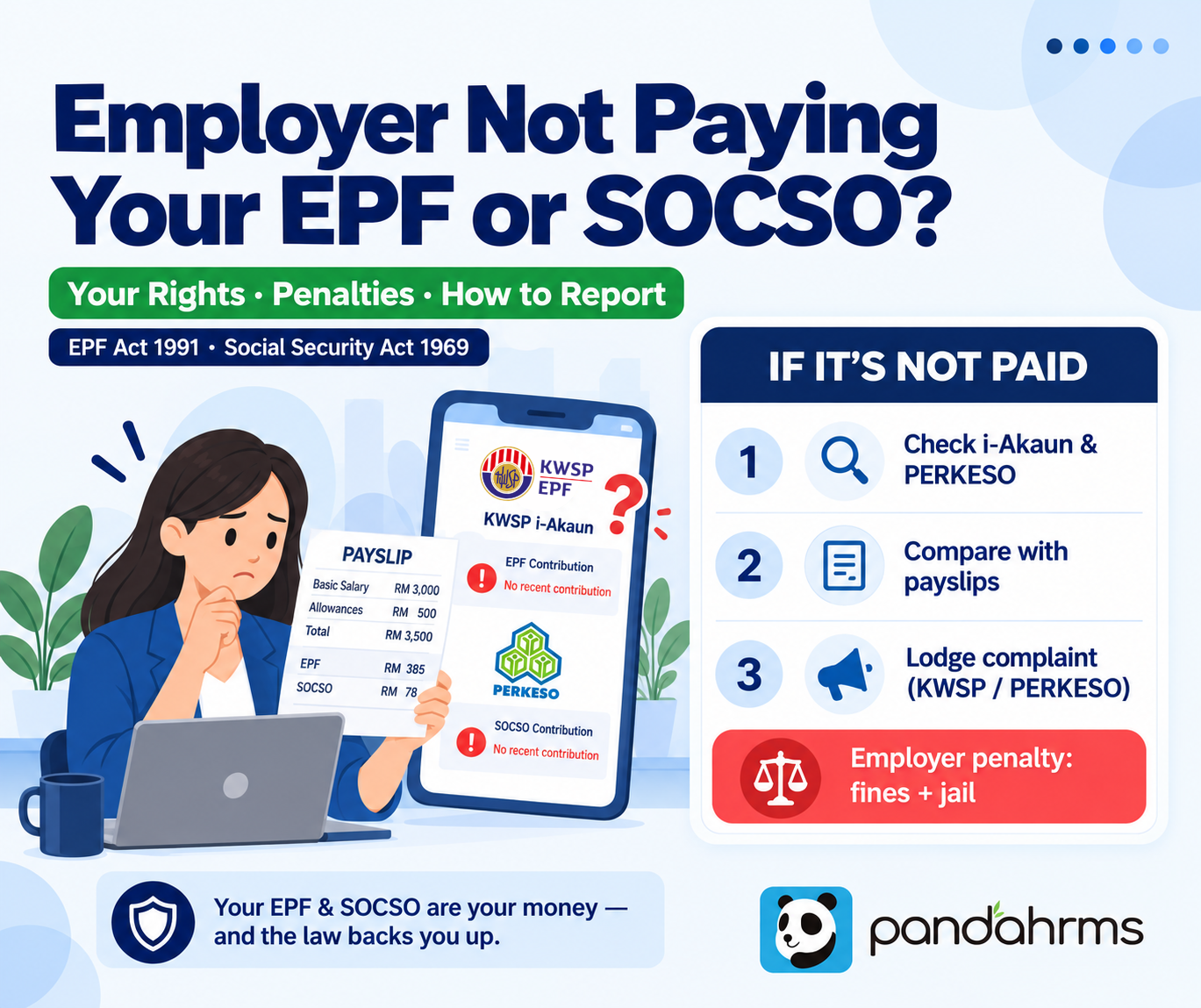
Every month, you see EPF and SOCSO deducted from your payslip and assume the money reaches KWSP and PERKESO. But what if it doesn’t? Some employees only discover — often years later — that their employer deducted the contributions but never actually paid them in. Here’s how to check, what your rights are, the penalties employers face, and exactly how to lodge a complaint.
First: Check Whether It’s Actually Being Paid
Before assuming the worst, verify. A deduction on your payslip is not proof the money was remitted.
- EPF: Log in to your KWSP i-Akaun (app or web) and check your monthly contribution records.
- SOCSO: Check your contribution history via the PERKESO Prihatin app or portal.
- Compare the contributions shown against your payslips, month by month.
If the payslip shows a deduction but the contribution isn’t recorded, that’s a red flag worth acting on.
Is the Employer Legally Required to Pay?
Yes — unambiguously. Employers are legally required to register eligible employees and pay contributions on time:
- EPF — under the Employees Provident Fund Act 1991
- SOCSO & EIS — under the Employees’ Social Security Act 1969 and the Employment Insurance System Act 2017
Contributions must be paid by the 15th of the following month. Deducting an employee’s share and failing to remit it is a serious offence.
The Penalties Employers Face
| Scheme | Penalty for non-payment |
|---|---|
| EPF | Imprisonment up to 3 years or a fine up to RM10,000 (or both), plus late payment charges and dividend arrears. Company directors can be held personally liable. |
| SOCSO / EIS | Fine up to RM10,000 or imprisonment up to 2 years (or both), plus interest on late contributions (around 6% per annum). |
Important for employees: Even where an employer failed to contribute to SOCSO, you may still be entitled to benefits — PERKESO can recover the arrears from the employer. Reporting the issue protects you.
How to Lodge a Complaint
For EPF
You can report a defaulting employer to KWSP using the Employee’s Complaint Against a Defaulting Employer form (Form KWSP 1879), available via KWSP. Have your name, IC number, and EPF membership number ready. KWSP can investigate, assess the unpaid contributions, and take recovery or legal action.
For SOCSO / EIS
Report missing or incorrect contributions directly to PERKESO. Its enforcement division investigates complaints and recovers overdue or underpaid contributions from the employer.
Keep copies of your payslips and your i-Akaun / PERKESO records — they’re your evidence.
What Employers Should Take From This
For employers, the lesson is simple: this is not an area to fall behind on. Deducting employees’ EPF/SOCSO and not remitting it — or paying late — exposes the business (and its directors) to fines, imprisonment, arrears, and reputational damage. Pay every contribution in full, by the 15th of the following month, and keep clean records. For the deadlines, see our Malaysia payroll deadlines & penalties guide.
Where Pandahrms Helps
Missed or late statutory payments almost always trace back to messy, manual payroll. With Pandahrms, EPF, SOCSO, and EIS are calculated correctly each month, contribution files are generated ready for submission, and every payment is recorded with a clear trail — so nothing slips past the deadline and employees can trust that what’s deducted is actually paid. Compliance becomes routine, not a risk.
Pay it right and on time, every month, and this problem never starts.
Final Thoughts
Your EPF and SOCSO are your money and your protection — and the law backs you up. If you suspect your employer isn’t paying, check your i-Akaun and PERKESO records, gather your payslips, and lodge a complaint with KWSP or PERKESO. And for employers: pay on time, keep records, and you stay well clear of the penalties. When a situation is genuinely unclear, confirm directly with KWSP or PERKESO.
Frequently Asked Questions (FAQs)
- How do I check if my employer is paying my EPF and SOCSO?
Log in to your KWSP i-Akaun (app or web) to check EPF contributions, and use the PERKESO Prihatin app/portal for SOCSO. Compare the records against your payslips month by month. - What can I do if my company isn’t paying my EPF or SOCSO?
For EPF, lodge a complaint with KWSP using the Employee’s Complaint Against a Defaulting Employer form (KWSP 1879). For SOCSO, report it to PERKESO’s enforcement division. Keep your payslips as evidence. - What penalties does an employer face for not paying EPF?
Under the EPF Act 1991, an employer can face imprisonment of up to 3 years or a fine of up to RM10,000 (or both), plus late payment charges and dividend arrears. Directors may be personally liable. - What penalties apply for not paying SOCSO?
Under the Employees’ Social Security Act 1969, penalties include a fine of up to RM10,000 or imprisonment of up to 2 years (or both), plus interest on late contributions. - Can I still claim SOCSO benefits if my employer didn’t contribute?
Possibly yes. Even where an employer failed to contribute, you may still be entitled to benefits, and PERKESO can recover the arrears from the employer — which is another reason to report it.
Sources
- KWSP (EPF) — Compliance & Enforcement: kwsp.gov.my
- Employees Provident Fund Act 1991, Malaysia
- PERKESO (SOCSO) — perkeso.gov.my; Employees’ Social Security Act 1969 & Employment Insurance System Act 2017



