
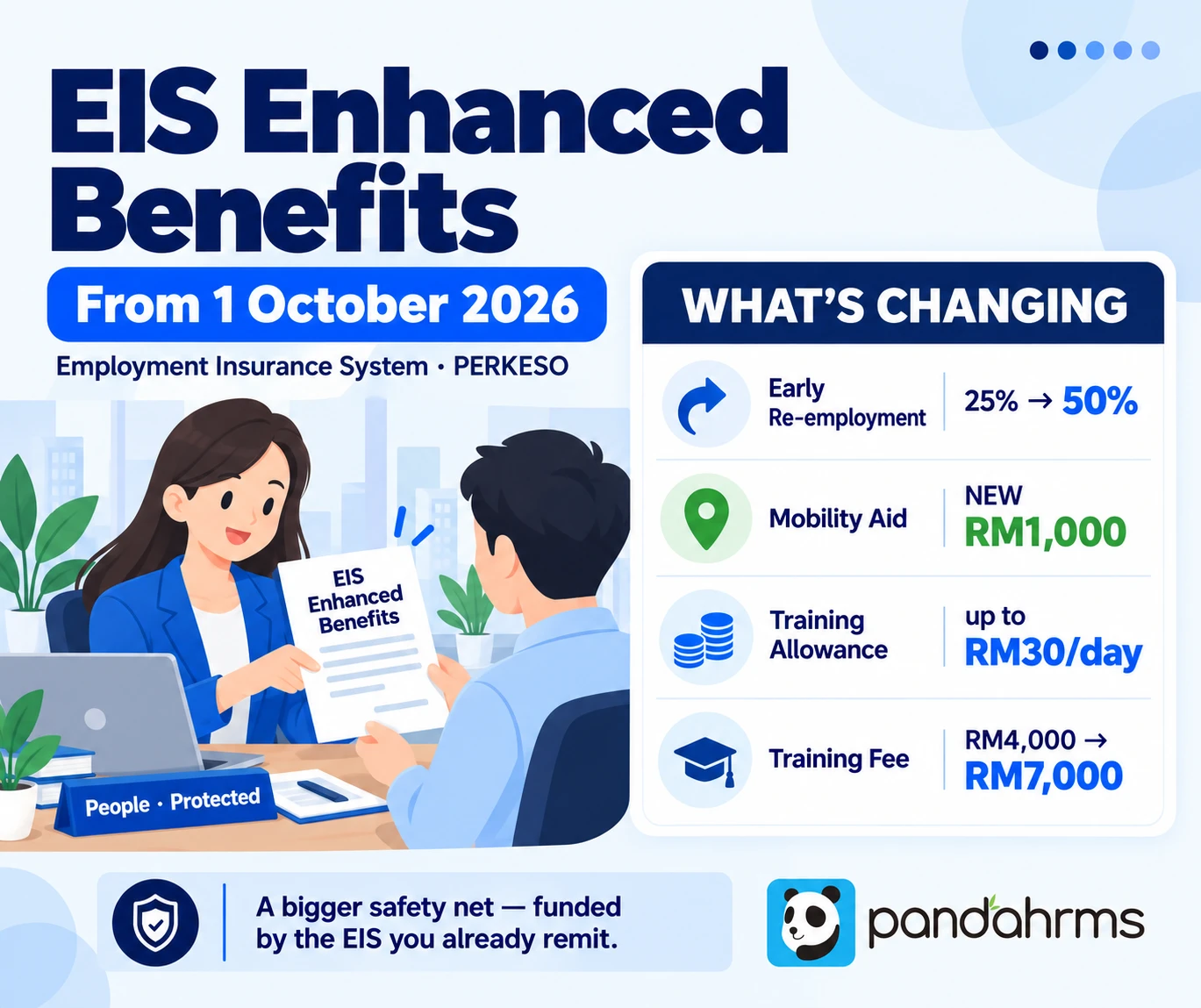
From 1 October 2026, Malaysia’s Employment Insurance System (EIS) is getting its biggest upgrade in years. Under amendments to the Employment Insurance System Act 2017, retrenched workers will receive stronger support to bounce back — a bigger early re-employment incentive, a brand-new relocation allowance, and more generous training help. For employers, EIS is a statutory contribution you already deduct and remit every payroll — so it’s worth knowing exactly what’s changing and what to tell your team. Here’s the employer’s rundown.
What’s Changing Under EIS From 1 October 2026?
The Human Resources Minister confirmed the enhancements take effect on 1 October 2026. Four EIS benefits are being improved:
| EIS Benefit | Until 30 Sept 2026 | From 1 Oct 2026 |
|---|---|---|
| Early Re-employment Allowance | 25% of remaining JSA | 50% of remaining JSA |
| Mobility Assistance Allowance | No equivalent benefit | RM1,000 one-off |
| Training Allowance | RM10–RM20 per day | RM30 per day |
| Maximum Training Fee | RM4,000 | RM7,000 |
Altogether, the government says an eligible contributor could receive up to RM25,000 in total support — but that is a combined ceiling across several benefits, not a guaranteed cash payout (more on that below).
The Four Enhancements, Explained
1. Early Re-employment Allowance — now 50% (was 25%)
The Early Re-employment Allowance (ERA) rewards Job Search Allowance recipients who return to work before using up their entitlement. Doubling the rate to 50% of the remaining JSA gives a much stronger incentive to get back into a job quickly. The actual amount still depends on the worker’s assumed monthly wage and how much JSA is left.
2. New RM1,000 Mobility Assistance Allowance
This is a completely new benefit: a one-off RM1,000 for eligible contributors who take up a new job more than 100 km from their residence. It’s designed to ease the cost of relocating and to help match workers with vacancies in other areas — useful for employers who hire beyond their immediate locality.
3. Training Allowance — now RM30 per day
The daily allowance for attending approved training rises to RM30 (from RM10–RM20). Over a 30-day programme that’s about RM900. Note this allowance is separate from the cost of the training course itself.
4. Maximum Training Fee — now RM7,000
EIS covers the cost of approved vocational or skills training for eligible JSA recipients. That ceiling nearly doubles — from RM4,000 to RM7,000 — giving retrenched workers more room to reskill into a new field.
What the “Up to RM25,000” Really Means
The RM25,000 headline is not a lump sum handed to every unemployed worker. It’s the combined value of everything a contributor might qualify for — Job Search Allowance, the early re-employment incentive, training support and mobility assistance — and it depends on contribution history, assumed wage and JSA entitlement. If your staff ask about it, set expectations accordingly.
Does the Job Search Allowance Change?
No. The core Job Search Allowance (JSA) — paid to insured workers who lose their sole source of income — keeps its existing rate structure for three to six months, depending on the Contributions Qualifying Conditions:
| Month | JSA Rate (of assumed monthly wage) |
|---|---|
| 1st month | 80% |
| 2nd month | 50% |
| 3rd & 4th month | 40% |
| 5th & 6th month | 30% |
In short, the October 2026 changes enhance the re-employment, mobility and training support around JSA — they don’t replace the JSA payments themselves.
What This Means for Employers
- It’s funded by contributions you already remit. EIS is a small monthly contribution (0.2% employer + 0.2% employee, subject to the wage ceiling) deducted through payroll. These enhanced benefits are only available to staff whose EIS has been correctly and consistently contributed — accurate, on-time remittance is what protects your people.
- Expect questions. Employees may ask what the “RM25,000” headlines mean for them. You now have the accurate answer.
- A healthier hiring pool. Mobility and re-employment support help displaced workers return to work faster — and can widen the pool of candidates willing to relocate for your vacancies.
- Getting it wrong has a cost. Late or under-contributed EIS can leave employees short on protection exactly when they need it — and expose your company to PERKESO penalties. See our guide on which wages are subject to SOCSO & EIS.
Where Pandahrms Helps
EIS only works for your employees if the contribution is calculated correctly and paid on time, every single cycle. With Pandahrms, each employee’s EIS — along with SOCSO, EPF and PCB — is computed automatically from the correct wage definition, deducted in payroll, and rolled up into the contribution figures you remit to PERKESO. No manual rate tables, no missed cut-offs. When statutory rates or rules change, the system keeps the calculation current — so your team stays protected and your business stays compliant. For the full picture, read our practical employer guide to EIS.
Final Thoughts
The 1 October 2026 EIS enhancements are genuinely good news for Malaysian workers — and a timely reminder for employers that the statutory contributions you process every month are what make that safety net real. Know what’s changing, be ready to explain it to your team, and make sure your EIS contributions are always accurate and on time.
Frequently Asked Questions (FAQs)
- When do the new EIS benefits take effect?
From 1 October 2026, under amendments to the Employment Insurance System Act 2017. - What are the main EIS changes?
The Early Re-employment Allowance rises to 50% of remaining JSA (from 25%), a new RM1,000 one-off Mobility Assistance Allowance is introduced, the Training Allowance increases to RM30 per day, and the maximum Training Fee rises to RM7,000 (from RM4,000). - Does every unemployed worker receive RM25,000?
No. RM25,000 is the maximum combined support across several benefits, depending on eligibility, contribution history and JSA entitlement — not a guaranteed cash payment. - Does the Job Search Allowance rate change?
No. JSA keeps its existing structure (80%, 50%, 40%, 40%, 30%, 30% over up to six months). The October 2026 changes enhance the re-employment, mobility and training support around it. - What do employers need to do?
There’s nothing new to register, but you must ensure EIS contributions are calculated correctly and remitted on time so employees remain protected. Payroll software like Pandahrms handles this automatically.



