
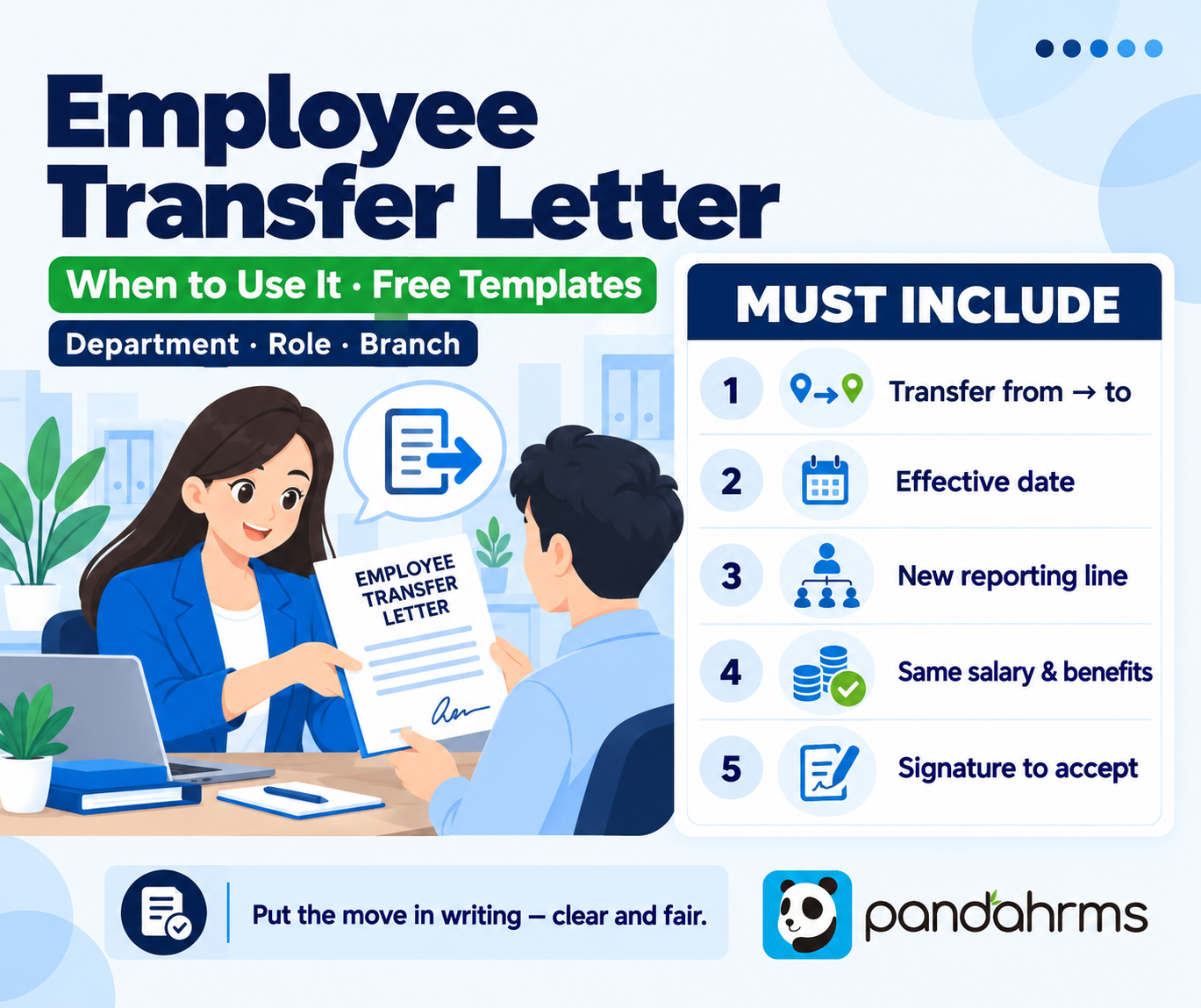
Moving an employee to another department, promoting them into a new role, or shifting them to a different branch is a normal part of running a business. But a transfer should never be a verbal “you’re moving next week.” A proper employee transfer letter puts the change in writing — protecting both sides and keeping your records clean. Here’s when you need one, what it must say, the legal points to watch in Malaysia, and free templates you can adapt.
What Is an Employee Transfer Letter?
An employee transfer letter is a formal written notice that an employee is being moved — to a new department, position, branch, or work location — while remaining employed by the same company (or, in a group, an associated company). It confirms what is changing, what stays the same, and when the transfer takes effect.
When Do You Need a Transfer Letter?
Issue one whenever an employee’s role or place of work changes materially, such as:
- Department transfer — moving from one team or function to another.
- Role or designation change — a lateral move, or a promotion into a new position.
- Branch or location transfer — relocating to a different office, outlet, or site.
- Inter-company transfer — moving to an associated company within the same group.
Can an Employer Transfer an Employee in Malaysia?
Generally yes — but the right isn’t unlimited. It usually flows from a transfer or mobility clause in the employment contract. Even with such a clause, the transfer must be exercised properly:
- In good faith (bona fide) — a genuine business need, not a disguised way to punish, victimise, or force someone out.
- No fundamental change to terms — a lateral transfer should keep the same (or comparable) salary, benefits, and grade. A transfer that cuts pay, demotes, or drastically worsens conditions can amount to constructive dismissal.
- Reasonable — for a location move, give reasonable notice and consider the hardship and relocation cost to the employee.
Handled fairly and documented well, a transfer is straightforward. Handled carelessly, it can end up at the Industrial Court.
What a Transfer Letter Must Contain
- Employee details & date — name, current position, and the date of the letter.
- The nature of the transfer — from which department/role/location, to which.
- Effective date — when the transfer takes effect.
- New reporting line — the new manager or supervisor, if it changes.
- Terms that stay the same — confirmation that salary, benefits, and service are unchanged (for a lateral transfer).
- Any new terms — a new allowance, revised job scope, or relocation support, if applicable.
- Acknowledgement — a space for the employee to sign acceptance.
Free Template — Internal Transfer (Department / Role)
| [Company Letterhead]
Date: [DD/MM/YYYY] | To: [Employee Name], [Current Position] RE: LETTER OF TRANSFER Dear [Employee Name], We are pleased to inform you that, effective [effective date], you will be transferred from [current department/role] to [new department/role]. In your new role you will report to [new manager/designation]. Your salary, benefits, and terms of employment remain unchanged, and your period of continuous service will carry over. [Include any new job scope, allowance, or arrangement here, if applicable.] We are confident this move will benefit both your career development and the company. Please sign below to acknowledge your acceptance of this transfer. Yours sincerely, ______________________ Acknowledged & accepted by: ______________ (Employee) Date: __________ |
Free Template — Branch / Location Transfer
| [Company Letterhead]
Date: [DD/MM/YYYY] | To: [Employee Name], [Position] RE: TRANSFER OF WORK LOCATION Dear [Employee Name], Pursuant to the terms of your employment, you will be transferred from our [current branch/location] to our [new branch/location] with effect from [effective date]. Your position, salary, and benefits remain unchanged. [Where applicable: To support your relocation, the company will provide [state relocation allowance / transport / notice arrangement].]Please acknowledge your acceptance of this transfer by signing below. Should you have any concerns, please speak to the HR department before the effective date. Yours sincerely, ______________________ Acknowledged & accepted by: ______________ (Employee) Date: __________ |
Do’s and Don’ts
- Do give reasonable notice — especially for a location transfer that affects commuting or requires relocation.
- Do keep the salary, grade, and benefits intact for a lateral move.
- Do explain the business reason where you can — it builds goodwill and reduces disputes.
- Don’t use a transfer as a backdoor to demote, punish, or push someone to resign.
- Don’t spring a major relocation with no notice or support.
- Don’t forget to get a signed acknowledgement and file it in the employee’s record.
Where Pandahrms Helps
A transfer isn’t just a letter — it’s a change that has to flow through your whole HR system. With Pandahrms, updating an employee’s department, designation, branch, or reporting line takes a moment, and the change is captured in their record with a clear effective date. The transfer letter and the employee’s signed acknowledgement sit in the same profile, so you always have a documented history of who moved, when, and why. Org charts, approval routing, and payroll cost centres update with the move — no scattered spreadsheets, no lost paperwork.
Final Thoughts
An employee transfer letter turns a big change into a clear, documented, and fair process. Confirm what’s changing and what’s staying the same, exercise any transfer clause in good faith, give reasonable notice, and always keep a signed copy. Do that, and transfers strengthen your business instead of creating disputes.
Frequently Asked Questions (FAQs)
- Can an employer transfer an employee without their consent?
Often yes, if the employment contract contains a transfer or mobility clause — but the right must be exercised in good faith and must not fundamentally change the employee’s terms (such as cutting pay or demoting them), which could amount to constructive dismissal. - What should an employee transfer letter include?
The employee’s details and date, the nature of the transfer (from/to), the effective date, the new reporting line, confirmation that salary and benefits are unchanged, any new terms, and a space to acknowledge acceptance. - Is a transfer the same as a promotion?
Not necessarily. A transfer moves an employee to a new department, role, or location. It may be lateral (same grade and pay) or come with a promotion — the letter should make clear which it is. - Can an employee refuse a transfer?
An employee may object, especially if the transfer is unreasonable or changes their terms significantly. If the transfer is a valid, good-faith exercise of a contractual clause with no adverse change to terms, an unjustified refusal may be treated as a disciplinary matter — but each case turns on its facts. - Does a transfer affect the employee’s length of service?
No. For an internal transfer (and typically an intra-group transfer), continuous service carries over, along with existing benefits and entitlements, unless the letter expressly states otherwise.



