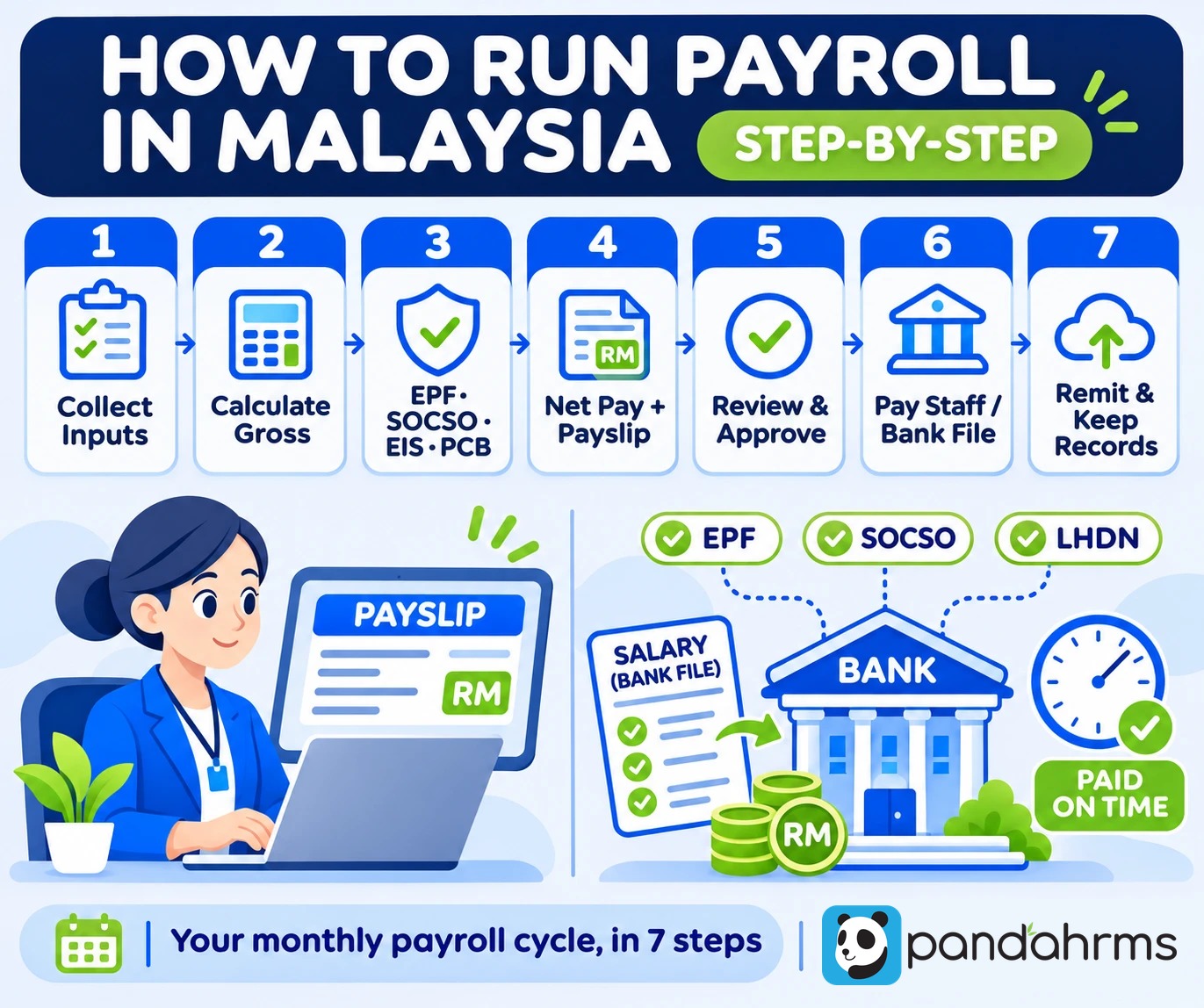
Paying your staff is not just clicking “transfer” in online banking. In Malaysia, every payroll run is a repeatable cycle of steps that each have to be right — the correct gross, the correct EPF, SOCSO, EIS and PCB, paid on time, and reported to the right agency before the deadline. Miss one and you are looking at penalties, unhappy staff, or both.
This guide walks through the full process the way most Malaysian employers actually run it: what you set up once before your first payroll, then the seven steps you repeat every month.
Before your first payroll run: register as an employer
These are one-time registrations, not monthly tasks. You cannot legally run payroll until they are done:
- SSM — your business must be registered with the Companies Commission of Malaysia.
- LHDN (Inland Revenue) — register as an employer to get an employer tax file number (E number) for PCB/MTD.
- EPF (KWSP) — register as an employer and enrol each employee.
- PERKESO — one registration covers both SOCSO and EIS.
Once these are in place, you repeat the cycle below for every wage period.
Step 1: Set the pay period and collect your inputs
Decide your wage period (most Malaysian SMEs run monthly) and your cut-off date — the date up to which you count attendance for that month. Then gather everything that affects pay:
- Attendance and any unpaid days
- Overtime hours
- Paid and unpaid leave taken
- Claims, allowances and deductions for the month
- New joiners, resignations and any salary changes
Clean inputs are everything. Most payroll errors are not calculation mistakes — they are a missing OT claim or a leave day that was never recorded.
Step 2: Calculate gross pay
Gross pay is the total earnings before any deduction. For a typical employee that is:
Basic salary + overtime + allowances + any bonus or commission for the month.
Two things catch employers out here. First, overtime and incomplete-month pay use a daily rate — the ORP (ordinary rate of pay) or the ÷26 method under the Employment Act, depending on the situation. Second, not every allowance is treated the same way for EPF, SOCSO and PCB, so you need to know which parts of gross are “wages” for each statutory deduction.
Step 3: Apply the statutory deductions (EPF, SOCSO, EIS, PCB)
This is where Malaysia-specific rules bite. Four mandatory items come off (and the employer also contributes its own share on top):
| Contribution | Employee share | Employer share |
|---|---|---|
| EPF (KWSP) | 11% | 13% (wages ≤ RM5,000) / 12% (wages > RM5,000) |
| SOCSO | 0.5% | 1.75% |
| EIS | 0.2% | 0.2% |
| PCB / MTD | Per LHDN schedule | — |
A few points to keep straight:
- SOCSO and EIS are contributed on wages up to a ceiling of RM6,000 a month.
- PCB depends on the employee’s income, marital status, number of children and any reliefs declared on their TP1 form — so two people on the same salary can have different PCB.
- Foreign workers follow different rules — EPF is now mandatory for them too (2% from the employer and 2% from the employee since 1 October 2025), SOCSO applies, and non-residents are taxed at a flat 30% PCB rate.
Step 4: Calculate net pay and generate payslips
Net pay — what actually lands in the employee’s account — is simply:
Gross pay − statutory deductions − any other lawful deductions.
Be careful with “other deductions”: under Section 24 of the Employment Act, an employer can only deduct from wages in specific allowed situations. When in doubt, don’t deduct. Every employee must then get an itemised payslip showing earnings, each deduction and the net figure.
Step 5: Review and approve before you pay
This is the step manual payroll skips — and the one that saves you. Before any money moves, review the run: compare this month’s totals against last month, check new joiners and leavers are prorated, and confirm the statutory figures look right. Once salaries are paid out, they are very hard to claw back, so the approval checkpoint belongs before payment, not after.
Step 6: Pay your employees
Most employers pay by generating a bank payment file (an IBG/bulk-payment file) and uploading it to their business banking portal, rather than transferring one person at a time. Whatever the method, the law is clear on timing: wages must be paid within seven days after the end of the wage period (Employment Act 1955, Section 19). Late salary is not just bad for morale — it is an offence.
Step 7: Remit to the statutory bodies and keep records
Paying your staff is only half the run. The amounts you withheld, plus the employer’s own contributions, must be sent to each agency:
- EPF → KWSP
- SOCSO and EIS → PERKESO
- PCB → LHDN
For a given month’s wages, these are generally due by the 15th of the following month. Then keep your payroll records — payslips, contribution receipts and the data behind them — so you can produce them on request and reconcile at year-end, when you issue the EA form to employees and file Form E with LHDN.
Doing this in Excel vs a payroll system
All seven steps can be done by hand in a spreadsheet — many small employers start there. The trouble is that Steps 3 and 7 change: EPF rates, the SOCSO/EIS ceiling, PCB tables and the statutory file formats all get updated, and a spreadsheet does not update itself. One wrong formula quietly repeats every month until an audit finds it.
A payroll system runs Steps 2 to 7 for you: it calculates gross, applies the current EPF, SOCSO, EIS and PCB automatically, produces payslips, generates the bank file, and creates the statutory submission files — so your monthly job shrinks to checking inputs and approving the run.
Want to see your own payroll run end-to-end in one place? Book a free Pandahrms demo and we’ll walk your numbers through all seven steps.
Frequently Asked Questions
- Is there a legal deadline to pay salaries in Malaysia?
Yes. Under Section 19 of the Employment Act 1955, wages must be paid within seven days after the last day of the wage period. - Can I run payroll in Excel?
You can, and many small businesses do. The risk is that statutory rates, ceilings and file formats change over time, and a spreadsheet won’t update itself — so errors in the deduction or remittance steps can repeat unnoticed. - What do I need to register before my first payroll?
Your business with SSM, then as an employer with LHDN (for PCB), EPF (KWSP) and PERKESO (which covers both SOCSO and EIS). - When must EPF, SOCSO, EIS and PCB be paid to the agencies?
For a given month’s wages, these are generally due by the 15th of the following month. - Is the payroll process the same for foreign workers?
The cycle is the same, but the statutory treatment differs — EPF is now mandatory for foreign workers (2% from the employer and 2% from the employee since 1 October 2025), SOCSO applies, and non-residents are taxed at a flat 30% PCB rate. Check each item against the current rules.