Every growing Malaysian SME hits the same fork: payroll has outgrown the office spreadsheet, and you have to decide whether to hand it to a bureau or run it in-house on software. Both work. They just trade off different things — cost, control, speed and who carries the compliance risk.
Here’s an honest comparison to help you pick, without the sales spin.
What each option really means
Payroll outsourcing — you send a bureau your headcount, salaries and changes each month, and they process payroll, calculate statutory deductions and hand back the payslips and files. You pay a fee, usually per employee.
In-house payroll software — you keep payroll inside the company but run it on a system that automates the maths: salaries, overtime and automatic EPF, SOCSO, EIS and PCB, with the submission files generated for you.
Side by side
| Factor | Outsourcing (bureau) | In-house software |
|---|---|---|
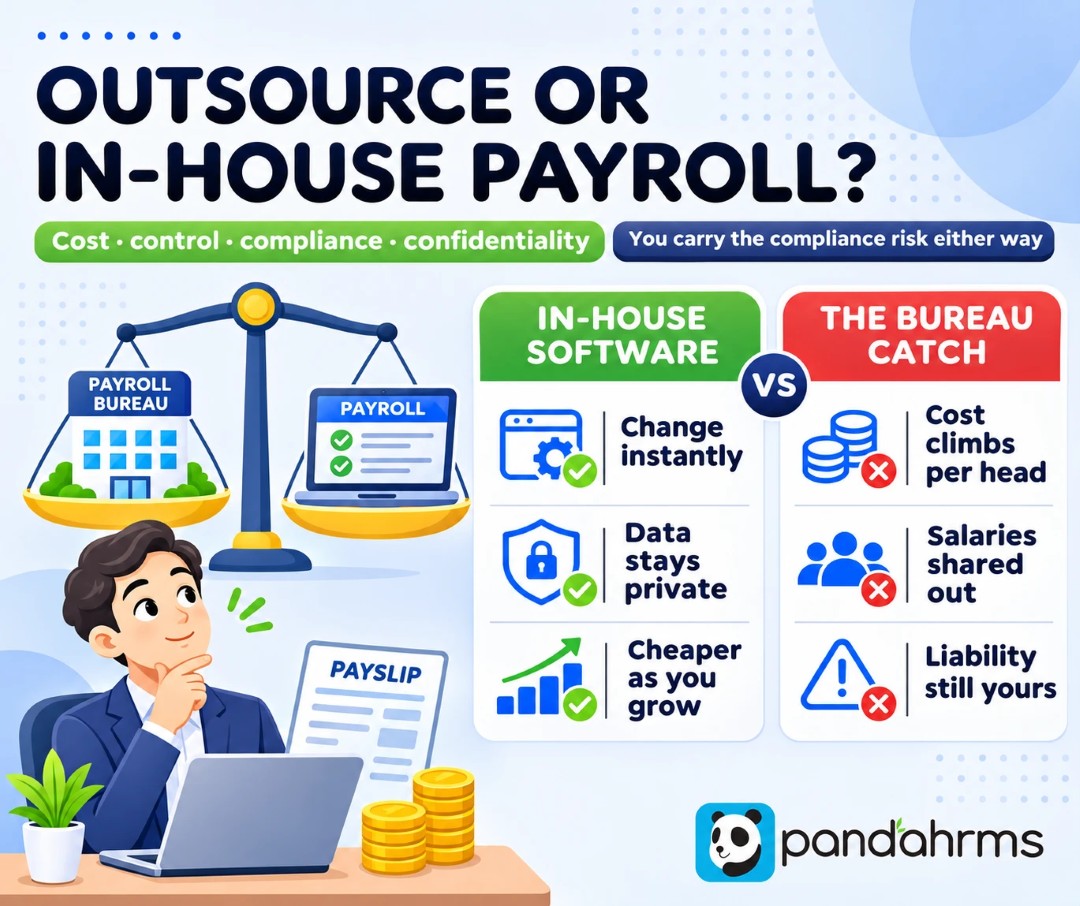
| Cost | Per-head fee; rises with headcount | Subscription; cheaper per head as you grow |
| Control & speed | A last-minute change means emailing the bureau | You edit and re-run instantly |
| In-house effort | Low — the bureau does the work | You still run it (but the system does the maths) |
| Confidentiality | Salaries shared with an outside party | Pay data stays inside the company |
| Scalability | Easy to start; cost climbs with size | Scales well, and adds leave/attendance too |
Cost: it flips with headcount
At a handful of staff, a bureau is often the cheapest and simplest option — no system to learn. But bureau fees are usually per employee, so as you grow, the monthly bill climbs in a straight line. Software subscriptions tend to cost less per head as headcount rises. Somewhere in the 10–30 employee range, in-house software usually becomes the cheaper option — and it does leave, attendance and claims as well, not just payroll.
Compliance: you carry the risk either way
This is the part employers miss. Outsourcing the processing does not outsource the liability. The employer remains legally responsible for paying the correct EPF, SOCSO, EIS and PCB on time. If a bureau makes a mistake or a deadline slips, it is the company — and its directors — who answer for it. Unpaid EPF, for instance, can even lead to directors being barred from leaving Malaysia.
Whether you outsource or run it in-house, keep visibility. You should always be able to see that payroll ran, the statutory amounts were correct, and the submissions were filed — because the responsibility stops with you.
When each one wins
Outsourcing suits you if: you’re very small, have no one to run payroll, and want it fully off your plate — and you’re comfortable sharing salary data with a third party.
In-house software suits you if: you’re growing, want changes done instantly, prefer salaries to stay inside the company, and would like leave, attendance and claims in the same place — not just payroll. Running several sites tips the balance further toward software; see payroll across multiple branches.
The modern middle ground
The old trade-off — outsource for ease, or go in-house for control — has softened. A good payroll system now gives you in-house control with a support team behind it: you run payroll in a few clicks, the statutory maths is automatic, and real people help with set-up, migration and tricky cases. You get the convenience of outsourcing without handing over your salary data or your compliance visibility.
Where Pandahrms fits
Pandahrms keeps payroll in-house and simple: automatic EPF, SOCSO, EIS and PCB, ready-to-upload statutory files, and leave, attendance and claims in one system — backed by a local team that handles migration and training, so you’re not alone with it. Book a free Pandahrms demo to see whether in-house makes sense for your headcount. It also helps to line the decision up against your payroll compliance checklist.
FAQ
- Is it cheaper to outsource payroll or use software?
For a handful of staff, a bureau is often cheapest and easiest. As headcount grows, per-employee bureau fees usually overtake a software subscription — commonly somewhere in the 10–30 employee range — and software also covers leave and attendance. - If I outsource payroll, am I still responsible for compliance?
Yes. Outsourcing the processing does not transfer the legal liability. The employer remains responsible for paying the correct EPF, SOCSO, EIS and PCB on time, so keep visibility of what was filed. - Is payroll data safer in-house or outsourced?
In-house software keeps salary data inside the company; outsourcing means sharing it with a third party. If confidentiality matters, that’s a point for keeping payroll in-house. - Can I switch from a bureau to in-house software later?
Yes. Most SMEs start with a bureau and move in-house as they grow. A good vendor will migrate your historical data and train your team during the switch. - What’s the hybrid option?
In-house software with a vendor support team: you run payroll yourself in a few clicks while real people help with set-up, migration and difficult cases — control and convenience together.