Overtime pay is one of the most common payroll components in Malaysia — and also one of the most frequently miscalculated.
For employers, mistakes in overtime calculations do not just affect payroll accuracy. They directly impact:
- Legal compliance under the Employment Act
- Employee trust and satisfaction
- Risk of disputes, complaints, or audits
Understanding how overtime pay works in Malaysia is essential for HR teams, payroll administrators, and business owners managing employees with varying work schedules.
This guide explains clearly:
- What overtime pay is
- When employees are entitled to overtime
- Official overtime rates in Malaysia
- Step-by-step calculation formula
- Common employer mistakes to avoid
What Is Overtime Pay in Malaysia?
Overtime pay refers to additional wages paid to employees who work beyond their normal working hours.
In Malaysia, overtime is regulated under the Employment Act 1955, which sets the rules on:
- Maximum working hours
- Overtime eligibility
- Minimum overtime pay rates
In simple terms, overtime pay is calculated based on:
- Hourly rate
- Overtime rate (multiplier)
- Number of overtime hours worked
When Is an Employee Eligible for Overtime?
Employees are entitled to overtime pay when their working hours exceed the legal limits:
- Maximum 8 hours per day, or
- Maximum 45 hours per week
Any work beyond these limits is considered overtime.
This primarily applies to employees covered under the Employment Act, particularly those within the prescribed salary threshold and job scope.
For employers, accurate tracking of working hours is critical — without it, overtime calculations will be incorrect.
Overtime Rates in Malaysia (By Day Type)
Overtime rates are not fixed — they vary depending on when the overtime is performed.
Normal Working Day
✔ Minimum 1.5x hourly rate
Rest Day
✔ Minimum 2.0x hourly rate
Public Holiday
✔ Minimum 3.0x hourly rate
These rates are statutory minimums. Employers may offer higher rates, but not lower.
How to Calculate Overtime Pay in Malaysia
Overtime calculation follows a standard formula that must be applied consistently.
Step 1: Calculate Hourly Rate
Monthly Salary ÷ 26 days ÷ 8 hours
Step 2: Apply Overtime Rate
- 1.5 (normal day)
- 2.0 (rest day)
- 3.0 (public holiday)
Step 3: Multiply by Overtime Hours
Overtime Pay = Hourly Rate × Overtime Rate × Hours Worked
Example: Overtime Calculation (Normal Working Day)
Employee earns RM2,600/month.
Step 1: Hourly Rate
RM2,600 ÷ 26 ÷ 8 = RM12.50
Step 2: Overtime Rate
Normal day = 1.5
Step 3: Overtime Pay (2 hours)
RM12.50 × 1.5 × 2 = RM37.50
Example: Public Holiday Overtime
Same employee works 2 hours on a public holiday.
RM12.50 × 3.0 × 2 = RM75.00
This shows how significantly overtime pay increases depending on the day type.
Common Overtime Calculation Mistakes Employers Make
Even with a simple formula, errors are common — especially in manual payroll processing.
1. Using Incorrect Overtime Rate
Failing to apply 1.5x / 2.0x / 3.0x correctly
2. Wrong Hourly Rate Calculation
Incorrect salary breakdown or divisor
3. Misclassifying Work Days
Treating rest day or public holiday as normal day
4. Poor Attendance Tracking
Inaccurate clock-in/out records
5. Manual Payroll Errors
Spreadsheet miscalculations or missed entries
Correct vs Incorrect Overtime Calculation
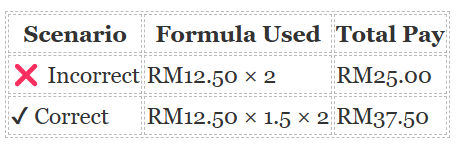
Even small mistakes, when repeated monthly, can lead to:
- Underpayment risks
- Payroll discrepancies
- Employee disputes
Legal Requirements Under Malaysian Law
Under the Employment Act 1955, employers must:
- Pay overtime at statutory minimum rates
- Ensure working hours do not exceed legal limits
- Maintain accurate payroll and attendance records
Additionally:
- Overtime should not exceed 104 hours per month
- Failure to comply may result in penalties or enforcement action
Why Accurate Overtime Calculation Matters
Overtime is not just a payroll item — it is a compliance responsibility.
1. Compliance
Ensures adherence to Malaysian labour law
2. Employee Trust
Employees expect fair and transparent pay
3. Payroll Accuracy
Reduces costly corrections and disputes
4. Operational Efficiency
Improves HR and payroll workflow consistency
HR Best Practices for Managing Overtime
To reduce errors and compliance risks, employers should:
- Track working hours in real time
- Standardise overtime approval processes
- Separate normal hours vs overtime clearly
- Review payroll calculations before submission
- Conduct periodic payroll audits
Consistency is more important than complexity in overtime compliance.
How Pandahrms Helps Employers Manage Overtime Accurately
Pandahrms HR System helps organisations simplify and automate overtime management by ensuring every extra working hour is accurately captured, calculated, and reflected in payroll according to Malaysian labour regulations.
With Pandahrms HR System, employers can:
- Automatically track overtime from real clock-in and clock-out data
- Apply correct overtime rates (1.5x, 2.0x, 3.0x) based on workday type
- Eliminate manual payroll calculation errors
- Integrate overtime directly into payroll processing
- Ensure compliance with Employment Act 1955
This is especially critical for:
- SMEs scaling workforce operations
- Companies with shift-based employees
- Businesses managing high overtime volume or complex schedules
Book a Pandahrms demo today to automate your overtime calculation, reduce HR workload, and improve payroll accuracy instantly.
Frequently Asked Questions (FAQ)
1. What is the maximum overtime allowed in Malaysia?
Overtime should not exceed 104 hours per month under the Employment Act.
2. How is overtime calculated for shift workers?
Overtime is calculated based on hours worked beyond the employee’s scheduled shift.
3. Do part-time employees receive overtime pay?
Yes, depending on their employment terms and eligibility under labour laws.
4. Is overtime pay taxable in Malaysia?
Yes. Overtime pay is part of employment income and subject to income tax.
5. Can employers refuse to pay overtime?
No. If employees are required to work beyond normal hours and are covered under the law, overtime payment is mandatory.