Every employer in Malaysia should be clear on one thing: annual leave is not a “perk” you hand out at your discretion — it is a paid entitlement protected by the Employment Act 1955. Get the days wrong, mishandle carry-forward, or fail to pay out a leaver’s balance, and it becomes a compliance problem. This guide explains annual leave entitlement under Section 60E, how to calculate it pro-rata for new staff, the rules on carry forward, and how to handle unused leave — all in one place.
What Is Annual Leave? Is It the Same as “Earned Leave”?
Annual leave is paid time off that an employee earns based on their length of service with the same employer. You may also hear it called “earned leave” (EL) — a term common in some countries and HR systems. In Malaysia there is no separate statutory leave called “earned leave”; what people mean by EL is simply annual leave, because it is “earned” progressively the longer an employee stays. So when a handbook or employee says “EL,” the Malaysian reference point is annual leave under the Employment Act 1955.
Annual Leave Entitlement Under the Employment Act 1955 (Section 60E)
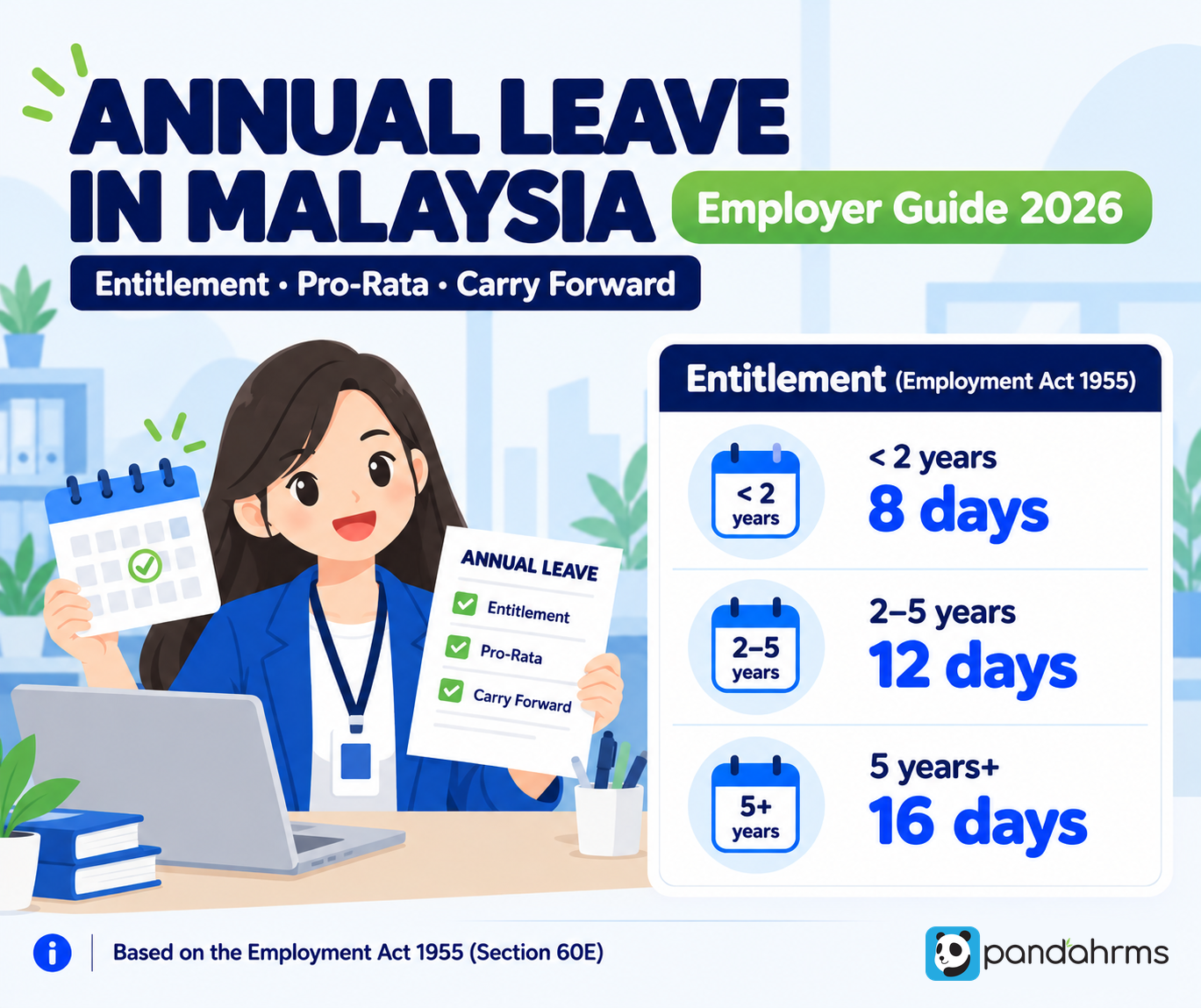
Under Section 60E of the Employment Act 1955, the minimum annual leave entitlement depends on an employee’s length of continuous service with the same employer:
| Length of service | Minimum annual leave (per year) |
|---|---|
| Less than 2 years | 8 days |
| 2 years to less than 5 years | 12 days |
| 5 years or more | 16 days |
These are the minimum figures the law requires. Employers are free to offer more (say 14 or 18 days) as part of the package — but not less than the rates above for employees covered by the Act. For the full picture of every leave type (sick, maternity, emergency and more), see our guide to the types of leave in Malaysia.
How to Calculate Pro-Rated Annual Leave (New or Part-Year Employees)
If an employee has not completed 12 months of service — for example, a new hire who joined mid-year, or someone who leaves before completing a full year — annual leave is calculated pro-rata (based on the number of completed months worked). The basic formula is:
Pro-rated leave = Annual entitlement × (Completed months of service ÷ 12)
Worked example: A new employee entitled to 8 days a year has worked 7 completed months by year-end:
- 8 days × (7 ÷ 12) = 4.67 days
- Under Section 60E(1A), a fraction of a day less than one-half is disregarded, and one-half or more is counted as one full day.
- 0.67 ≥ 0.5 → rounded up to 5 days of annual leave.
When Must Annual Leave Be Taken? Can It Be Forfeited?
Two important points under Section 60E:
- When it must be taken — The employer shall grant, and the employee shall take, annual leave within the 12 months after completing each 12 months of continuous service (Section 60E(2)). It is not meant to be banked indefinitely.
- When it can be forfeited — If an employee is absent from work without permission or a reasonable excuse for more than 10% of the working days during that 12-month period, they may be deemed to have given up their right to that annual leave (Section 60E(3B)).
Carry Forward: Can Unused Leave Roll Over to Next Year?
This is the question employers get asked most. The answer: the Employment Act 1955 does not require employers to allow annual leave to be carried forward. The intent of the law is for leave to be taken within the relevant 12-month period. Whether unused leave can be carried over, forfeited, or paid out is governed by the employment contract or company policy.
Practical tip for employers: put your carry-forward policy in writing and make it clear — how many days may be carried over, the expiry date, and whether any encashment applies. This avoids year-end disputes with staff.
Unused Annual Leave: Encashment and Payment
Where an employee has an unused annual leave balance, there are two situations:
- While still employed — leave encashment (paying out unused leave) is a matter of company policy; it is not a legal requirement unless stated in the contract.
- On resignation or end of service — accrued annual leave (including the pro-rata portion) must be paid out to the employee.
For a step-by-step method of calculating the payment for unused leave, see: Leave Encashment in Malaysia (2026).
Annual Leave During Notice or Resignation
During the notice period, an employee is still entitled to their pro-rata annual leave balance up to their last working day. The employer and employee may agree to offset the leave balance against the notice period, or to pay out the unused balance — depending on agreement and policy. Make sure the last day, completed months, and pro-rata portion are calculated correctly so there are no later claims.
Common Employer Mistakes About Annual Leave
- Using the same rate for everyone, instead of following length of service (8 / 12 / 16 days).
- Forgetting to pro-rate leave for new hires or mid-year leavers.
- Assuming all unused leave automatically lapses without a clear written policy.
- Failing to pay out annual leave balances when an employee’s service ends.
- Confusing annual leave with sick leave — remember, sick leave (Section 60F: 14 / 18 / 22 days) is not pro-rated the way annual leave is.
How Pandahrms Helps Manage Annual Leave
Calculating annual leave by hand — by length of service, pro-rated months, carried-forward balances and final payouts — gets error-prone fast once you have more than a handful of staff. Pandahrms calculates each employee’s annual leave entitlement automatically from their start date, updates balances in real time, applies the carry-forward policy you set, and prepares the records needed for encashment when someone leaves. Employees can apply for leave and check their own balance in the app — fewer queries, fewer miscalculations. For the wider view of every leave type, see our complete guide to types of leave in Malaysia.
Frequently Asked Questions (FAQs)
- How many days of annual leave are mandatory in Malaysia?
Under Section 60E of the Employment Act 1955: 8 days (less than 2 years’ service), 12 days (2 to less than 5 years), and 16 days (5 years or more). These are minimums; employers may give more. - Is “earned leave” the same as annual leave?
Yes. Malaysia has no separate statutory leave called “earned leave” — it refers to annual leave, which is earned according to length of service under the Employment Act 1955. - How do I calculate pro-rated annual leave for a new employee?
Use the formula: annual entitlement × (completed months of service ÷ 12). A fraction of a day less than one-half is disregarded; one-half or more counts as a full day. - Can unused annual leave be carried forward to the next year?
The Employment Act does not require it. Carry forward, forfeiture, or encashment depend on the employment contract or company policy — so set it out clearly in writing. - Must unused annual leave be paid out when an employee resigns?
Yes. Accrued annual leave (including the pro-rata portion) must be paid out to the employee when their service ends.
Source: Employment Act 1955 (Sections 60E and 60F) and guidance from the Department of Labour Peninsular Malaysia (JTKSM). The entitlement figures are statutory minimums; actual terms may vary by employment contract and company policy. This article is general information, not legal advice — confirm your specific situation with the Department of Labour or a legal adviser.