Still Confused About Borang B vs Borang BE?
Every year during tax season in Malaysia, the same question comes up:
- Should I submit Borang B or Borang BE?
- What if I have both salary and side income?
- Does having multiple income sources change my tax form?
Choosing the wrong form is not a small mistake — it can lead to:
- incorrect income declaration
- delays in tax processing
- penalties from Lembaga Hasil Dalam Negeri (LHDN)
This guide breaks down everything you need to know — clearly, practically, and from an HR & employer compliance perspective.
Borang B vs Borang BE (Malaysia)
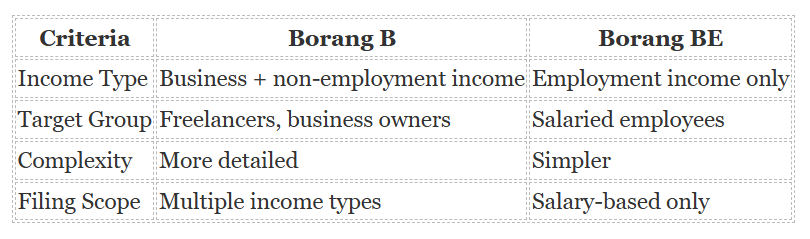
- Borang B → For individuals with business or non-employment income
- Borang BE → For individuals with employment income only (salary earners)
The rule is simple:
Your tax form depends on your income source — NOT your job title.
2026 Tax Filing Deadlines (Malaysia)
For the Year of Assessment 2025 (filed in 2026), the submission deadlines set by Lembaga Hasil Dalam Negeri (LHDN) are as follows:
For Individuals (Employment Income Only – Borang BE / e-BE):
- Manual submission: 30 April 2026
- e-Filing submission: 15 May 2026 (includes typical grace period extension)
For Individuals with Business Income (Borang B):
- Manual submission: 30 June 2026
- e-Filing submission: 15 July 2026 (includes typical grace period extension)
All submissions must be completed via the MyTax portal for e-Filing.
Employers and HR teams should remind employees to file early to avoid last-minute errors, system congestion, or penalties.
What Is Borang B?
Borang B is used by individuals who earn non-employment income, including business or freelance earnings.
Who Should Use Borang B?
You must submit Borang B if you are:
- self-employed
- a freelancer or gig worker
- a business owner (sole proprietor)
- earning both salary AND side income (non-employment)
Examples
- A freelance designer earning RM3,000/month from projects
- A small business owner with additional part-time employment
- A commission-based agent working independently
If you have any income outside employment, Borang B is required.
What Is Borang BE?
Borang BE is designed for individuals who earn employment income only.
Who Should Use Borang BE?
You should submit Borang BE if you are:
- a salaried employee
- earning fixed monthly income
- not running a business
- not receiving freelance or independent income
Examples
- office employees
- retail staff
- corporate professionals
If your income is purely from salary, Borang BE is sufficient.
Key Differences Between Borang B and Borang BE
Important Clarification (Common Misunderstanding)
👉 Multiple income ≠ automatically Borang B
What matters is the type of income:
- Salary + salary (2 employers) → still Borang BE
- Salary + freelance income → Borang B
Real Scenario
An employee earns:
- RM4,000/month salary
- RM800/month from freelance design work
If they submit Borang BE:
- freelance income may not be properly declared
- risk of non-compliance and audit
✔ Correct approach: Submit Borang B
Commission Income: Borang B or BE?
This is where many people get confused.
✔ If commission is:
- part of your employment salary (e.g. sales role) → Borang BE
✔ If commission is:
- earned independently (agent, freelance, side income) → Borang B
👉 The key again: employment vs non-employment income
Why Choosing the Correct Form Matters
Submitting the wrong form can result in:
- incorrect tax declaration
- incomplete income reporting
- audit risk from LHDN
- penalties or fines
This is especially risky when income sources are mixed.

Employer & HR Responsibilities
Although tax filing is the employee’s responsibility, employers play a key compliance role.
What Employers Must Ensure
- Accurate EA Form issuance
- Complete payroll data
- Proper reporting of:
- salary
- allowances
- benefits-in-kind
- Consistent payroll records
Common HR Risks
- Employees choosing the wrong tax form
- Missing income components
- Payroll data mismatch with tax submissions
Common Mistakes to Avoid
1. Assuming Salary = Borang BE (Without Checking Side Income)
Employees often overlook freelance or side income.
2. Ignoring Small Side Income
Even small amounts must be declared.
3. Choosing Borang BE Because It’s Simpler
Simpler does not mean correct.
4. Relying on Job Title Instead of Income Source
Always assess based on income type.
How Payroll Systems Help Ensure Compliance
Manual payroll processes increase the risk of:
- missing income components
- inaccurate reporting
- inconsistencies with EA Forms
A structured payroll system helps:
- centralise employee income data
- generate accurate statutory reports
- reduce human error
- improve compliance with Malaysian tax regulations
How Pandahrms Supports Employers
Pandahrms helps organisations:
- manage payroll with accuracy
- ensure all income components are recorded
- generate EA Forms and statutory reports
- reduce tax season confusion for employees
This ensures smoother tax filing and lower compliance risk.
You may also refer to:
- How to Submit Form E in Malaysia (2026 Employer Guide)
- e-Filing 2026 Malaysia: Opening Date, Deadlines & Complete Employer Guide
- What Is PCB in Malaysia? Employer Guide to Monthly Tax Deduction (2026)
FAQs: Borang B vs Borang BE
1. Can I submit Borang BE if I have side income?
No. If you have non-employment income, you must use Borang B.
2. What happens if I submit the wrong form?
You may need to amend your submission and could face penalties.
3. Is commission income considered business income?
Only if it is earned outside employment.
4. Do freelancers always use Borang B?
Yes, because they earn non-employment income.
5. Can HR decide which form employees use?
No. Employees are responsible, but HR can provide guidance.
Conclusion: Understand Your Income, Choose the Right Form
The decision between Borang B and Borang BE comes down to one rule:
Your income source determines your tax form.
Employers and HR teams should:
- ensure accurate payroll reporting
- educate employees on tax obligations
- support compliance through proper systems
Simplify Payroll & Tax Compliance with Pandahrms
Manual payroll processes can lead to:
- reporting errors
- compliance risks
- tax season confusion
Pandahrms helps you:
- maintain accurate payroll records
- generate statutory forms
- support employee tax reporting
- reduce compliance risks
Book a 35-minute demo with Pandahrms to streamline your payroll and compliance processes.