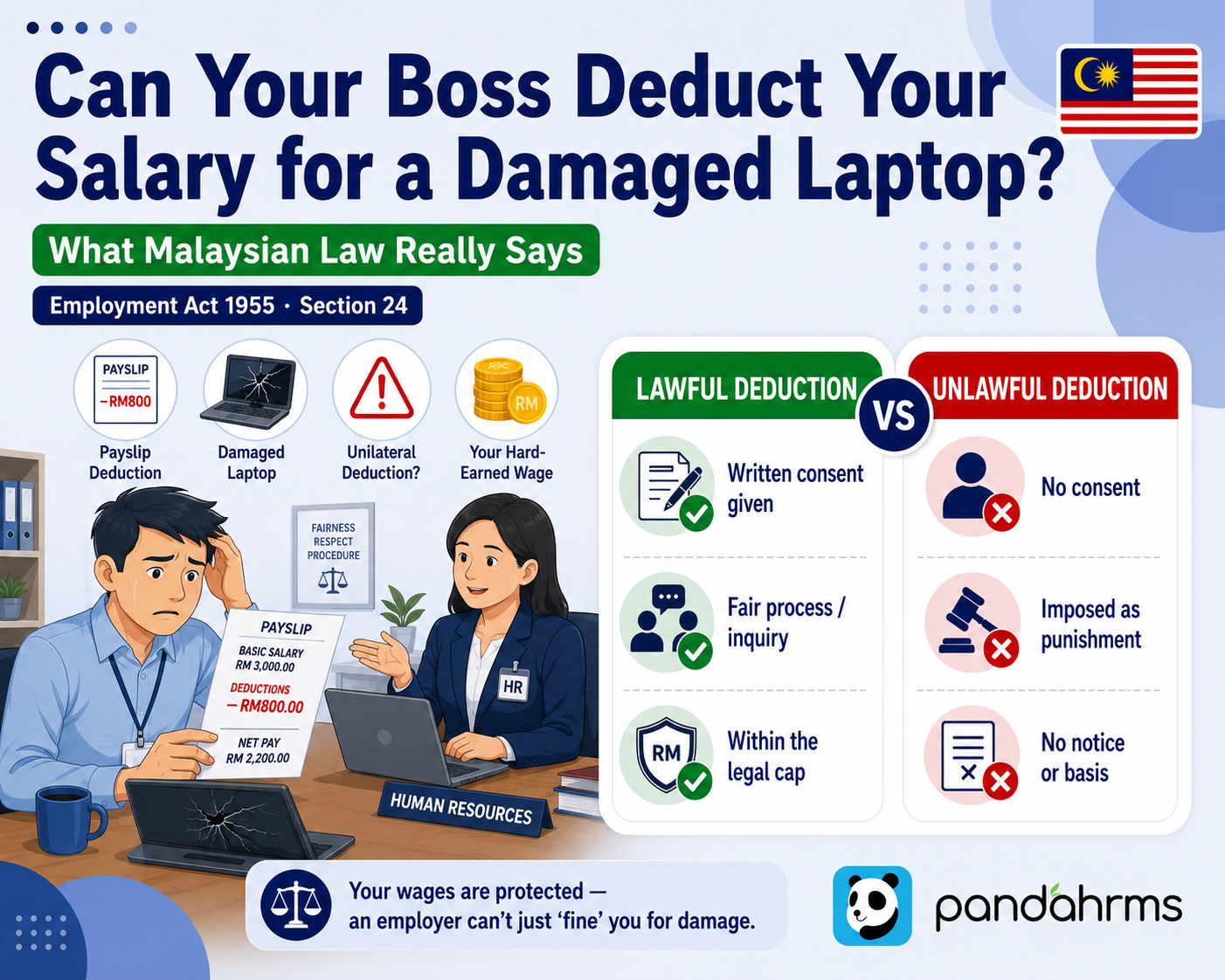
Imagine opening your payslip and finding RM800 simply gone — no heads-up, no explanation. That’s what happened to one Malaysian employee, who was later told by HR the money was deducted as “punishment” for a damaged company laptop. He’d never signed anything agreeing to it. After he pushed back, the full RM800 was returned within a week.
It’s a scenario that raises a question every employer and employee should know the answer to: can your employer legally deduct your salary for damaged or lost company property? Here’s what Malaysian law actually says.
Can an Employer Deduct Your Salary for Damaged or Lost Company Property?
The short answer: generally, no — not automatically, and not as a “punishment.” An employer cannot simply dock your wages for a damaged laptop, a lost phone, or broken equipment on their own say-so. Salary deductions in Malaysia are tightly controlled by Section 24 of the Employment Act 1955, and deducting for damage or loss without meeting its requirements is unlawful.
Key point: Your wages are protected. An employer needs proper legal grounds to deduct from them — a manager deciding to “fine” you for damage does not count.
The Law: Section 24 of the Employment Act 1955
Section 24 sets out a strict rule: no deductions may be made from an employee’s wages except those specifically allowed. The permitted deductions include:
- Deductions authorised by law — such as EPF, SOCSO/EIS, and PCB (income tax).
- Recovery of overpaid wages — where the employer overpaid in error (within the allowed period).
- Recovery of advances — money advanced to the employee.
- Indemnity due to the employer — in specific circumstances set out in the Act.
- Deductions the employee requests in writing, and certain deductions that also require the Director General of Labour’s approval.
Notice what’s not on that list: an automatic right to deduct for damaged or lost property. That kind of deduction only becomes lawful if the proper conditions are met.
When Is a Deduction for Damage Lawful — and When Isn’t It?
| ✅ Potentially lawful | ❌ Unlawful |
|---|---|
| Employee gives genuine written consent to the deduction | Deducted without consent or authorisation |
| Proper process / inquiry establishes responsibility | Imposed as a “fine” or punishment with no process |
| Where required, the DG of Labour’s approval is obtained | Amount is arbitrary or exceeds the actual loss |
| Total monthly deductions stay within the legal cap | Deduction pushes total beyond the allowed limit |
There’s also a ceiling: under Section 24, the total of deductions in any one month generally must not exceed 50% of the employee’s wages (with limited exceptions, such as on termination). So even a permitted deduction can’t wipe out someone’s pay.
The RM800 Laptop Case: What Went Wrong
The viral case is a textbook example of an unlawful deduction. Three things were missing:
- No written consent — the employee never signed anything authorising a deduction for damaged property.
- No proper process — it was applied as a “punishment,” not through a fair inquiry establishing what happened and who was responsible.
- No notice — the money simply disappeared from his payslip.
That’s why, once challenged, the company quickly refunded the full amount — they were on the wrong side of Section 24. It’s also a reminder that employees have every right to question a deduction they didn’t agree to.
What Employees Should Do
- Ask for it in writing. Request a clear explanation of any deduction and the legal basis for it.
- Check what you signed. Did you genuinely authorise deductions for damage or loss? A vague clause isn’t a blank cheque.
- Don’t accept it out of fear. Questioning an unlawful deduction is your right, not misconduct.
- Escalate if needed. You can raise an unlawful deduction with the Department of Labour (JTK).
What Employers Should Do
- Never deduct unilaterally. Don’t dock wages for damage or loss as an on-the-spot penalty.
- Get proper authorisation. Where a deduction is contemplated, obtain the employee’s written consent and, where required, the DG of Labour’s approval.
- Run a fair inquiry. Establish the facts and responsibility before considering any recovery.
- Document everything and stay within the monthly deduction limit.
For related situations, see our guides on whether your boss can deduct salary for being late and whether an employer can cut your salary.
Where Pandahrms Helps
Most deduction disputes come down to one thing: was it authorised, and can you prove it? With Pandahrms, every payslip line is transparent, authorised deductions are recorded with the employee’s consent on file, and nothing comes out of wages without a clear, documented basis. So your payroll stays compliant with Section 24, employees can see exactly what they’re paid and why, and “where did my RM800 go?” never becomes a dispute.
Keep deductions transparent and on record, and you protect both the business and your people.
Final Thoughts
An employer can’t treat your salary as a fund to cover damaged equipment. Deductions in Malaysia are strictly limited by Section 24 of the Employment Act 1955 — they need a proper legal basis, usually the employee’s genuine consent, a fair process, and they must stay within the monthly cap. The RM800 laptop case shows what happens when those rules are ignored: the deduction was unlawful, and the money had to be returned. Handle deductions properly, and payslips stay clear — no surprises, no disputes.
Frequently Asked Questions (FAQs)
- Can my employer deduct my salary for a damaged or lost company laptop?
Not automatically. Under Section 24 of the Employment Act 1955, an employer cannot deduct wages for damaged or lost property as a punishment. Such a deduction is only lawful with proper grounds — typically the employee’s genuine written consent, a fair process, and (where required) the Director General of Labour’s approval. - What deductions are actually allowed under Section 24?
Deductions authorised by law (EPF, SOCSO/EIS, PCB), recovery of overpaid wages or advances, indemnity due to the employer in specific circumstances, and certain deductions the employee requests in writing — some of which also need the DG of Labour’s approval. - Is there a limit on how much can be deducted?
Yes. Under Section 24, total deductions in any one month generally must not exceed 50% of the employee’s wages, with limited exceptions such as on termination. - What can I do if my salary was deducted without my agreement?
Ask for the deduction and its legal basis in writing, check whether you actually authorised it, and if it’s unlawful, raise it with your employer — and, if unresolved, with the Department of Labour (JTK). As one viral case showed, an unlawful deduction can be reversed once challenged. - Can an employer make employees pay for damage they caused?
Only through the proper legal channels — not by unilaterally docking wages. Any recovery must comply with Section 24, which generally requires consent and, where applicable, official approval, alongside a fair process to establish responsibility.