One of the most common questions HR professionals receive is:
“Can my employer reject my annual leave?”
The short answer is:
Yes—but not without a valid reason.
Many employees assume that having annual leave entitlement means they can take leave whenever they want. On the other hand, some employers believe they can reject leave applications simply because the company is busy.
In reality, the law sits somewhere in the middle.
Under Malaysia’s Employment Act 1955, eligible employees are entitled to paid annual leave based on their length of service. However, employers also have the right to manage leave applications to ensure business operations continue smoothly.
The key is balancing business needs with employee rights.
In this guide, we’ll explain:
- What the Employment Act 1955 says about annual leave
- Whether employers can reject leave applications
- When annual leave can be postponed
- Whether employers can cancel approved leave
- What happens if employees take leave without approval
- HR best practices for managing annual leave fairly
What Does the Employment Act 1955 Say About Annual Leave?
Section 60E of the Employment Act 1955 provides eligible employees with paid annual leave based on their completed years of service.
The statutory minimum entitlement is:
| Years of Service | Minimum Annual Leave |
|---|---|
| Less than 2 years | 8 days |
| 2 years to less than 5 years | 12 days |
| 5 years or more | 16 days |
These are the minimum requirements under the law.
Many employers offer additional annual leave as part of their employee benefits package through employment contracts, company policies, or collective agreements.
Annual leave should generally be taken within 12 months after the end of the period in which it is earned, and employers should ensure employees have a reasonable opportunity to enjoy their statutory leave entitlement.
Can Employers Reject Annual Leave?
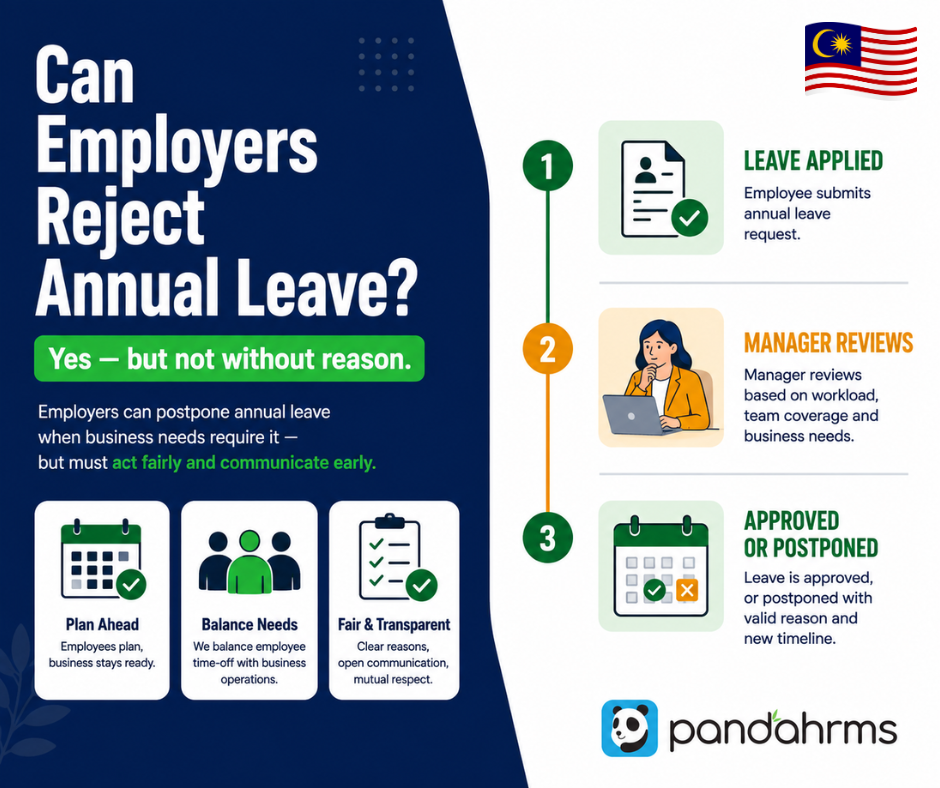
Yes.
However, employers should only reject annual leave requests when there is a genuine business or operational reason.
Annual leave is an employee entitlement, but employees are not automatically entitled to choose any date they wish.
Employers remain responsible for ensuring sufficient manpower is available to keep the business running.
For this reason, employers may approve, postpone or reject leave requests based on operational requirements.
When Can Employers Reject Annual Leave?
Some common situations include:
1. Too Many Employees Are Already on Leave
If several employees from the same department request leave during the same period, approving every application may leave the company short-staffed.
Example: Three payroll executives request leave during month-end payroll processing. The employer may approve one request while asking the others to choose alternative dates.
2. Peak Business Periods
Certain industries experience busy seasons throughout the year. Examples include:
- Retail during Chinese New Year
- F&B during festive holidays
- Hotels during school holidays
- Accounting firms during tax season
Employers may temporarily restrict leave during these critical periods to maintain service quality.
3. Critical Projects or Deadlines
Leave may also be postponed when employees are required for:
- System implementation
- Internal or external audits
- Product launches
- Major client projects
- Regulatory inspections
Once the critical period has passed, employees should still be given the opportunity to utilise their annual leave.
4. Leave Application Procedures Were Not Followed
Most companies have internal leave policies. For example:
- Leave must be applied at least seven days in advance.
- Employees must submit leave through the HR system.
- Department manager approval is required.
If employees fail to follow the company’s established procedures, employers may reject the application.
Can Employers Reject Annual Leave Forever?
No.
Rejecting one leave application does not mean employers can indefinitely prevent employees from taking their statutory annual leave.
Employers should work with employees to identify suitable alternative dates while ensuring business operations continue smoothly.
The objective is to postpone leave—not to deny the employee’s entitlement altogether.
Can Employers Cancel Approved Annual Leave?
Sometimes unexpected business situations arise after leave has already been approved. Examples include:
- Emergency operational issues
- Unexpected manpower shortages
- Critical equipment breakdowns
- Major client emergencies
- Business continuity incidents
In such situations, employers may request employees to postpone approved leave.
However, cancelling approved leave should only happen in exceptional circumstances.
If the cancellation causes employees to suffer financial losses—such as non-refundable flight tickets or hotel bookings—it is good HR practice to discuss reasonable compensation or alternative arrangements.
Open communication helps maintain trust and positive employee relations.
Can Employers Force Employees to Take Annual Leave?
Yes, in certain circumstances. Examples include:
- Company shutdowns
- Factory maintenance
- Office renovations
- Seasonal closures
- Temporary business slowdown
Before requiring employees to use annual leave, employers should ensure the arrangement is consistent with employment contracts, company policies, collective agreements (if applicable), and employment laws.
Providing sufficient notice is considered good HR practice.
What Happens If Employees Take Leave Without Approval?
Employees should obtain approval before taking annual leave.
If an employee is absent without approval, the absence may be treated as unauthorised. Depending on the circumstances, disciplinary action may follow.
However, employers should first determine whether the employee has a valid reason, such as:
- Medical emergencies
- Family emergencies
- Bereavement
- Other unforeseen circumstances
Each situation should be assessed fairly before disciplinary action is considered.
HR Best Practices for Managing Annual Leave
A clear leave management process benefits both employers and employees. HR teams should:
- Create a clear annual leave policy
- Explain the leave application process
- Encourage employees to plan leave early
- Apply leave policies consistently
- Respond to leave requests promptly
- Maintain accurate leave records
- Plan staffing during peak periods
- Discuss alternative dates instead of simply rejecting leave
- Ensure employees have a reasonable opportunity to utilise their statutory leave entitlement
A transparent process helps reduce misunderstandings and improves employee satisfaction.
Simplify Leave Management with Pandahrms
Managing annual leave manually using spreadsheets or paper forms can become complicated as your business grows.
With Pandahrms Leave Management System, employers can:
- Submit leave applications online
- Approve or reject leave from anywhere
- View team leave calendars
- Prevent overlapping leave requests
- Track leave balances automatically
- Generate leave reports instantly
By digitising the leave approval process, HR teams can improve efficiency while ensuring company policies are applied consistently.
Frequently Asked Questions (FAQs)
1. Can employers reject annual leave in Malaysia?
Yes. Employers may reject or postpone annual leave if there is a genuine operational or business reason. However, employees should still be given a reasonable opportunity to utilise their statutory annual leave.
2. Can employers cancel approved annual leave?
Yes, but only in exceptional circumstances, such as business emergencies or operational disruptions. Employers should communicate with employees promptly and discuss alternative arrangements where appropriate.
3. Can employees choose any annual leave date they want?
No. Employees may request annual leave, but employers generally have the authority to approve or reject the requested dates based on operational requirements.
4. Can employers force employees to take annual leave?
Yes. This may happen during company shutdowns, seasonal closures or maintenance periods, provided the arrangement complies with employment contracts, company policies and applicable laws.
5. What happens if an employee takes annual leave without approval?
Unauthorised absence may lead to disciplinary action. However, employers should first consider whether the employee had a reasonable explanation, such as a medical or family emergency.
6. Can unused annual leave be carried forward?
This depends on the company’s leave policy or employment contract, provided it complies with the Employment Act 1955 and other applicable laws.
Final Thoughts
Annual leave is both a statutory employee entitlement and a business management responsibility.
While employers have the right to reject or postpone annual leave when genuine operational needs arise, decisions should always be made fairly, consistently and with clear communication.
A well-managed leave process not only helps maintain business continuity but also builds trust, improves employee morale and reduces workplace disputes.
For HR teams, having clear leave policies—and a reliable leave management system—can make annual leave administration significantly easier.