
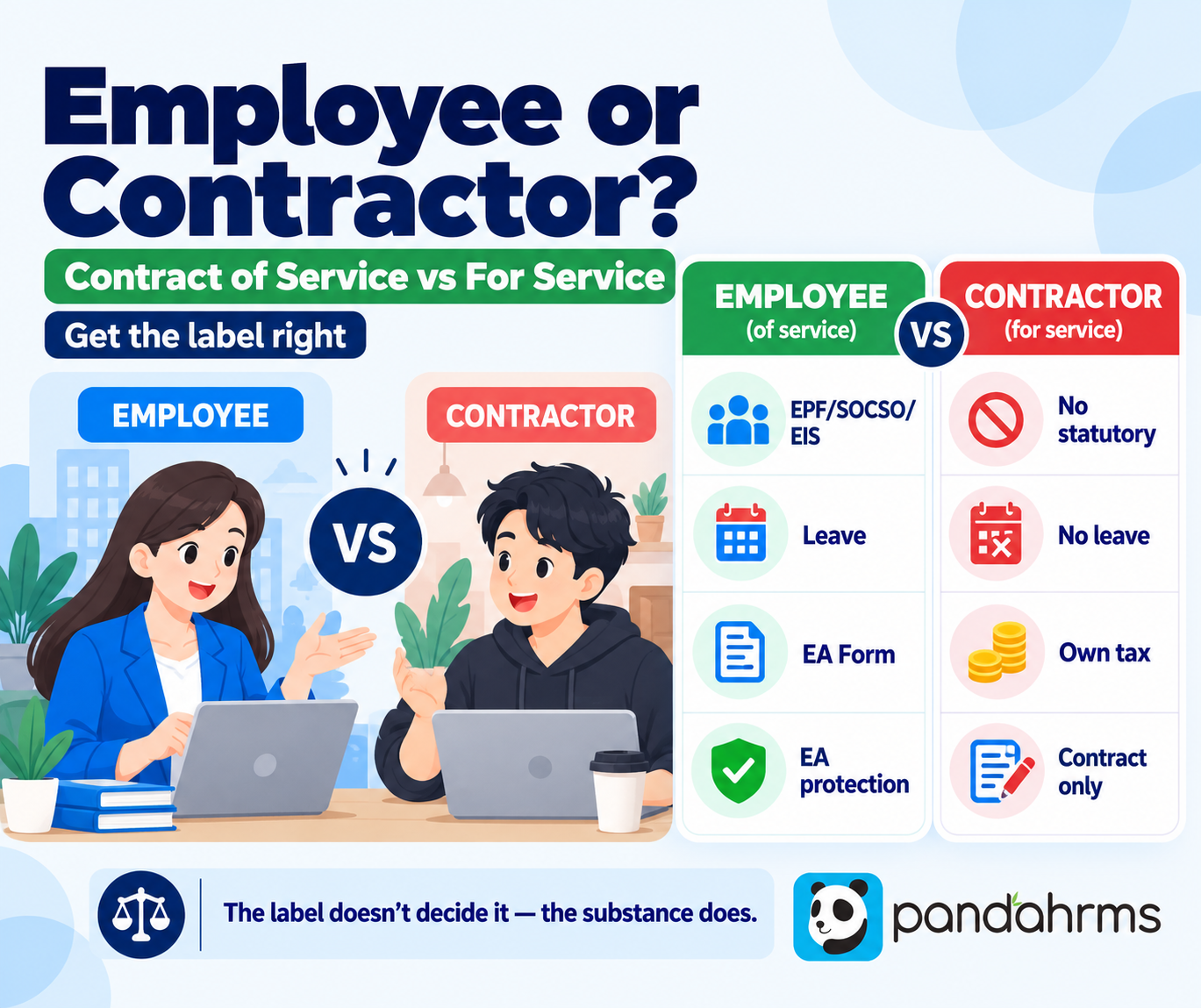
You’ve found someone to do the work. But before they start, one question matters more than it looks: are they an employee or an independent contractor? In Malaysia that’s the difference between a contract of service and a contract for service — and it decides EPF, SOCSO, EIS, tax, leave, and legal protection. Get the label wrong and the cost can be steep. Here’s how to tell them apart.
Contract of Service vs Contract for Service
- A contract OF service = an employee. They work under your control, as part of your organisation.
- A contract FOR service = an independent contractor (or freelancer/vendor). They provide a service to you, but run their own business.
What Changes Depending on the Label
| Employee (contract of service) | Contractor (contract for service) | |
|---|---|---|
| EPF / SOCSO / EIS | Yes — employer must contribute | No (they handle their own) |
| PCB & EA Form | Yes — deduct PCB, issue EA Form | No — they invoice & file their own tax |
| Leave & benefits | Annual, sick, public holidays, etc. | None — only what the contract states |
| Employment Act protection | Yes (unfair dismissal, etc.) | No — governed by contract law |
How to Tell Which One It Really Is
Here’s the key point: the label on the contract doesn’t decide it — the substance does. If a dispute reaches the courts, they look at the real relationship, using tests such as:
- Control — do you decide what work is done, when, where, and how? More control points to an employee.
- Integration — is the person a built-in part of your organisation (fixed hours, company email, reports to a manager), or running their own separate business?
- Economic reality — do they provide their own tools, bear financial risk, work for multiple clients, and profit from their own management? That points to a contractor.
Calling someone a “freelancer” in the contract won’t help if, in practice, they work like a full-time employee.
Why Misclassification Is Risky
Labelling an employee as a “contractor” to save on EPF and SOCSO is a costly gamble:
- Back-contributions & penalties — KWSP and PERKESO can reclassify the person and pursue unpaid contributions, with penalties.
- Industrial Court claims — a “contractor” can bring an unfair-dismissal claim; if the court finds they were really an employee, you’re liable.
- Tax exposure — LHDN may treat payments as employment income, with PCB and EA-Form obligations you missed.
See also our guide on common HR & payroll practices that may be against the law.
Where Pandahrms Helps
Once someone is correctly classified as an employee, everything that follows has to be handled properly — and that’s exactly what Pandahrms does. It computes and tracks EPF, SOCSO, EIS and PCB, issues compliant payslips and EA Forms, and manages statutory leave — so every employee on a contract of service is fully covered and compliant, with a clean record from day one. Get the classification right, and Pandahrms takes care of the rest. For getting the paperwork right at the start, see our employment contract guide.
Final Thoughts
Employee or contractor isn’t just a word on a page — it sets your obligations for contributions, tax, leave, and protection. Look at the real relationship, not the label, and when someone genuinely works as part of your team, treat them as an employee and give them their full entitlements. It’s the compliant choice, and the fair one.
Frequently Asked Questions (FAQs)
- What is the difference between a contract of service and a contract for service?
A contract of service creates an employer–employee relationship (the person is an employee); a contract for service is an arrangement with an independent contractor who provides a service but runs their own business. - Do I pay EPF and SOCSO for an independent contractor?
No. EPF, SOCSO and EIS apply to employees. A genuine independent contractor manages their own contributions — but only if they are truly a contractor, not an employee in disguise. - Does calling someone a “freelancer” make them a contractor?
No. The label doesn’t decide it. Courts look at the real relationship — control, integration, and economic reality — so someone who works like an employee is an employee regardless of the contract’s wording. - What are the risks of misclassifying an employee as a contractor?
Back-payment of EPF/SOCSO with penalties, unfair-dismissal claims at the Industrial Court, and tax exposure with LHDN for unpaid PCB and missing EA Forms. - Can a person be both an employee and a contractor?
For different work, potentially yes, but each engagement is assessed on its own facts. The safest approach is to classify each relationship correctly based on how the work is actually done.



