For many new mothers in Malaysia, the weeks after maternity leave are financially tight — the standard leave ends, but the caregiving doesn’t. A proposed new benefit aims to ease exactly that gap: the Elaun Pasca Cuti Bersalin, or Post-Maternity Leave Allowance.
Introduced through proposed amendments to the Employment Insurance System (EIS) Act 2017 and expected to roll out from 2026, it would give eligible working mothers extra financial support — funded by the government through PERKESO, not by employers.
Here’s a clear guide to what it is, who qualifies, how much it pays, and how to claim once it takes effect.
What Is Elaun Pasca Cuti Bersalin?
Elaun Pasca Cuti Bersalin (EPCB) is a proposed post-maternity financial allowance under the Employment Insurance System (SIP / EIS), administered by PERKESO (SOCSO).
The idea is to extend support beyond the standard maternity leave period — helping mothers who take additional time to recover and care for their newborn without a paycheck. Crucially, it is government-funded through the EIS, so it is not an added cost to employers.
Please note: This benefit is currently proposed/expected and subject to the finalised EIS rules. Always confirm the latest status, eligibility, and figures directly with PERKESO before relying on it.
How Much Is the Allowance?
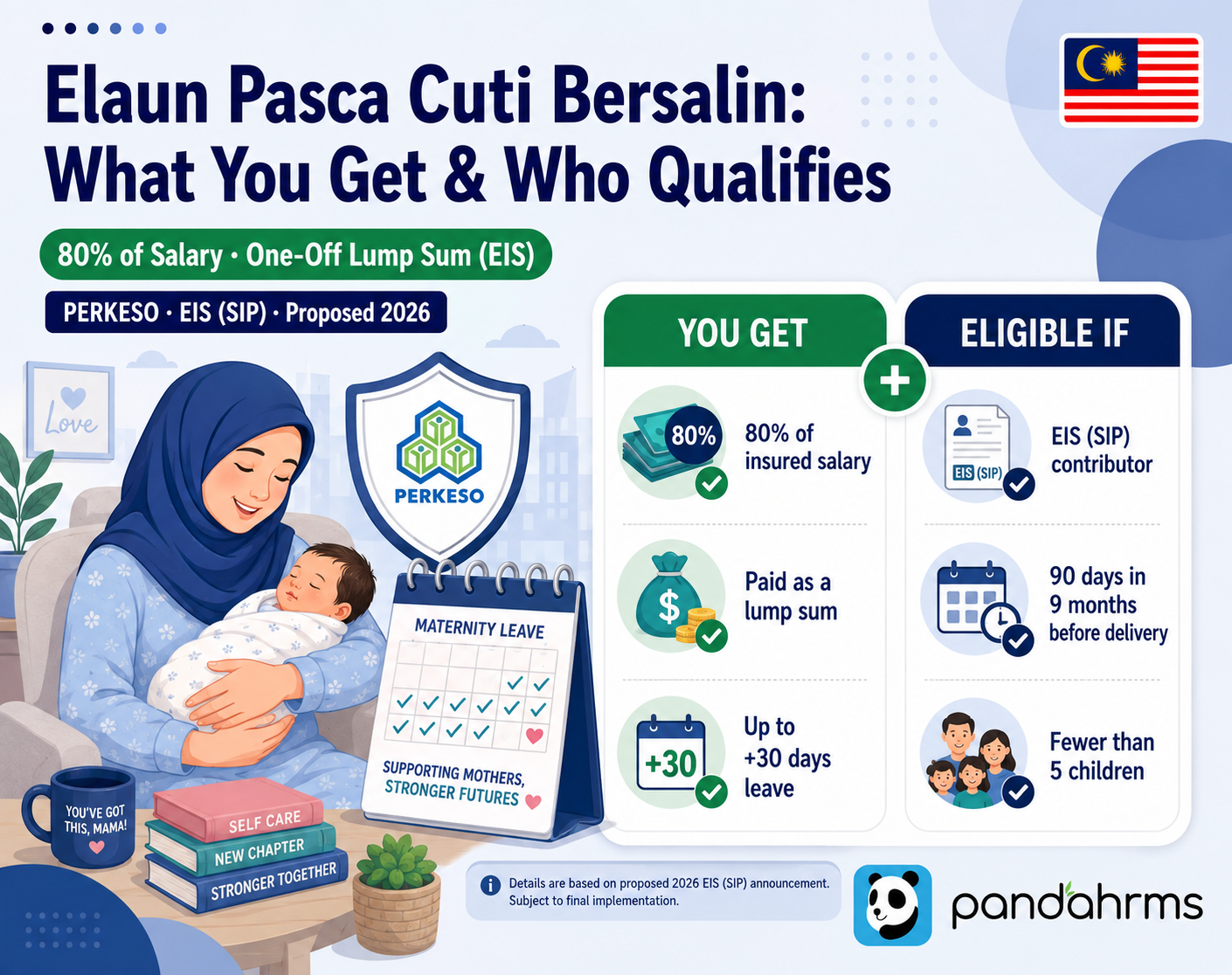
Once implemented, the allowance is expected to pay:
- 80% of the mother’s insured monthly salary
- Paid as a one-off lump sum — not spread across days
Because it’s tied to your insured monthly wage under the EIS, the exact amount will vary from person to person.
Who Is Eligible?
Eligibility is based on your EIS (SIP) contribution record. Based on the proposed criteria, an employee would generally need to:
| Requirement | Detail |
|---|---|
| Be an EIS (SIP) contributor | Registered and insured under the Employment Insurance System |
| Contribution history | Worked/contributed at least 90 days within the 9 months before delivery |
| Recent employment | Worked at least 1 day within the 4 months before delivery |
| Number of children | Have fewer than 5 living children at the time of birth |
These conditions mirror how other EIS benefits assess eligibility — steady contributions plus recent employment.
The Leave Period: 98 + 30 Days
The allowance connects to Malaysia’s maternity leave framework:
- 98 days of standard maternity leave remains employer-paid (unchanged).
- Under this initiative, an eligible mother may opt for up to 30 additional days — potentially bringing the total time away to around 128 days.
The extra period is where the government-funded allowance is intended to provide support, rather than shifting the cost onto employers.
How to Claim
Once the benefit is live, claims are expected to be handled through PERKESO (SOCSO) under the EIS, the same body that manages other employment insurance benefits.
Step 1: Confirm your eligibility
Check your EIS contribution record and the finalised criteria.
Step 2: Prepare your documents
Have your identification, employment details, and maternity/delivery documentation ready.
Step 3: Apply through PERKESO
Submit your application via PERKESO/SOCSO (or the Department of Labour, JTK) following the official process once announced.
Step 4: Keep your records
Retain confirmation of your application and any reference numbers.
Because the exact procedure and forms will be set by PERKESO on launch, always follow the official PERKESO instructions for the current process.
What It Means for Employers and HR
Even though the allowance is government-funded, HR still has a role to play:
- Inform eligible staff — many new mothers won’t know this benefit exists.
- Keep accurate EIS contribution records — eligibility depends on them.
- Support the leave process — track the 98-day leave and any additional 30 days cleanly.
For employers, this is a benefit that helps retain working mothers without adding to payroll cost — worth communicating well.
Where Pandahrms Helps
Getting employees the benefits they’re entitled to starts with accurate records — contribution history, leave taken, and eligibility details all in one place.
With Pandahrms, HR can track maternity leave and the additional days accurately, maintain each employee’s EIS/SIP contribution details, and keep the documentation organised — so when a new mother needs to check her eligibility or apply, the information she needs is ready, not scattered.
Keep the records clean, and let your team access the support they’re entitled to.
Final Thoughts
The Elaun Pasca Cuti Bersalin is a welcome step toward better support for working mothers in Malaysia — extra financial help, funded by the government, exactly when families need it most.
As with any new benefit, the details will firm up on launch. For now, working mothers should understand the proposed eligibility, and employers should be ready to inform and support their staff. When it takes effect, being prepared means no one misses out.
Frequently Asked Questions (FAQs)
- What is Elaun Pasca Cuti Bersalin?
It is a proposed post-maternity leave allowance under Malaysia’s Employment Insurance System (EIS/SIP), administered by PERKESO. It aims to pay eligible working mothers 80% of their insured monthly salary as a one-off lump sum, funded by the government. - How much does the allowance pay?
The proposed rate is 80% of the mother’s insured monthly salary, paid as a single lump sum. The exact amount depends on your insured wage under the EIS. - Who is eligible for Elaun Pasca Cuti Bersalin?
Generally, an EIS (SIP) contributor who worked at least 90 days within the 9 months before delivery, worked at least 1 day within the 4 months before delivery, and has fewer than 5 living children at the time of birth. Confirm final criteria with PERKESO. - Do employers have to pay for this allowance?
No. The allowance is government-funded through the EIS — it is not an added cost to employers. Employers continue to pay the standard 98 days of maternity leave. - How do I apply for the allowance?
Once launched, applications are expected to go through PERKESO (SOCSO) under the EIS. Follow the official PERKESO process and documentation requirements at that time.