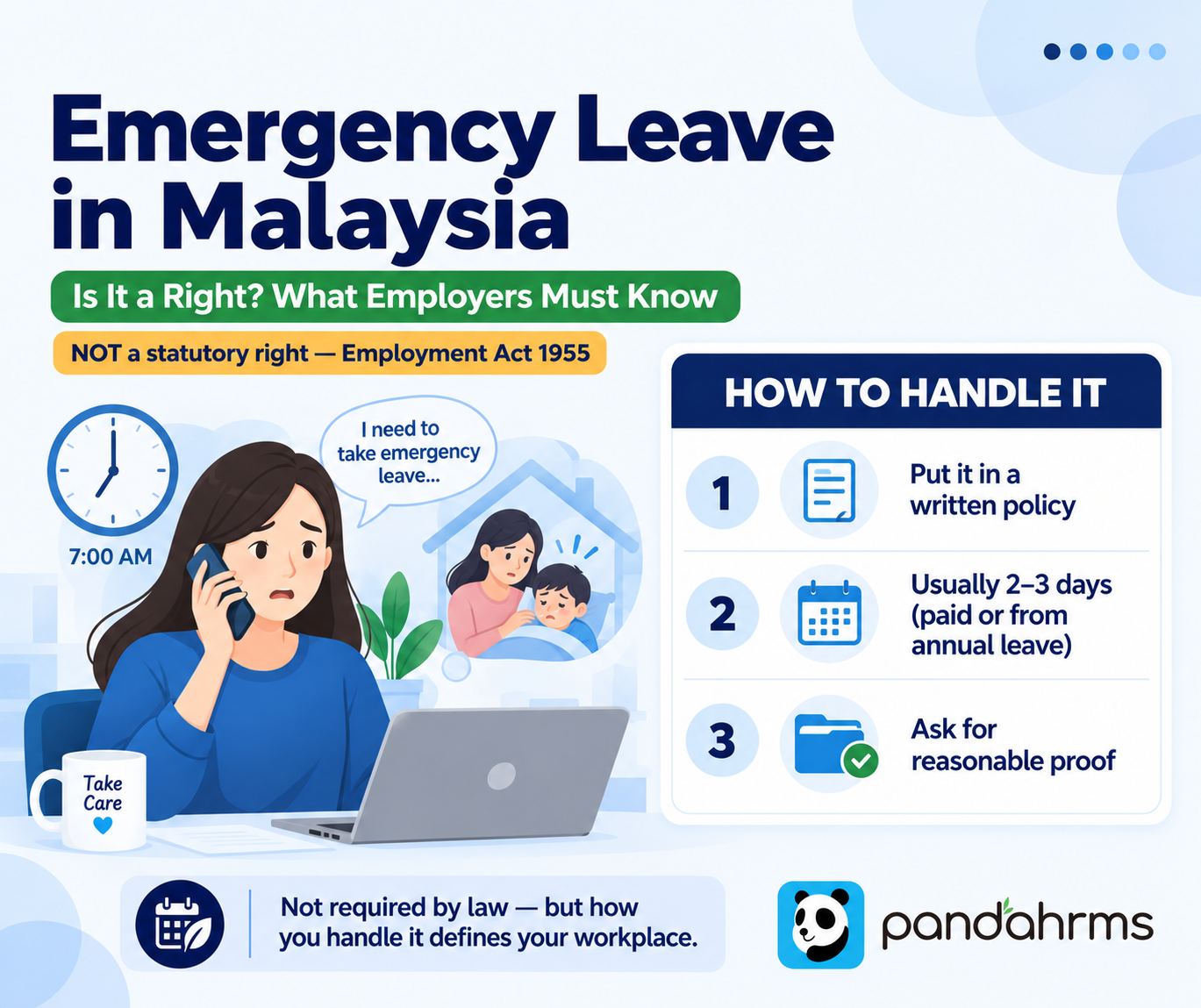
An employee messages at 7am: “Sorry boss, I have an emergency, I can’t come in today.” It happens to every employer. But is emergency leave something employees are legally entitled to — or is it entirely up to you? The answer surprises a lot of people on both sides. Here’s exactly where emergency leave stands in Malaysia, what counts as a genuine emergency, and how to handle it fairly.
Is Emergency Leave a Legal Right in Malaysia?
No. There is no “emergency leave” under the Employment Act 1955. The Act sets out paid annual leave, sick leave, maternity and paternity leave, and public holidays — but emergency leave is not a statutory category, and no law compels an employer to grant it.
That means emergency leave is a discretionary benefit: it exists only if your company chooses to offer it, on the terms you set. Employees can’t demand it as a right — but a blanket “no” to a genuine crisis is bad practice and bad for retention.
So Where Does “Emergency Leave” Actually Come From?
In practice, emergency leave usually comes from one of three places:
- A discretionary allowance — many employers grant a small number of emergency leave days (commonly 2–3 days a year), paid, as a goodwill benefit.
- Deducted from annual leave — the absence is simply taken from the employee’s existing annual leave balance.
- Unpaid leave — once any allowance and annual leave are used up, further emergency absences are treated as unpaid.
Whatever you choose, the key is to put it in writing so everyone knows the rules before an emergency happens.
Emergency Leave vs Other Types of Leave
| Leave type | Legal status |
|---|---|
| Emergency leave | Not in the Employment Act — discretionary, per company policy. |
| Annual leave | Statutory entitlement (Section 60E), scaling with years of service. |
| Sick leave (MC) | Statutory entitlement (Section 60F), needs a registered medical practitioner’s certificate. |
| Compassionate / bereavement | Not statutory — a common company benefit (often folded into emergency leave). |
| Unpaid leave | By agreement — used when paid entitlements are exhausted. |
The important takeaway: an emergency involving the employee’s own illness is covered by sick leave (with an MC). Emergency leave is for the urgent situations that aren’t the employee’s own medical issue.
What Counts as a Genuine Emergency?
Because there’s no legal definition, employers should spell out what qualifies. Widely accepted emergency reasons include:
- Death of an immediate family member (bereavement).
- Serious illness, accident, or hospitalisation of an immediate family member the employee must attend to.
- Accidents — e.g. a road accident on the way to work.
- Natural disasters directly affecting the employee’s home or family (floods, fire).
- A house break-in, fire, or similar crisis requiring the employee’s presence.
- Urgent legal or authority obligations — e.g. a court summons.
What usually does NOT count
Set expectations here too. Things like running personal errands, oversleeping, a pre-planned appointment, or “didn’t feel like coming in” are not emergencies — those belong in annual leave, applied for in advance.
Can Employers Ask for Proof?
Yes — it’s reasonable to request supporting documentation for an emergency absence, where one would naturally exist. Common examples:
- A medical certificate or hospital slip (for a family member’s illness/accident).
- A death certificate or funeral documentation (bereavement).
- A police report (accident, break-in, theft).
- A court summons or local authority notice.
Ask for proof consistently and reasonably — not to punish, but to keep the system fair and prevent abuse.
How Employers Should Handle Emergency Leave
1. Have a written policy
Define what qualifies, how many days are granted (paid or unpaid), whether it comes out of annual leave, the notification method, and the proof required. A clear policy removes the case-by-case arguing.
2. Be reasonable and human
These are real crises. Unreasonably rejecting a genuine emergency — a death in the family, a child in hospital — damages trust and drives good people away. Discretion cuts both ways: use it kindly for genuine cases.
3. Require prompt notification
Ask employees to inform their manager as early as possible (a call or message the same morning), even if the paperwork follows later.
4. Apply it consistently
Treat similar situations the same way across the team. Inconsistent decisions are how disputes — and claims of unfair treatment — start.
For the closely related question of urgent personal absences, see our guide on personal matter leave, and for planned time off, whether employers can reject annual leave.
Where Pandahrms Helps
Because emergency leave isn’t a fixed statutory type, it has to be configured — and that’s exactly what Pandahrms makes easy. Set up a custom Emergency Leave type with your own rules (entitlement days, paid or unpaid, whether it draws from annual leave), let employees apply from their phone the moment a crisis hits, route it to the right approver, and have every balance and document tracked automatically. No WhatsApp guesswork, no messy spreadsheets — just a clear, consistent record for every leave type you offer.
Final Thoughts
Emergency leave isn’t a legal right in Malaysia — but how you handle it says a lot about your company. Put a clear policy in writing, decide upfront whether it’s paid or drawn from annual leave, ask for reasonable proof, and apply it consistently and humanely. Get that balance right and you protect both your operations and your people when it matters most.
Frequently Asked Questions (FAQs)
- Is emergency leave a legal entitlement in Malaysia?
No. Emergency leave is not covered by the Employment Act 1955 and is not compulsory. It’s a discretionary benefit that each employer may choose to offer under its own policy. - How many days of emergency leave should a company give?
There’s no legal figure. Many employers grant around 2–3 paid emergency leave days a year, with anything beyond that taken from annual leave or treated as unpaid — but it’s entirely up to company policy. - What reasons qualify as an emergency?
Typically the death, serious illness, or accident of an immediate family member, natural disasters or a fire/break-in affecting the employee’s home, and urgent legal obligations like a court summons. Routine errands or oversleeping don’t qualify. - Can an employer ask for proof of an emergency?
Yes. It’s reasonable to request documentation such as a medical certificate, death certificate, police report, or court summons — applied consistently and fairly. - Is emergency leave the same as sick leave?
No. If the employee is personally ill, that’s sick leave (MC) under Section 60F. Emergency leave covers urgent situations that aren’t the employee’s own medical condition, such as a family crisis.