Your company organises a 2-day team-building event on normal working days. Then HR tells everyone:
“Please use your annual leave for the event.”
Can the company actually do that?
It’s a question a lot of Malaysian employees — and HR teams — are quietly asking. And the honest answer is more nuanced than a simple yes or no:
Not every company team-building arrangement automatically allows an employer to deduct annual leave. It depends on whether participation is voluntary or compulsory, whether the employee is genuinely required to attend, and how the employer treats those days under the employment arrangement.
The Employment Act 1955 sets out statutory annual leave entitlements under Section 60E — but the real controversy is about whether employees should be made to spend that entitlement on a company-organised activity. Here’s a careful, practical breakdown for both employers and employees.
What Happened? The Team-Building Annual Leave Question
A recent Malaysian workplace discussion highlighted a situation where employees were allegedly encouraged to use two days of annual leave for a 2-day, 1-night company team-building programme held during normal working days.
It raises a question many workplaces face:
If the company organises an event during working days, should employees have to use their own annual leave to attend?
Notably, even in that discussion it wasn’t fully clear whether attendance was truly compulsory, whether leave would be deducted automatically, or whether employees could decline without using annual leave. Those exact details are what determine the answer — so let’s start with the law.
What Does Malaysian Law Say About Annual Leave?
Under Section 60E of the Employment Act 1955, eligible employees are entitled to paid annual leave based on length of service:
| Length of Service | Minimum Annual Leave |
|---|---|
| Less than 2 years | 8 days |
| 2 years to less than 5 years | 12 days |
| 5 years or more | 16 days |
These are statutory minimums — an employer can offer more, but not less.
Two balanced points matter here:
- Annual leave is an employee entitlement — but that doesn’t mean an employee can take any date they like without employer approval.
- At the same time, employers should not treat statutory annual leave as a pool of days to be deducted whenever the company simply needs staff away from their normal workplace.
Scope note: The Employment Act 1955 applies to Peninsular Malaysia and Labuan. Sabah and Sarawak have their own labour legislation (the Sabah Labour Ordinance and the Sarawak Labour Ordinance), so employees there should refer to the applicable ordinance.
Can an Employer Require Employees to Use Annual Leave for Team Building?
This is the heart of the question. It helps to separate three very different situations.
Scenario 1 — Team Building Is Completely Voluntary
If employees are genuinely free to decide whether to join, and can keep working normally without attending, the picture is different. The company may invite employees — but it should be crystal clear that participation is optional and that no one is penalised for opting out.
Scenario 2 — Team Building Is Compulsory During Working Days
This is far more sensitive. If employees are required to attend a company-organised activity during their normal working schedule, HR should think carefully before classifying those days as annual leave.
Working time is generally understood as the period when an employee is at the employer’s disposal and not free to use their time as they wish. Whether a specific team-building activity counts as working time depends on the actual circumstances — including the degree of employer control and whether attendance is mandatory. A compulsory event under employer control looks a lot more like work than leave.
Scenario 3 — The Company Is Actually Closing Operations
This is different again — for example a company-wide shutdown, factory maintenance, temporary closure, or an office relocation. In those cases, employers should review the employment contract, company policy, and applicable employment requirements before deciding how employees’ leave should be handled.
Key point: Don’t lump every company event into the same bucket. A compulsory working-day event, a genuinely optional outing, and a business shutdown each call for different handling.
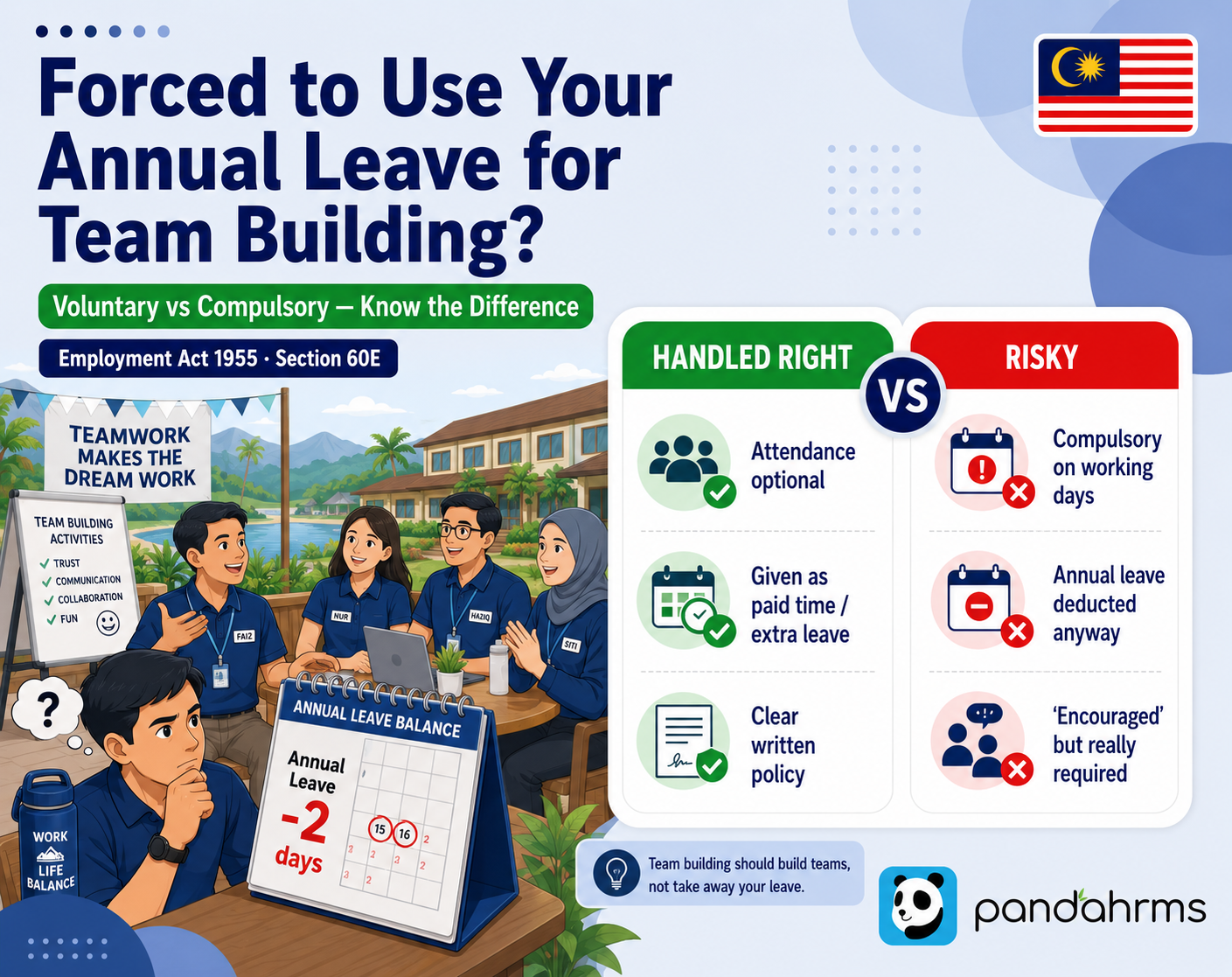
“Encouraged” Is Not the Same as “Required”
Much of the controversy comes down to wording. There’s a major difference between:
- “We encourage everyone to join.”
- “Everyone must attend, and two days will be deducted from your annual leave.”
Calling something “encouraged” while everyone understands attendance is really expected — and leave is deducted anyway — blurs that line. To avoid disputes, HR should be able to answer clearly:
- Is attendance compulsory?
- Is the event during normal working hours?
- Will annual leave actually be deducted?
- Can employees choose not to attend?
- If they don’t attend, are they expected to work normally?
- What happens if an employee has insufficient annual leave?
Can Employers Force Employees to Take Annual Leave?
On the broader principle: the Ministry of Human Resources has previously stated that employees have the right to decide when they wish to apply for annual leave, and that employers should not force employees to take annual leave or unpaid leave simply to reduce business costs.
That said, this isn’t an absolute rule that an employer can never have a say in leave scheduling. The practical takeaway for employers is this:
Annual leave should be managed consistently with the employee’s statutory entitlement, the employment contract, company policy, and applicable employment requirements — not treated as a lever to cut costs or cover company events.
What Should HR Do Before Deducting Annual Leave for a Company Event?
A simple checklist keeps the company on safe ground:
1. Check whether attendance is compulsory
Don’t use vague wording like “encouraged” if employees are actually expected to attend.
2. Check whether the event is during working hours
A company activity on normal working days raises different considerations from an optional weekend outing.
3. Review the employment contract
Check whether company events, shutdowns, and annual leave arrangements are addressed.
4. Review the company’s leave policy
Make sure the practice is consistent with your written policy.
5. Communicate clearly and in advance
Employees should know the event dates, attendance requirements, leave arrangements, whether annual leave will be deducted, and what happens if they don’t participate.
6. Keep proper leave records
Accurate records matter for HR and payroll — and they’re your evidence if a dispute arises.
What If an Employee Doesn’t Have Enough Annual Leave?
Consider a common scenario:
An employee has only one day of annual leave left, but the team-building event runs for two working days. Can HR just deduct two days anyway?
There’s no automatic yes. HR should not simply convert the shortfall into unpaid leave or another form of absence without considering the applicable employment terms and the employee’s agreement and rights. This is exactly the kind of situation where you check the company’s leave policy, and seek professional advice for disputed cases.
What If Employees Aren’t Happy About Using Annual Leave?
For Employers
- Explain the reason for the arrangement.
- Give employees sufficient notice.
- Avoid ambiguous wording.
- Apply the same policy consistently.
- Provide a clear alternative where appropriate.
- Keep written records.
For Employees
- Check your employment contract.
- Check your annual leave policy.
- Ask HR whether attendance is compulsory.
- Ask whether the leave will actually be deducted.
- Keep written communication.
- If you believe your employment rights have been breached, consider contacting the Labour Department (JTKSM), whose complaints channel covers employment-related issues and breaches of employment terms.
How HR Software Helps Prevent Annual Leave Disputes
Many annual leave disputes start because employees and HR have different records of the same thing:
How much leave was available → when it was requested → who approved it → how much was deducted.
A centralised system removes that ambiguity. With a digital HRMS such as Pandahrms, HR teams can manage leave applications, approval workflows, and employee leave balances in one place — reducing manual spreadsheet tracking and helping maintain consistent, defensible leave records. When a question comes up about a team-building event, the numbers are clear and everyone is looking at the same record.
Frequently Asked Questions (FAQs)
- Can an employer force employees to use annual leave for team building in Malaysia?
There’s no simple rule that every team-building event must be treated as annual leave, or that an employer can automatically deduct it. The circumstances matter — whether attendance is compulsory, whether it takes place during normal working hours, and how the employer treats the arrangement. - Can an employer force employees to take annual leave?
Employers should be careful about requiring employees to use statutory annual leave. The law provides employees with annual leave entitlements, and the Ministry of Human Resources has stated that employers should not force employees to take annual or unpaid leave simply to reduce business costs. - Is team building considered working time?
Not automatically. Whether an activity is working time depends on the circumstances — including whether attendance is compulsory and the level of control the employer exercises during the programme. - Can employees refuse to attend a company team-building event?
It depends on whether participation is voluntary or compulsory, and on the applicable employment arrangements. Employees should check the company’s policy and clarify the attendance requirements with HR. - How many days of annual leave are employees entitled to in Malaysia?
Under Section 60E of the Employment Act 1955, the statutory minimum is 8 days for under two years of service, 12 days for two to under five years, and 16 days for five years or more. - What should HR do if employees complain about annual leave deductions?
Review the employment contract, company leave policy, the circumstances of the event, and the employee’s leave records. Where there’s uncertainty about compliance, obtain professional employment-law advice.
Final Thoughts
Annual leave is more than a number in an HR system — it’s a statutory employee entitlement that needs to be managed carefully.
For employers, the key isn’t just whether a team-building event is a good idea. It’s whether the arrangement is communicated clearly, applied consistently, and handled in line with the applicable employment requirements. For employees, understanding the difference between voluntary participation, compulsory attendance, and annual leave deduction helps prevent unnecessary misunderstandings.
As workplace practices keep evolving in Malaysia, HR teams should keep their leave policies, approval processes, and records properly organised.
Need a simpler way to manage employee leave and attendance? Pandahrms helps Malaysian businesses manage HR digitally — from leave applications and approvals to employee records and payroll administration.