
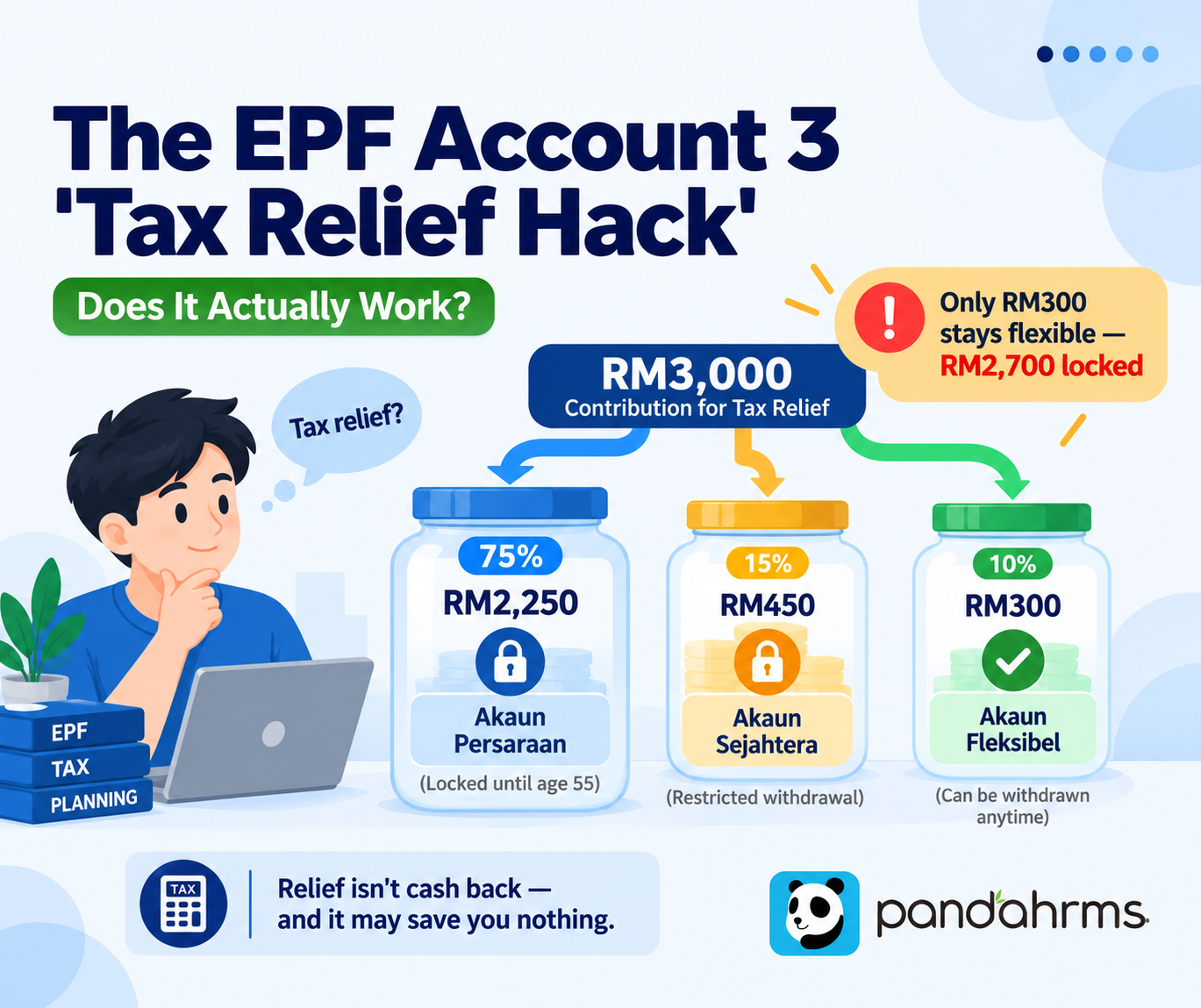
A money “hack” has been doing the rounds: withdraw RM3,000 from your EPF Akaun Fleksibel (Account 3), then put it back as a voluntary contribution to claim income tax relief — pocketing the tax saving while your money “stays in EPF.” It sounds clever. But before you try it, it’s worth understanding what actually happens to that money and to your tax bill — because the reality is very different from the headline.
First, What Is Account 3 (Akaun Fleksibel)?
Since 2024, every EPF contribution is split across three accounts:
- Akaun Persaraan (Retirement) — 75%, locked until age 55.
- Akaun Sejahtera (Wellbeing) — 15%, for approved needs like housing, healthcare, and education.
- Akaun Fleksibel (Flexible) — 10%, which you can withdraw anytime, for any reason.
Account 3 is the only one you can freely tap — which is exactly why the “hack” targets it.
The “Hack,” Step by Step
The idea circulating online goes like this:
- Withdraw, say, RM3,000 from your Akaun Fleksibel.
- Immediately recontribute it to EPF as a voluntary contribution.
- Claim that RM3,000 as income tax relief — and enjoy the tax saving.
On paper it looks like free money: the cash is “still in EPF,” and you get a tax break. Here’s where it falls apart.
Reality Check 1: Your Money Gets Locked Up Again
When you recontribute voluntarily, the money doesn’t go back into Account 3. It’s redistributed across all three accounts using the same 75 / 15 / 10 split as any other contribution:
| Where your RM3,000 goes | Share | Access |
|---|---|---|
| Akaun Persaraan — RM2,250 | 75% | Locked until 55 |
| Akaun Sejahtera — RM450 | 15% | Restricted (housing, health, education) |
| Akaun Fleksibel — RM300 | 10% | Withdraw anytime |
So of the RM3,000 you pulled out of your flexible account, only RM300 stays flexible. The other RM2,700 is now locked away — RM2,250 until age 55. You’ve effectively converted freely-accessible cash into long-term retirement savings. That may not be a bad thing for your retirement — but it’s the opposite of “keeping your money handy.”
Reality Check 2: The Tax Relief May Be Worth Nothing Extra
This is the part most people miss. In Malaysia, tax reliefs are grouped into capped categories, and voluntary EPF contributions do not have their own separate box. Under current LHDN rules:
- Mandatory EPF (your normal salary deductions) and other approved schemes sit in a bucket capped at RM4,000.
- Voluntary EPF contributions are grouped together with life insurance and family takaful premiums in a separate bucket capped at RM3,000.
The catch: if you already pay RM3,000 or more a year in life insurance or takaful premiums — which a great many working Malaysians do — that RM3,000 bucket is already full. Adding a voluntary EPF contribution on top gives you zero additional relief. You’d have locked up RM2,700 of accessible cash for no tax benefit at all.
Bottom line: the “hack” only does anything if you still have unused space in that RM3,000 category. Check your existing insurance/takaful relief first.
Reality Check 3: Relief Is Not Cash Back
Even where you do have room, tax relief is often misunderstood. Relief reduces your chargeable income — it is not a direct cash refund. Your actual saving is the relief amount multiplied by your marginal tax rate:
- In the 25% bracket: RM3,000 relief → about RM750 saved.
- In a lower bracket (say 3%–8%): only RM90–RM240 saved.
- Below the tax threshold (no tax payable): RM0 — the relief does nothing.
So even in the best case, you’re trading the flexibility of RM2,700 for, at most, a few hundred ringgit — and only if you’re a higher earner with unused relief.
So… Does It Ever Make Sense?
It can, but only in a narrow situation: you’re a higher-rate taxpayer, you haven’t used up the RM3,000 insurance/voluntary-EPF category, and you’re genuinely happy to lock most of the money away for retirement. For most people — especially anyone who might need that cash, or who already claims full insurance relief — the “hack” simply trades liquidity for little or no benefit.
Two things that are true and worth knowing: withdrawals from Account 3 are not taxed, and EPF dividends are tax-exempt — so your retirement savings still grow efficiently either way.
What This Means for Employers
Come tax-filing season, HR and payroll teams field a lot of these “should I do this?” questions from staff — about EPF accounts, voluntary contributions, and reliefs. You’re not there to give tax advice, but you can point people to the facts: mandatory versus voluntary contributions, how the accounts split, and where to verify reliefs (LHDN). What employers are responsible for is making sure the mandatory side is flawless — every EPF contribution calculated correctly and paid on time, every month.
Where Pandahrms Helps
The statutory contributions you must get right — EPF, SOCSO, and EIS — are exactly where Pandahrms takes the risk out of payroll. Contributions are calculated correctly for each employee every month, submission-ready files are generated, and every payment is recorded with a clear trail — so nothing is missed, late, or wrong. Your people can trust that what’s deducted is properly paid, and you stay fully compliant without the manual guesswork. The personal-finance “hacks” are theirs to weigh; the compliance is handled.
Final Thoughts
The EPF Account 3 tax-relief “hack” is a good reminder that viral money tips rarely survive the fine print. Recontributing to EPF locks up 90% of the money and only helps your taxes if you have unused relief in the right category and earn enough to benefit. Understand the accounts, check your existing reliefs, and when in doubt, confirm with KWSP and LHDN before you move any money.
Frequently Asked Questions (FAQs)
- Can I withdraw from EPF Account 3 (Akaun Fleksibel) anytime?
Yes. Akaun Fleksibel holds 10% of your contributions and can be withdrawn at any time, for any reason, subject to EPF’s minimum withdrawal rules. - If I recontribute the money, does it go back into Account 3?
No. A voluntary contribution is redistributed across all three accounts using the standard 75% / 15% / 10% split, so only 10% returns to Akaun Fleksibel. The rest is locked or restricted. - Do voluntary EPF contributions qualify for income tax relief?
They can, but under current LHDN rules voluntary EPF contributions share a capped RM3,000 relief category with life insurance and family takaful premiums. If that category is already used up by your insurance premiums, a voluntary contribution gives no extra relief. Always confirm the current relief categories with LHDN. - How much tax will I actually save?
Relief reduces your chargeable income, not your tax bill directly. Your saving equals the relief amount times your marginal tax rate — for example, RM3,000 at a 25% rate saves about RM750, while a low earner saves far less and someone below the tax threshold saves nothing. - Are Account 3 withdrawals or EPF dividends taxed?
No. Withdrawals from Akaun Fleksibel are not subject to income tax, and EPF dividends are tax-exempt.
Sources
- KWSP (EPF) — Akaun Fleksibel & member benefits: kwsp.gov.my
- KWSP — How to File Income Tax (YA 2025): kwsp.gov.my
- LHDN (Lembaga Hasil Dalam Negeri) — Personal tax reliefs, YA 2025: hasil.gov.my



