If your staff have been asking why their EPF statement suddenly shows three accounts instead of two — Akaun Persaraan, Akaun Sejahtera and Akaun Fleksibel — this is the guide to hand them. In May 2024, EPF restructured every member’s savings into three accounts, each with a different job and different withdrawal rules. Here’s what changed, how each account works, how the new Account 3 (Akaun Fleksibel) withdrawal works, and what it means for employers running payroll.
What Changed in May 2024
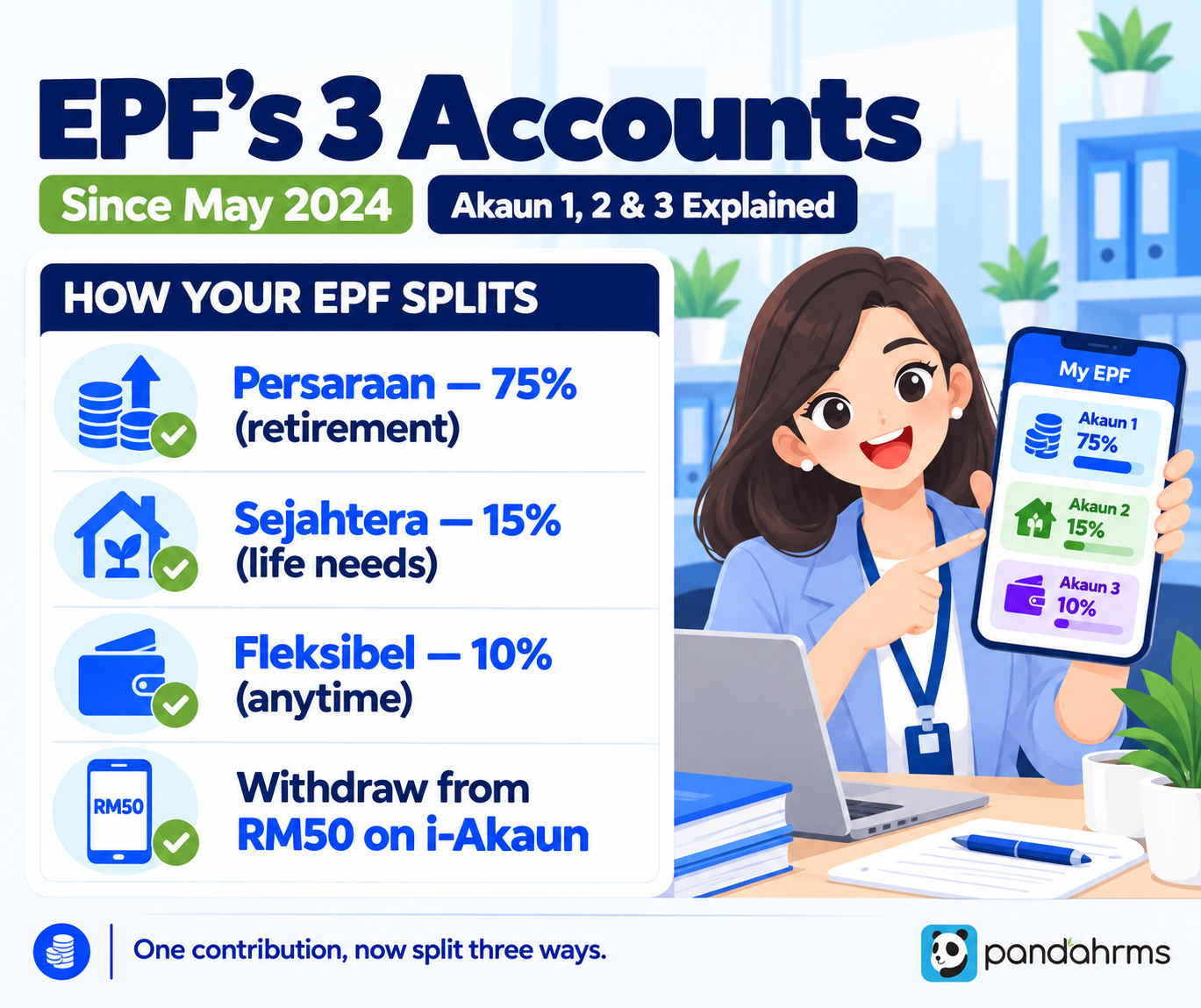
On 11 May 2024, EPF moved from the old two-account structure (Account 1 and Account 2) to a three-account structure. From that date, every monthly contribution is split across three accounts:
| Account | Share of contribution | Purpose |
|---|---|---|
| Akaun Persaraan (Retirement) | 75% | Long-term retirement savings, locked until retirement age |
| Akaun Sejahtera (Wellbeing) | 15% | Life-cycle needs — housing, healthcare, education |
| Akaun Fleksibel (Flexible) | 10% | Short-term needs — withdrawable at any time |
The restructuring applied automatically to all members aged 55 and below, and members could not opt out of it.
What Happened to the Old Account 1 and Account 2?
Your existing savings were not lost or reshuffled randomly:
- The balance in the old Account 1 moved into Akaun Persaraan.
- The balance in the old Account 2 moved into Akaun Sejahtera.
- Akaun Fleksibel started at zero and fills up from the 10% share of new contributions going forward.
At launch, EPF also opened a one-time transfer window (which closed on 31 August 2024) that let members move part of their Akaun Sejahtera balance into Akaun Fleksibel. That window is now closed — so today, Akaun Fleksibel grows mainly from the ongoing 10% allocation.
How Each Account Works
Akaun Persaraan (75%) — the retirement core. This is the biggest slice and the most protected. It is built for retirement and is generally locked until age 55, when a member can start withdrawing (with full withdrawal options at 55 and 60). Keeping the largest share here is the whole point of the restructure — to protect retirement adequacy.
Akaun Sejahtera (15%) — life-cycle needs. This replaces the old Account 2 role. It can be tapped for approved life needs such as housing, healthcare and education, and for certain age-based withdrawals. It is not a free-for-all — withdrawals are tied to EPF’s approved purposes.
Akaun Fleksibel (10%) — short-term flexibility. This is the new one. Members can withdraw from it at any time, for any reason, subject to EPF’s rules. The minimum withdrawal is RM50, and any amount left in the account continues to earn the annual EPF dividend. It’s designed as a cushion for short-term needs without touching retirement savings.
How to Withdraw From Akaun Fleksibel (Account 3)
Withdrawal is done online and is straightforward:
- Log in to i-Akaun (the KWSP member app or portal).
- Select the Akaun Fleksibel withdrawal.
- Enter the amount (minimum RM50, up to your available balance), subject to EPF’s current limits.
- Complete identity verification (eKYC) and submit; approved funds are paid to your bank account.
A word of caution for employees: Akaun Fleksibel money is still your retirement savings. Anything you take out stops earning the EPF dividend and compounding for the future. Treat it as an emergency cushion, not a monthly top-up.
Does This Change Anything for Employers?
For payroll, the honest answer is: almost nothing changes operationally. You still calculate and remit the total EPF contribution (employer and employee shares) the same way — EPF handles the 75/15/10 split internally once the money is received. Your contribution rates and the wages subject to EPF are unchanged by the restructure.
What does change is the questions you’ll field. Staff will ask HR why they have three accounts and how to withdraw from Account 3. Being able to explain it clearly — and pointing them to i-Akaun — saves a lot of back-and-forth. (New to registering staff for EPF? See our EPF registration guide.)
How Pandahrms Helps
Pandahrms calculates EPF correctly on every payroll run, remits the right employer and employee amounts, and keeps clean contribution records and payslips — so while EPF handles the three-account split on their side, your payroll and statements stay accurate and audit-ready on yours.
Frequently Asked Questions (FAQ)
- What are the three EPF accounts?
Since 11 May 2024, EPF savings are split into Akaun Persaraan (75%, retirement, locked until 55), Akaun Sejahtera (15%, life-cycle needs like housing, health and education), and Akaun Fleksibel (10%, withdrawable at any time). - What happened to my old Account 1 and Account 2?
Account 1 became Akaun Persaraan and Account 2 became Akaun Sejahtera. Akaun Fleksibel is new and started at zero, filling up from the 10% share of new contributions. - How much can I withdraw from Akaun Fleksibel?
The minimum is RM50, up to your available balance, subject to EPF’s current rules and limits. Withdrawals are done online through i-Akaun. - Does money in Akaun Fleksibel still earn dividend?
Yes. Any balance left in the account continues to earn the annual EPF dividend. Once you withdraw it, that amount stops earning returns. - Can I still move money from Akaun Sejahtera to Akaun Fleksibel?
The one-time transfer window closed on 31 August 2024. Today, Akaun Fleksibel grows mainly from the ongoing 10% allocation of new contributions. - Does the restructure change how employers contribute?
No. Employers still calculate and remit the total EPF contribution as before. EPF applies the 75/15/10 split automatically once the contribution is received.
Source: Employees Provident Fund (EPF / KWSP) Account Restructuring, effective 11 May 2024 — Akaun Persaraan (75%), Akaun Sejahtera (15%) and Akaun Fleksibel (10%), with the one-time Akaun Sejahtera-to-Fleksibel transfer window that closed on 31 August 2024. Withdrawal rules, limits and dividend rates are set by EPF and updated from time to time. This article is general information, not financial advice — check the latest rules on the official EPF portal (kwsp.gov.my) or i-Akaun before making a withdrawal decision.