A story recently went viral on Malaysian social media: a young employee said she quit after just one month on the job because her company allegedly gave her a choice — resign, or be fired.
According to her account, she was left without proper guidance, accused of “overstepping” for asking IT about training, removed from work chat groups, discouraged from consulting HR, and eventually told to “think over the weekend” about whether she had a future with the company. She resigned with a detailed seven-point letter and said she was gathering evidence for a possible constructive dismissal claim.
Thousands of Malaysians weighed in. Many urged her to document everything. And a lot of them asked the same question: is this even legal?
For employers, this is more than internet drama. It’s a warning. The phrase “just resign lah” feels like the quick, clean way to part with a struggling new hire — but under Malaysian law, pushing an employee out the door can expose your company to an unfair dismissal claim at the Industrial Court, even when the person “resigned” and even when they were still on probation.
Here’s what every Malaysian employer and HR team needs to understand.
What Is Constructive Dismissal?
Constructive dismissal happens when an employee resigns — but the law treats it as if the employer dismissed them.
The idea is simple. If an employer behaves in a way that seriously breaks the employment relationship, and the employee resigns because of that behaviour, the employee can argue they had no real choice but to leave. In legal terms, the resignation is treated as a dismissal by the employer.
Malaysian courts apply the contract test, not a general “was the employer being unreasonable” test. This was established in cases such as Wong Chee Hong v Cathay Organisation (M) Sdn Bhd and reaffirmed in Anwar Abdul Rahim v Bayer (M) Sdn Bhd.
To succeed in a constructive dismissal claim, an employee generally must show four things:
| Requirement | What it means |
|---|---|
| 1. A fundamental breach | The employer breached a term that goes to the root of the contract (express or implied). |
| 2. Serious enough breach | The breach was significant — not a minor or one-off inconvenience. |
| 3. Resignation in response | The employee resigned because of that breach. |
| 4. No undue delay | The employee did not wait too long or otherwise “accept” the breach before leaving. |
A common implied term at the heart of these cases is the mutual duty of trust and confidence — the understanding that an employer will not, without reasonable cause, act in a way calculated to destroy the working relationship. Ultimatums, humiliation, removing someone’s access or duties, or freezing them out can all point to a breach of that duty.
“But She Resigned” — Why That Doesn’t Protect the Employer
This is the single most misunderstood point.
Many employers assume that once an employee signs a resignation letter, the matter is closed and the company is safe. That is not how Malaysian employment law works.
If the resignation was triggered by the employer’s conduct, the employee can file a representation claiming they were, in effect, dismissed without just cause or excuse. A resignation letter does not automatically waive that right — especially when the letter itself documents the employee’s grievances, as it did in the viral case.
In other words: a forced resignation is still a dismissal in the eyes of the law. Telling someone “resign or we’ll fire you” does not make the exit voluntary. If anything, an ultimatum like that can become the strongest evidence against the employer.
Does This Apply During Probation?
Yes — and this is where many Malaysian employers get caught out.
A widespread myth is that probationers have “no rights” and can be let go freely. That is not true under Malaysian law.
A probationer enjoys the same protection against dismissal without just cause or excuse as a confirmed employee. The Malaysian courts have made this clear in decisions such as Khaliah bte Abbas v Pesaka Capital Corp Sdn Bhd. An employer still needs a valid reason to end a probationer’s employment, and still needs to act fairly in how it does so.
What probation does change is mainly the remedy. If an unfair dismissal is proven:
- A confirmed employee may be awarded back wages of up to 24 months.
- A probationer is generally limited to back wages of up to 12 months.
The exposure is smaller — but it is far from zero. A 12-month back-wages award, plus legal costs and management time, is a heavy price for what began as an awkward conversation with a new hire.
What HR Should and Shouldn’t Say During a Termination Conversation
The difference between a defensible parting and a constructive dismissal claim often comes down to what is said in the room. Here is a practical guide.
What HR Should Avoid
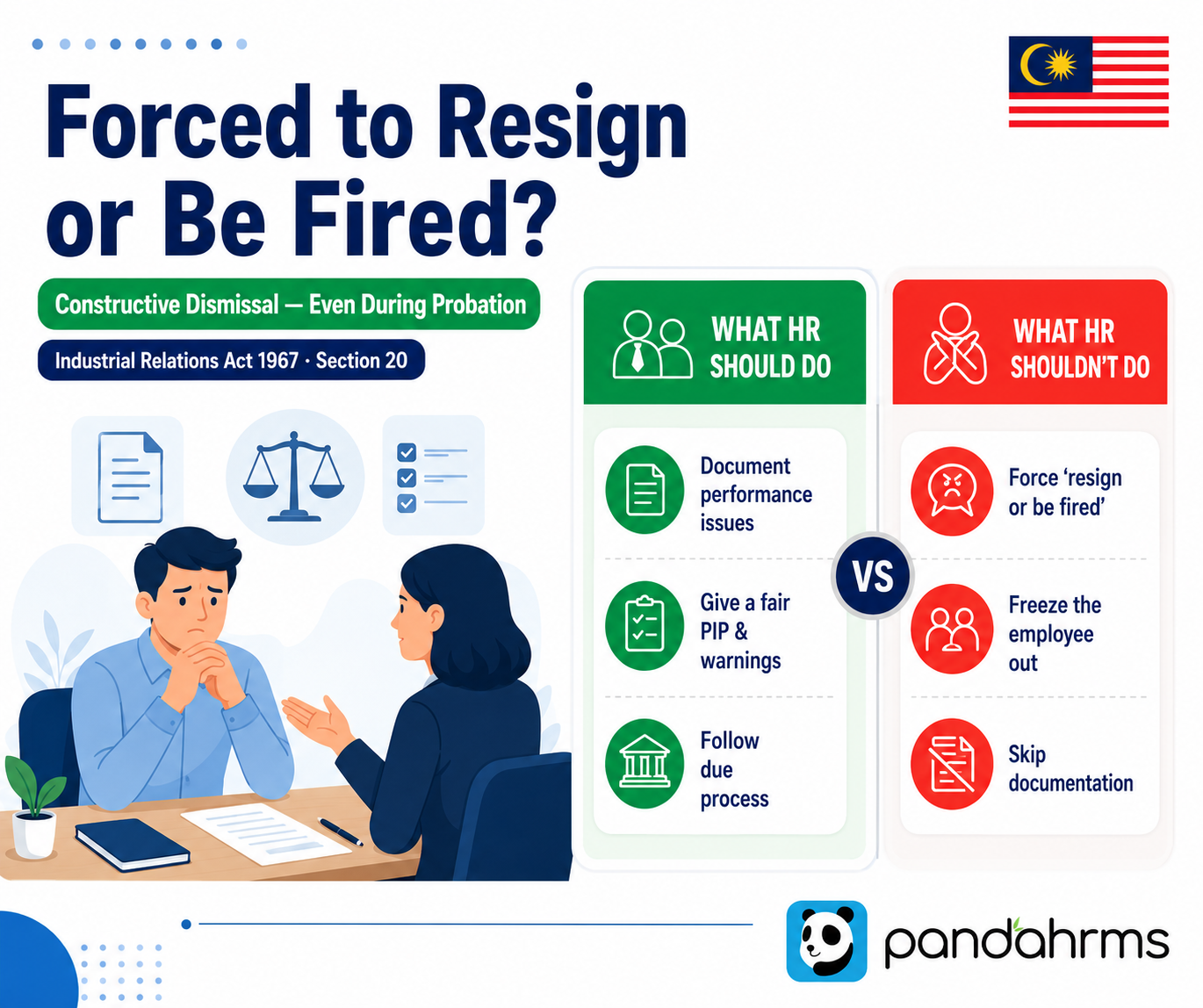
- “Resign, or we’ll fire you.” An ultimatum is the classic trigger for a constructive dismissal claim.
- “Think about your future here over the weekend.” Vague pressure to leave, without a formal process, reads as forcing someone out.
- “There’s no point talking to HR.” Discouraging an employee from raising concerns undermines the duty of trust and confidence.
- Silent freeze-outs. Removing someone from chat groups, systems, or meetings before any proper process signals the relationship has been broken by the employer.
- Public or humiliating criticism. Beyond being poor practice, it can support a claim of breach.
What HR Should Do Instead
- State the specific concern. Point to actual performance or conduct issues, with examples and dates.
- Give a genuine chance to improve. Use a documented Performance Improvement Plan (PIP), clear targets, and a realistic timeline.
- Offer support, not just judgment. Training, guidance, and check-ins show good faith — particularly for someone new to the role or industry.
- Keep the door to HR open. Employees should feel able to raise questions about their employment terms.
- Document everything. Warnings, reviews, meeting notes, and improvement plans are what protect the company later.
Key principle: If you genuinely need to part ways with an underperforming employee, do it through a fair, documented process — not through pressure. A clean, well-evidenced dismissal is far safer than a “voluntary” resignation you engineered.
The Real Risk: A Section 20 Claim at the Industrial Court
When an employee believes they were dismissed without just cause or excuse — including through constructive dismissal — they can file a representation under Section 20 of the Industrial Relations Act 1967.
A few things Malaysian employers should know:
- The employee generally has 60 days from the date of dismissal to file the representation.
- The matter first goes through conciliation at the Industrial Relations Department; if unresolved, it may be referred to the Industrial Court.
- If the dismissal is found to be unfair, the court can order reinstatement or compensation (back wages plus compensation in lieu of reinstatement).
- The burden falls on the employer to prove the dismissal was with just cause and excuse.
That last point is crucial. In these disputes, the company is effectively on the back foot from the start — it must justify the exit. Without documentation, that is very hard to do.
How Employers Can Protect Themselves
Most constructive dismissal risk is preventable. It comes down to process and paper trail.
Step 1: Set clear expectations from day one
Give new hires a proper job description, onboarding, and defined probation objectives. People can’t meet a standard they were never told about.
Step 2: Give real support during probation
Especially for employees new to the role or industry, provide training and regular check-ins. “Sink or swim” is both bad management and a legal liability.
Step 3: Address issues formally and early
If performance is falling short, raise it in writing. Use structured reviews and a Performance Improvement Plan with specific, measurable goals.
Step 4: Document every step
Keep records of feedback, warnings, review meetings, and improvement plans. If a dispute arises, this is your evidence.
Step 5: If you must part ways, follow due process
Base the decision on documented grounds, communicate it professionally, and never resort to ultimatums or freeze-outs.
Where the Right HR System Helps
Everything above comes down to one thing: documentation. When a dispute reaches the Industrial Court, the employer with a clear, dated paper trail can defend the decision — and the one without it usually cannot.
This is the quiet work an HR system like Pandahrms is built for. Probation periods are tracked with automatic reminders before each review date, appraisals and warnings are recorded against each employee, and supporting documents stay in one organised place instead of scattered across chats and inboxes — so a consistent, defensible record is built as part of the routine, not scrambled together after a claim is filed.
Handle performance fairly, and let your system keep the proof.
Final Thoughts
The viral resign-or-be-fired story struck a nerve because it captured something a lot of Malaysian workers have quietly experienced. For employers, the lesson is clear.
You cannot sidestep unfair dismissal law by pressuring someone to resign — not for a confirmed employee, and not for a probationer. What protects your company is not a signed resignation letter. It is a fair process and solid documentation.
Handle underperformance the right way: set clear expectations, give genuine support, address problems in writing, and make decisions you can defend. Do that, and you protect both your people and your business.
Frequently Asked Questions (FAQs)
What is constructive dismissal in Malaysia?
Constructive dismissal occurs when an employee resigns because of the employer’s serious breach of the employment contract. Even though the employee resigns, the law can treat it as a dismissal by the employer, allowing the employee to claim unfair dismissal.
Can an employee claim constructive dismissal if they signed a resignation letter?
Yes. A resignation letter does not automatically protect the employer. If the resignation was caused by the employer’s conduct — such as an ultimatum or being forced out — the employee may still bring a constructive dismissal claim.
Do probationers have rights against unfair dismissal in Malaysia?
Yes. Probationers are protected against dismissal without just cause or excuse, the same as confirmed employees. The main difference is the remedy — back wages for a probationer are generally capped at 12 months, versus up to 24 months for a confirmed employee.
Is telling an employee to “resign or be fired” legal?
Giving an ultimatum to resign can be strong evidence of constructive dismissal. Rather than making the exit “voluntary,” it often strengthens the employee’s claim that they were effectively dismissed.
What is a Section 20 claim?
Under Section 20 of the Industrial Relations Act 1967, an employee who believes they were dismissed without just cause or excuse can file a representation seeking reinstatement. It is generally filed within 60 days of the dismissal and may proceed to the Industrial Court.
How can employers reduce the risk of a constructive dismissal claim?
Set clear expectations, provide support during probation, address performance issues in writing through a documented process, avoid ultimatums, and keep thorough records. Good documentation is the strongest protection.
Disclaimer
This article is intended for general informational purposes only and should not be regarded as legal advice. Employment outcomes depend on the specific facts, the applicable laws, and individual circumstances. Employers are encouraged to refer to the latest official guidance and, where necessary, consult a qualified employment lawyer or industrial relations adviser before making any decisions.
Sources
- WeirdKaya — M’sian quits after one month, claims company made her choose between resigning or being fired
- Industrial Relations Act 1967 (Act 177), Malaysia — Section 20
- Wong Chee Hong v Cathay Organisation (M) Sdn Bhd [1988] 1 MLJ 92
- Anwar Abdul Rahim v Bayer (M) Sdn Bhd [1998] 2 MLJ 599
- Khaliah bte Abbas v Pesaka Capital Corp Sdn Bhd [1997] 3 MLJ 1