
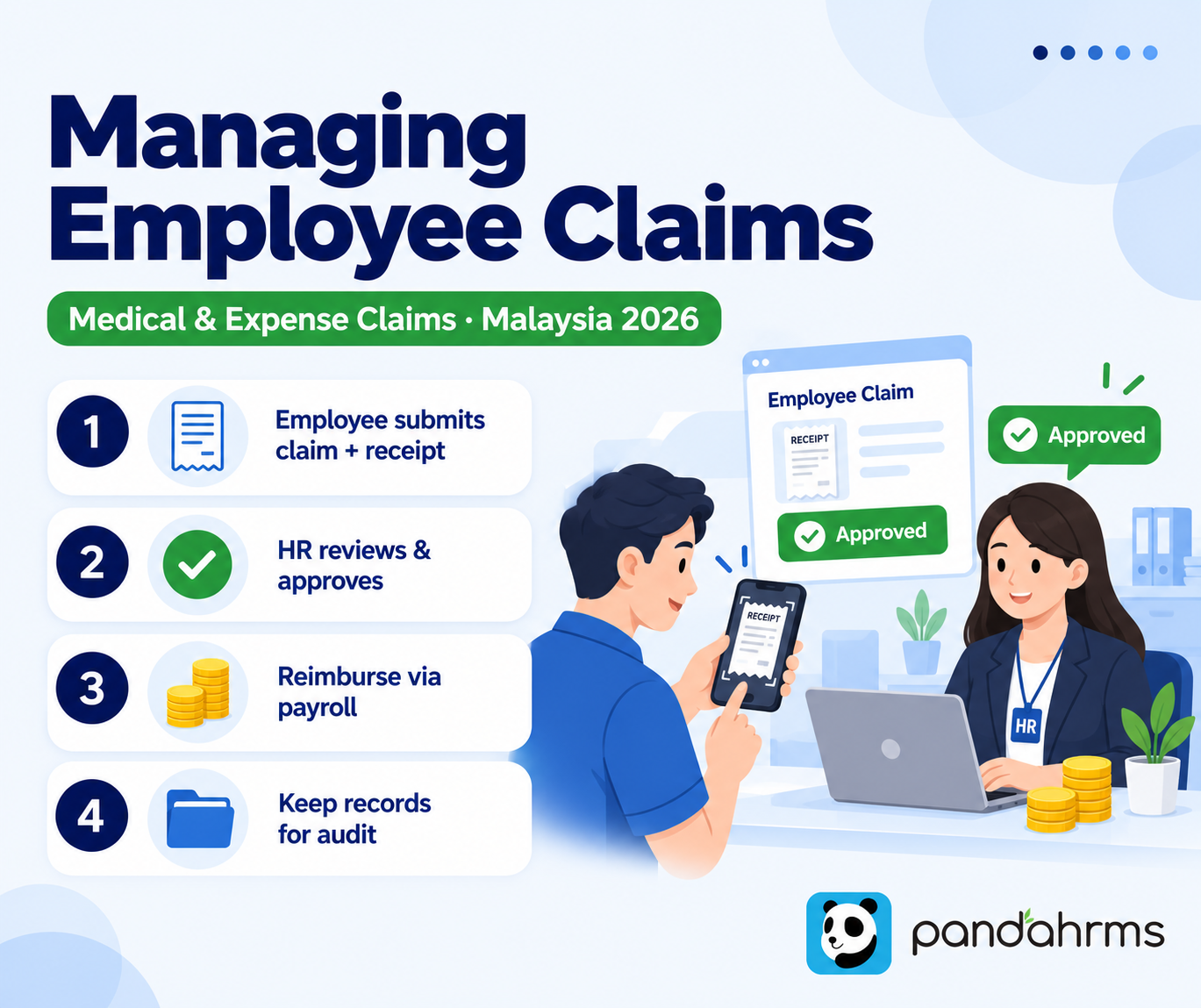
Employees spend their own money on work — a client lunch, a medical visit, mileage to a site, a phone bill. Reimbursing them fairly and quickly seems simple, but for many Malaysian employers it turns into a mess of paper receipts, WhatsApp approvals, and end-of-month disputes. A clear claims process fixes that — and protects the business.
Here’s a practical guide to managing employee medical and expense claims properly.
What Are Employee Claims?
Employee claims are reimbursements for money an employee spends on the company’s behalf, or on benefits the company provides. The most common are medical claims (clinic visits, medication) and expense claims (travel, meals, and other work costs). Unlike a fixed allowance, a claim reimburses an actual, incurred cost — usually backed by a receipt.
Common Types of Employee Claims
| Claim type | Examples |
|---|---|
| Medical | Clinic/GP visits, medication, dental/optical (per policy) |
| Travel & mileage | Mileage, tolls, parking, transport for work trips |
| Meals & entertainment | Client meals, working meals (within limits) |
| Other work expenses | Phone/internet, supplies, training, per company policy |
Why a Clear Claims Process Matters
- Fairness & morale — staff get repaid promptly for their own money; delays breed resentment.
- Cost control — clear limits and categories stop spending from creeping.
- Fraud prevention — receipts and approvals deter inflated or fake claims.
- Clean records — proper documentation supports audits and tax treatment.
How to Set Up a Good Claims Process
Step 1: Write a clear claims policy
Define what’s claimable, the limits/caps per category, what documents are needed, and the deadline to submit. Communicate it so everyone knows the rules.
Step 2: Standardise submission (with receipts)
Require a consistent claim submission with the amount, category, date, purpose, and a receipt. A digital submission beats loose paper every time.
Step 3: Review & approve
Route each claim to the right approver (manager/HR/finance) to check it against policy before payout.
Step 4: Reimburse — usually through payroll
Pay approved claims on a set cycle, commonly with the monthly salary, so it’s predictable for staff and finance.
Step 5: Keep the records
Retain the claim, approval, and receipt. This is your evidence for audits and correct tax treatment.
Claims Are Not the Same as Allowances
An important payroll distinction: a genuine reimbursement of an actual expense is generally not “wages” — so, unlike a fixed allowance, a true expense reimbursement (and a travelling/mileage claim) is typically not subject to EPF or SOCSO/EIS. A fixed monthly allowance, on the other hand, usually is. Classify each one correctly. For the detail, see our guides on which allowances are subject to EPF and which wages are subject to SOCSO & EIS.
Common Claims Mistakes Employers Make
- No written policy — every claim becomes a case-by-case negotiation.
- Accepting claims without receipts — no proof, no control.
- Slow, manual approvals — claims pile up and staff chase HR.
- Treating reimbursements as allowances (or vice versa) — wrong EPF/SOCSO treatment.
- Poor records — a headache at audit time.
Where Pandahrms Helps
Claims are painful only when they’re manual. With Pandahrms, employees submit medical and expense claims digitally with a photo of the receipt, claims route automatically to the right approver, approved amounts flow into payroll, and every claim, approval, and receipt is stored in one place. Set your categories and limits once, and the whole cycle — submit, approve, reimburse, record — runs cleanly, with a full audit trail.
Make claims paperless, and reimbursements stop being a monthly headache.
Final Thoughts
A good claims process is simple in principle: a clear policy, receipts, quick approvals, reimbursement through payroll, and clean records. Get those right — and classify reimbursements correctly against EPF and SOCSO — and you pay your people fairly, keep costs in check, and stay audit-ready.
Frequently Asked Questions (FAQs)
- Are employee expense reimbursements subject to EPF or SOCSO?
Generally no. A genuine reimbursement of an actual expense (and travelling/mileage claims) is typically not treated as wages, so it’s usually not subject to EPF or SOCSO/EIS — unlike a fixed allowance, which usually is. Classify each correctly. - Do employees need to provide receipts for claims?
Yes — best practice is to require a receipt (or valid supporting document) for every claim. It’s your proof of the expense and your main control against inflated or fake claims. - How should claims be reimbursed?
Most employers reimburse approved claims on a set cycle — commonly together with the monthly salary — so it’s predictable for staff and easy for finance to manage. - What should a claims policy include?
What’s claimable, the limits per category, the documents required, the submission deadline, and the approval flow. Clear rules prevent disputes and keep spending controlled. - How can we reduce claims fraud?
Require receipts, set clear limits, route claims through proper approval, and keep records. A digital claims system with a documented trail makes inflated or duplicate claims much easier to catch.



