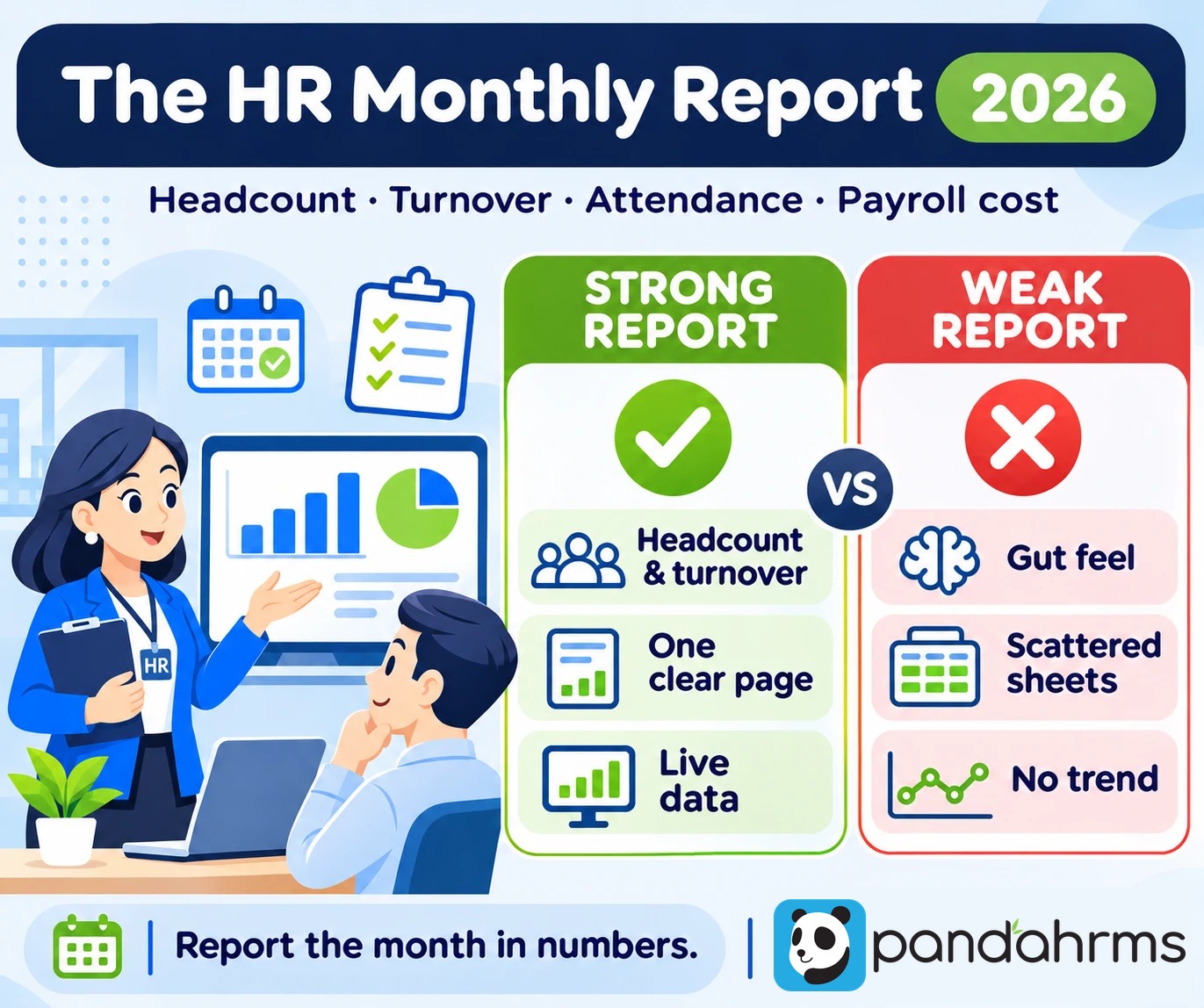
“How is the team doing?” When management asks, a gut-feel answer is not enough. A monthly HR report turns the month into numbers the boss can act on — who joined and left, how much leave was taken, what payroll actually cost, and what is coming up. Done well, it takes minutes to produce and replaces a dozen scattered spreadsheets.
This guide covers what a monthly HR report should include, the key metrics and how to calculate them, and how a system can build the whole thing for you.
What a Monthly HR Report Should Include
A good report is one or two pages, not a novel. Cover these sections and management has what it needs:
- Headcount & movement — opening headcount, new joiners, leavers, closing headcount, split by department if useful.
- Turnover — the turnover rate for the month, with the year-to-date trend.
- Attendance & absenteeism — attendance rate, late/absent days, and any patterns worth flagging.
- Leave — leave taken in the month, remaining balances, and the leave liability carried on the books.
- Overtime — total OT hours and cost, and which teams are driving it.
- Payroll cost & statutory — total payroll, employer EPF/SOCSO/EIS, and cost per head.
- Recruitment — open positions, offers out, and time-to-fill.
- Compliance & upcoming — confirmations due, contract or permit expiries, and statutory deadlines for the coming month.
The Key Metrics — and How to Calculate Them
Numbers only help if they are calculated the same way every month. These are the core ones.
| Metric | How to calculate |
|---|---|
| Turnover rate | Leavers ÷ average headcount × 100 |
| Absenteeism rate | Days absent ÷ total working days × 100 |
| Attendance rate | Days present ÷ total working days × 100 |
| Overtime as % of payroll | OT cost ÷ total payroll × 100 |
| Cost per head | Total payroll cost ÷ headcount |
Pick one definition for each metric and stick to it. A turnover rate that is calculated differently each month tells management nothing — consistency is what makes a trend real.
A Quick Turnover Example
If you start the month with 48 staff, end with 52, and 2 people left, your average headcount is 50 and turnover for the month is 2 ÷ 50 × 100 = 4%. Track it month on month and the direction matters more than any single figure.
Who Reads It, and How Often
The monthly HR report is for management — the business owner, a director, or the finance lead. Keep it to a short summary page of headline numbers, with the detail behind it available on request. Most SMEs run it monthly, aligned to the payroll close, so the payroll and statutory figures are final when the report goes out.
How a System Builds It for You
The slow way is to pull headcount from one spreadsheet, leave from another, attendance from a third, and payroll from a fourth — then reconcile them by hand every month. With Pandahrms, headcount, attendance, leave, overtime and payroll cost all live in one place, so the monthly report is generated from live data in a few clicks — the turnover rate, leave liability and payroll cost are already calculated, and the numbers reconcile because they come from the same source. That turns a day of spreadsheet work into minutes, and the figures are ready the moment payroll closes. For the payroll side of those numbers, see our guide on how to run payroll in Malaysia.
Want your monthly HR numbers generated automatically? Book a free Pandahrms demo.
Frequently Asked Questions
- What should a monthly HR report include?
Headcount and movement, turnover, attendance and absenteeism, leave taken and balances, overtime, payroll cost and statutory contributions, recruitment status, and upcoming compliance items such as confirmations and permit expiries. - How do you calculate the monthly turnover rate?
Divide the number of leavers in the month by the average headcount (opening plus closing, divided by two), then multiply by 100. Use the same formula every month so the trend is meaningful. - How long should the report be?
One or two pages. Lead with a summary of headline numbers for management, and keep the supporting detail available behind it rather than crammed onto the front page. - When should it be prepared?
After the monthly payroll close, so the payroll cost and statutory figures are final. Most SMEs run it once a month on a fixed date. - Can the report be automated?
Yes. When headcount, attendance, leave and payroll sit in one system, the report and its metrics are generated from live data in a few clicks, instead of being rebuilt from separate spreadsheets each month.
This article is general guidance for employers, not legal advice.