Salaries do not just “appear” in employees’ accounts on payday. Behind every payment run is a bank payment file — a list of who gets paid, how much, and into which account — uploaded to the bank and processed through Malaysia’s payment rails. Get the file right and payday is invisible; get an account number wrong and you have a frustrated employee and a failed transfer to chase.
This guide covers how the law says wages must be paid, what a bank payment file is, the difference between IBG, DuitNow and RENTAS, and the rejections that trip employers up.
How the Law Says Wages Must Be Paid
Two sections of the Employment Act 1955 set the ground rules.
| Rule | What it means |
|---|---|
| Pay into a bank account (s.25) | Wages, after lawful deductions, must be paid into the employee’s own or joint bank account |
| Cash/cheque is the exception (s.25A) | Allowed only at the employee’s request and with the Director General’s approval |
| Pay on time (s.19) | Wages must be paid within 7 days after the end of the wage period |
Bank payment is not just convenient — it is the default required by law. Paying salaries by cash or cheque without the employee’s request and the Director General’s approval is an offence.
What a Bank Payment File Actually Is
A bank payment (or “bulk payment”) file is the batch instruction your payroll produces for the bank. It lists, for each employee: the bank name/code, the account number, the account holder name, and the net amount to credit. You upload it to the bank’s corporate portal, authorise it, and the bank credits every employee in one run — instead of making dozens of transfers by hand.
Each bank expects its own file format, so a file formatted for one bank will usually be rejected by another. This is why payroll software lets you export the file in the specific layout your bank requires.
IBG, DuitNow or RENTAS — Which Rail?
Malaysia has three main ways to move the money. Most salary runs use IBG or DuitNow.
| Rail | Best for | Speed & cost |
|---|---|---|
| IBG (Interbank GIRO) | Standard bulk salary runs | Low cost; credited same or next working day in set batches |
| DuitNow | Instant pay; paying to an ID (IC/phone) | Near-instant, round the clock |
| RENTAS | Large or urgent single payments | Real-time; higher fee |
The Rejections That Trip Employers Up
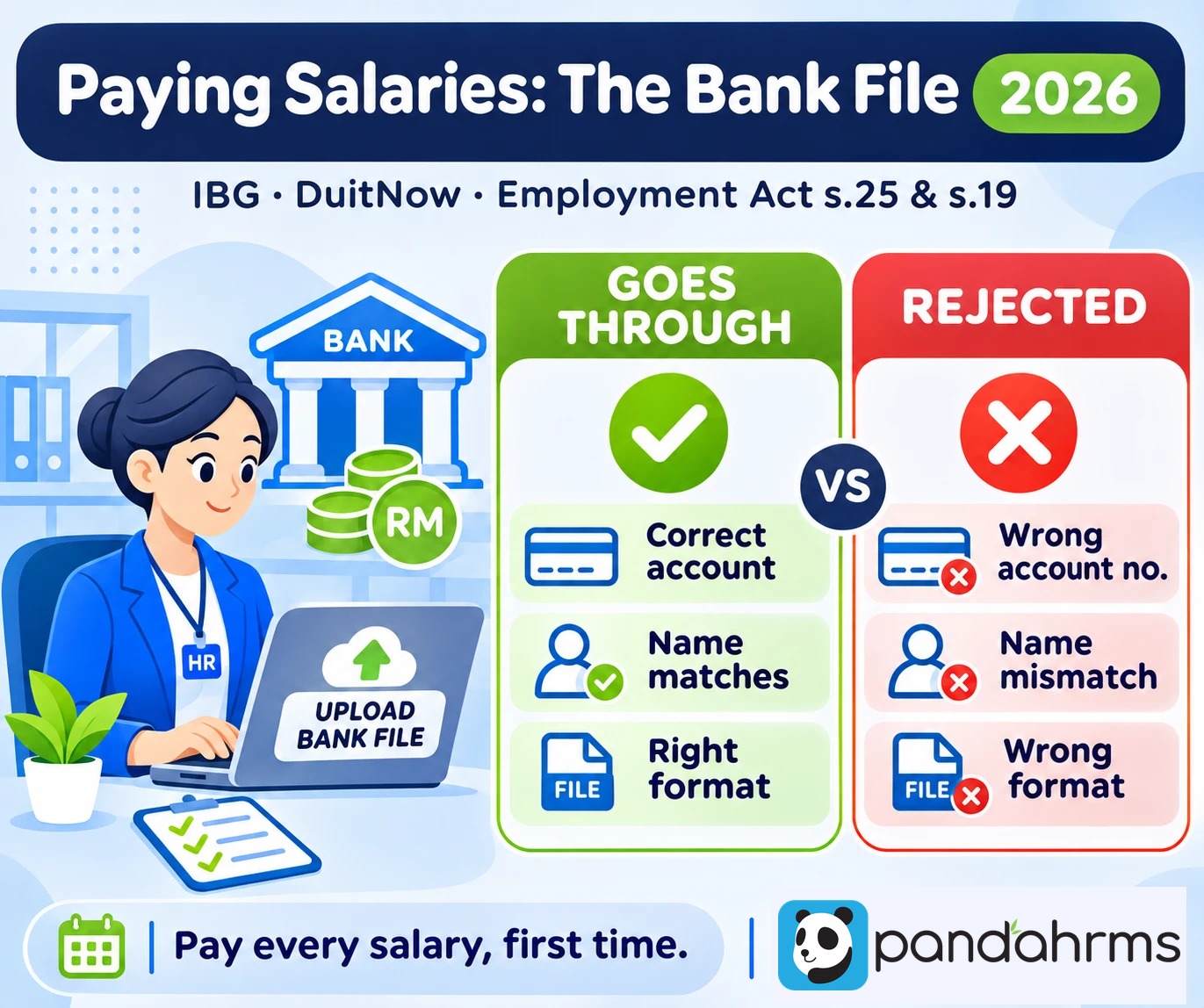
A payment file fails for boring, avoidable reasons. The usual suspects:
- Wrong account number — a single mistyped digit bounces the transfer back.
- Name mismatch — the account holder name does not match the bank’s records.
- Closed or dormant account — the employee changed banks and forgot to tell HR.
- Wrong bank code — the account is mapped to the wrong bank.
- Wrong file format — the file is not in the layout that specific bank expects.
The fix is clean employee bank data and a correctly formatted file — which is exactly what a payroll system maintains for you. A failed transfer can also push a payment past the 7-day deadline, so catching these before upload matters.
How a System Generates the File
With Pandahrms, once payroll is finalised the bank payment file is generated in your bank’s exact format — employee accounts, names and net amounts already validated — ready to upload and authorise. No re-keying, no wrong-format rejections, and the net figures tie back to the payslips automatically. For the full monthly flow that produces those net figures, see our guide on how to run payroll in Malaysia, and on the timing rules, late salary payment and the law.
Want salary payments that just work every month? Book a free Pandahrms demo.
Frequently Asked Questions
- Must salaries be paid into a bank account in Malaysia?
Yes. Under Section 25 of the Employment Act 1955, wages (after lawful deductions) must be paid into the employee’s own or joint bank account. Cash or cheque is allowed only at the employee’s request and with the Director General of Labour’s approval. - What is a bank payment file?
It is the batch instruction payroll sends to the bank — each employee’s bank code, account number, name and net amount — uploaded to the bank’s portal so everyone is paid in one run instead of transfer by transfer. - What is the difference between IBG and DuitNow?
IBG (Interbank GIRO) is the low-cost standard for bulk salary runs, credited in set batches same or next working day. DuitNow is near-instant and round the clock, and can pay to an ID such as an IC or phone number. - Why do salary transfers get rejected?
Most often a wrong account number, a name that does not match the bank’s records, a closed account, a wrong bank code, or a file in the wrong format. Clean bank data and a correctly formatted file prevent nearly all of them. - By when must wages be paid?
Within 7 days after the end of the wage period, under Section 19 of the Employment Act. A rejected transfer that is not fixed quickly can push a payment past that deadline.
Source: Employment Act 1955 (Sections 19, 25 and 25A). This article is general information, not legal advice — confirm your specific situation with the Labour Department (JTKSM) or an employment lawyer.