As the year winds down, one question quietly hangs over many Malaysian workplaces: “Are we getting a bonus?” — and on the other side of the desk, “Do we actually have to pay one?” Employees often assume a year-end bonus is a given. Employers under cost pressure aren’t so sure. So what does the law really say?
The answer is more nuanced than a simple yes or no. Whether a bonus is mandatory depends almost entirely on one thing: what was promised. Here’s how it works in Malaysia.
Is a Year-End Bonus Mandatory in Malaysia?
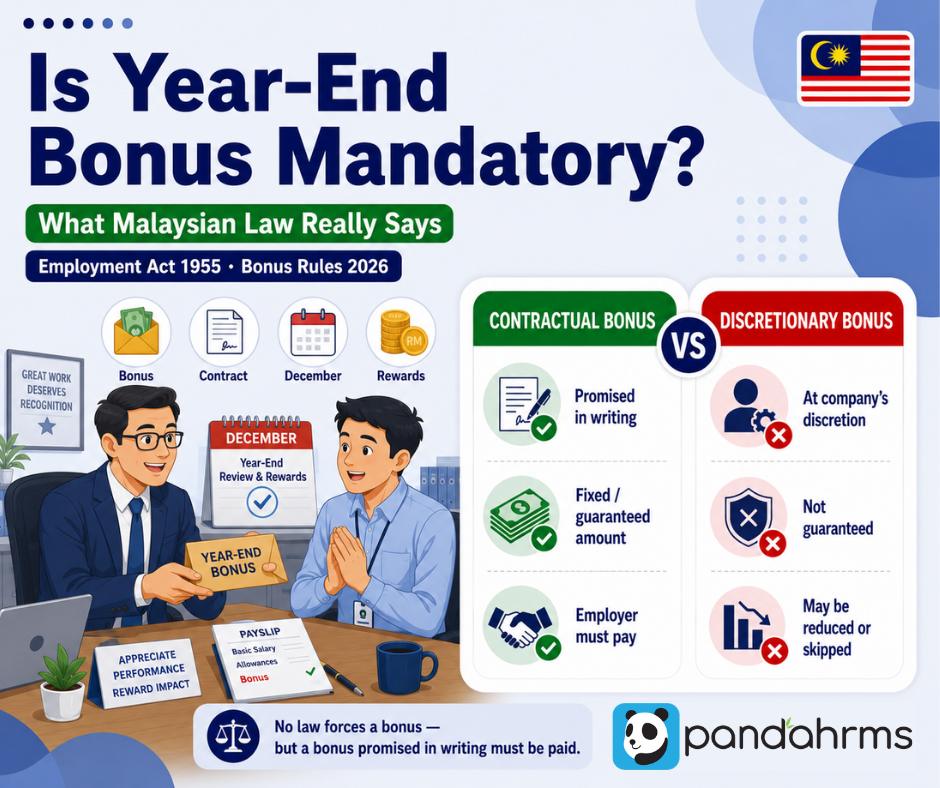
The short answer: No — there is no law in Malaysia that forces an employer to pay a year-end bonus. The Employment Act 1955 sets out wages, leave, and statutory benefits, but it does not require any annual or year-end bonus.
But — and this is the crucial part — a bonus can become a legal obligation if it was promised contractually. If it’s written into the employment contract, offer letter, company policy, or a collective agreement as a guaranteed payment, then it’s no longer optional. The employer must pay it.
Key point: A bonus isn’t mandatory by law — but it is mandatory by contract. The moment a fixed bonus is promised in writing, it stops being a “gift” and becomes an entitlement the employee can enforce.
Contractual Bonus vs Discretionary Bonus
Almost every bonus dispute comes down to this single distinction. Get it clear and most confusion disappears:
| Contractual Bonus | Discretionary Bonus |
|---|---|
| Promised in the contract, offer letter, or policy | Stated to be “at the company’s discretion” |
| Often a fixed amount (e.g. “1 month’s salary” / “13th month”) | Amount (if any) decided each year |
| Employer must pay it | Not guaranteed — may be reduced or skipped |
| Enforceable as a contractual right | Must still be decided fairly and in good faith |
When Does a Bonus Become Mandatory?
A bonus crosses from “nice to have” into “must pay” in these situations:
- It’s in the employment contract or offer letter as a fixed or guaranteed payment.
- Company policy or the handbook states a defined bonus employees are entitled to.
- A collective agreement (for unionised workplaces) provides for it — these are legally binding.
- Long, consistent practice — where an employer has paid the same bonus every year without fail, employees may argue it has become an implied term through custom and practice (harder to prove, but a real risk).
If any of these apply, withholding the bonus can expose the employer to a contractual claim.
What “Discretionary” Really Means
Even a genuinely discretionary bonus isn’t a free-for-all. If the contract says bonus is “at the company’s discretion,” the employer can decide the amount — including zero in a bad year — but that discretion is expected to be exercised reasonably and in good faith, not arbitrarily or to unfairly single someone out. Labelling something “discretionary” doesn’t licence bad-faith or discriminatory decisions.
Common Types of Bonus in Malaysia
- Fixed / contractual bonus — a guaranteed amount promised in writing (mandatory).
- 13th month salary — an extra month’s pay; mandatory only if it’s contractual, not by law.
- Performance bonus — tied to individual or company performance; usually discretionary.
- Profit-sharing / ex-gratia — a goodwill payment when the business does well; discretionary.
What About Employees Who Resigned or Joined Mid-Year?
This is where it gets contractual again. Whether a leaver or a mid-year joiner gets a bonus — or a pro-rated portion — depends on the wording. Many contracts state that an employee must still be in service on the bonus payment date to qualify, or set out how a partial year is pro-rated. Always check the specific terms; there’s no universal statutory rule here.
Bonus, Tax & Statutory Deductions
When a bonus is paid, remember it’s not tax-free. A bonus is treated as part of the employee’s remuneration, so it’s subject to PCB (monthly tax deduction), and EPF and SOCSO/EIS contributions apply. Employers should factor this into payroll so the bonus is processed and reported correctly.
For a related read on how pay is protected, see Can an Employer Cut Your Salary in Malaysia?
What Employers Should Do
- Be crystal clear in writing. State plainly in contracts and policies whether a bonus is contractual (guaranteed) or discretionary.
- Avoid vague promises. Casual assurances of “we always give a bonus” can come back as an expectation you’re bound to.
- Apply it consistently and fairly — especially for discretionary bonuses — to avoid claims of bad faith or unequal treatment.
- Communicate early. If a tough year means a smaller or no bonus, explain it honestly rather than leaving staff guessing.
Where Pandahrms Helps
Bonus season gets messy when terms, eligibility, and calculations live in scattered documents. With Pandahrms, employment terms and policies are recorded in one place, bonus payments run through payroll with the correct PCB, EPF and SOCSO applied automatically, and every payout is documented cleanly. So whether a bonus is contractual or discretionary, it’s processed accurately and transparently — no disputes, no payroll errors, no year-end scramble.
Set the terms clearly and let the system handle the rest.
Final Thoughts
So — is a year-end bonus mandatory in Malaysia? Not by law. But if you promised it in writing, it absolutely is. For employees, the payslip question is really a contract question: check what was actually agreed. For employers, the safest path is clarity — spell out whether a bonus is guaranteed or discretionary, apply it fairly, and communicate honestly. Do that, and bonus season stays a motivator, not a dispute.
Frequently Asked Questions (FAQs)
- Is a year-end bonus compulsory in Malaysia?
No. There is no statutory law requiring employers to pay a year-end or annual bonus. However, a bonus becomes mandatory if it is promised contractually — in the employment contract, offer letter, company policy, or a collective agreement. - What’s the difference between a contractual and a discretionary bonus?
A contractual bonus is promised in writing (often a fixed amount) and must be paid. A discretionary bonus is stated to be “at the company’s discretion” — the employer decides whether and how much to pay each year, though that discretion must still be exercised reasonably and in good faith. - Is a 13th month salary mandatory in Malaysia?
Not by law. A 13th month payment is only mandatory if it is written into the contract or policy as a guaranteed entitlement. Otherwise it is discretionary. - Do I get a bonus if I resign before it’s paid?
It depends on your contract. Many contracts require the employee to still be in service on the bonus payment date, or set out how a partial year is pro-rated. Check the specific wording, as there is no universal statutory rule. - Is a bonus taxable in Malaysia?
Yes. A bonus is part of your remuneration and is subject to PCB (monthly tax deduction), and EPF and SOCSO/EIS contributions apply. It should be processed through payroll and reported accordingly.