Every manager faces it eventually: an employee who just isn’t delivering. Missed deadlines, sloppy work, targets slipping month after month. It’s one of the most uncomfortable — and most mishandled — situations in HR. Move too slowly and the whole team suffers. Move too harshly and you’re staring down an unfair dismissal claim.
The good news: there’s a right way to handle underperformance that’s fair to the employee, protects the business, and often turns the situation around. Here’s the step-by-step process every Malaysian employer and HR team should follow.
What Counts as an Underperforming Employee?
An underperforming employee is one who consistently fails to meet the expected standards of their role — not someone who has a single bad week. The key word is consistently. Look for a pattern, such as:
- Repeatedly missing deadlines or targets (KPIs)
- Work quality that falls below the agreed standard
- Low productivity compared to the role’s expectations
- Frequent, avoidable errors that others have to fix
One missed deadline is an incident. A three-month pattern is underperformance. Always base your assessment on evidence, not a gut feeling.
First, Find the Root Cause
Before you escalate to warnings or a PIP, ask why. Jumping straight to discipline when the real problem is unclear expectations or missing tools will only backfire. Common root causes include:
- Unclear expectations — the employee doesn’t actually know what “good” looks like
- Insufficient training or resources — they were set up to fail
- Personal or health issues — something outside work is affecting them
- Poor communication or low engagement — they’ve quietly checked out
- Unrealistic workload — too much, too little support
Diagnosing the cause first tells you whether this is a coaching problem, a resourcing problem, or a genuine capability problem — and each needs a different response.
The Right Way to Manage Underperformance: Step by Step
Step 1: Identify the performance gap with evidence
Pinpoint exactly where performance falls short — with specific, measurable examples, not vague criticism. “Your reports were late 6 of the last 8 weeks” is actionable; “you’re not committed” is not. Document the shortfall against KPIs, targets, or quality standards.
Step 2: Have an honest private conversation
Meet the employee privately, share your observations calmly, and listen to their perspective. Ask about workload, whether they understand what’s expected, what support they’re missing, and what’s getting in the way. Often the real problem surfaces here.
Step 3: Set clear expectations
Spell out exactly what success looks like — specific KPIs, targets, deadlines, quality standards, and behaviours. Make them clear and measurable so there’s no ambiguity about what “improved” means.
Step 4: Provide support
Give the employee a genuine chance to improve: training, coaching, mentoring, regular feedback, and the resources or tools they need. This step matters legally too — a fair employer is expected to help the employee improve before dismissing them.
Step 5: Put a Performance Improvement Plan (PIP) in place
If informal support isn’t enough, formalise it with a written PIP that clearly states: the performance gaps, the specific improvement goals, the support being provided, review checkpoints, a realistic timeline (commonly 30–90 days), and how success will be measured. A PIP is both a genuine tool to help the employee and evidence of a fair process.
Step 6: Monitor, document, and take fair formal action if needed
Hold regular review meetings and keep records — performance reviews, KPI reports, coaching notes, meeting minutes, emails, and warning letters. If performance genuinely doesn’t improve despite the support and time given, you may proceed to formal warnings and, as a last resort, dismissal — but only after a fair process (see below).
The Legal Side: Can You Dismiss for Poor Performance in Malaysia?
Yes — poor performance is a valid reason for dismissal in Malaysia — but only if you follow a fair process. This is where many employers get caught out. Under Section 20 of the Industrial Relations Act 1967, a dismissed employee can claim they were dismissed “without just cause or excuse” (generally within 60 days). If it reaches the Industrial Court, the burden is on the employer to prove both a valid reason and a fair procedure.
For a poor-performance dismissal to stand, an employer is generally expected to show that the employee was:
- Warned that their performance was below standard;
- Given a reasonable opportunity and time to improve (typically via a PIP);
- Provided guidance and support to help them improve; and
- Still failed to meet the required standard despite all of the above.
Key point: Poor performance is not misconduct. You don’t fire someone for underperformance on the spot — you build a documented trail of warnings, support, and chances to improve. Skip that, and even a genuinely underperforming employee can win an unfair dismissal claim.
For the bigger picture on dismissal risk, see our guide: Unfair Dismissal in Malaysia: Legal Risks, Procedures, and Real Case Examples.
The Fair Approach vs the Risky Shortcut
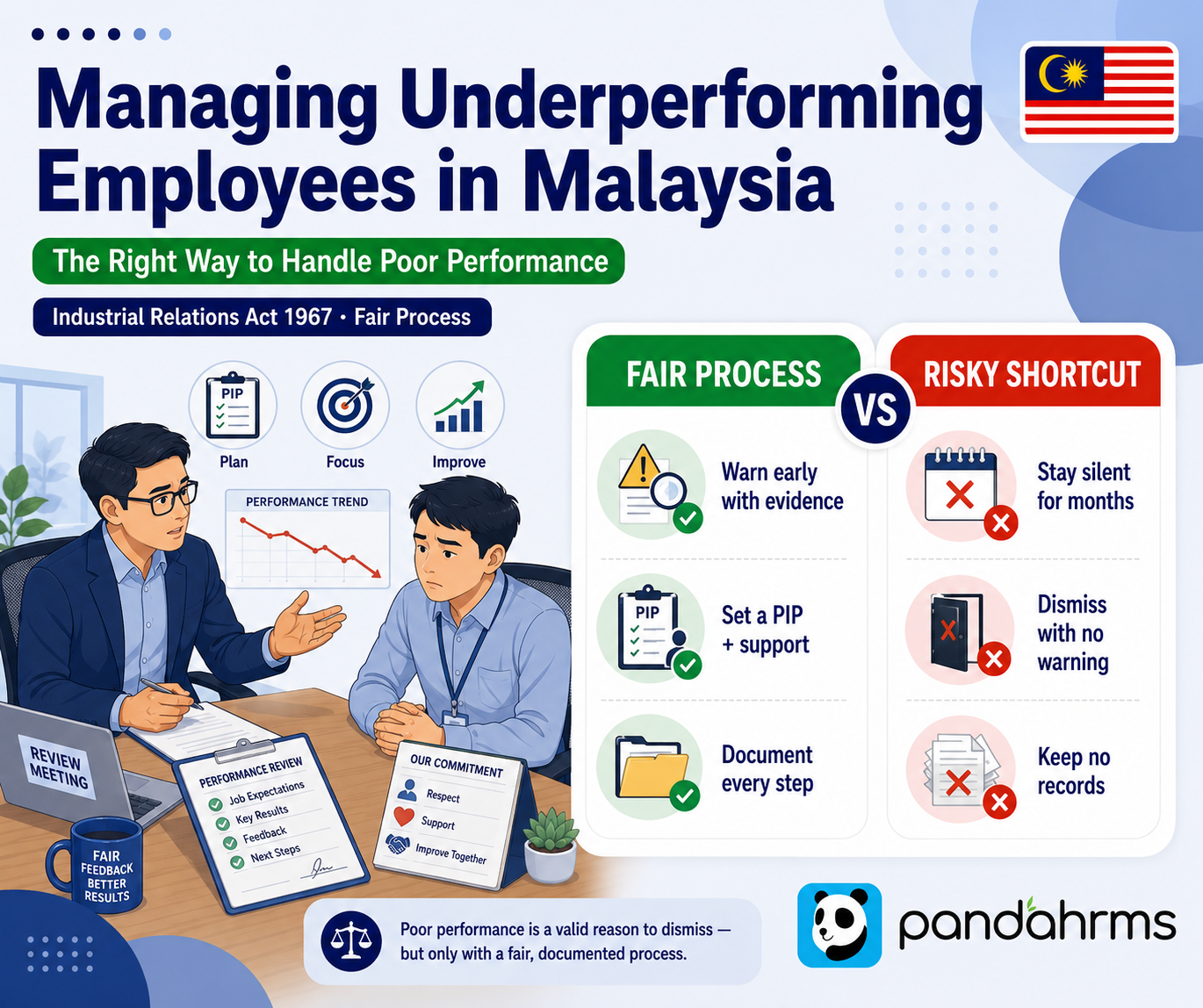
| ✅ Fair Process (Do) | ❌ Risky Shortcut (Don’t) |
|---|---|
| Raise concerns early, in private, with evidence | Say nothing for months, then explode |
| Set clear, measurable improvement goals | Give vague feedback like “buck up” |
| Provide a PIP with support and a fair timeline | Dismiss on the spot with no warning |
| Document every step | Keep no records of the process |
Common Mistakes Employers Make
- Ignoring the problem — hoping it fixes itself while the team resents carrying the slack.
- Delaying action — the longer you wait, the harder it is to justify sudden dismissal.
- Vague feedback — the employee never truly understood what to fix.
- Inconsistency — managing one person out while ignoring the same behaviour in another invites a fairness challenge.
- Assuming laziness — punishing what is actually a training or health issue.
- No documentation — no paper trail means no defence if it’s challenged.
Where Pandahrms Helps
Managing underperformance fairly comes down to clarity and records — and that’s exactly where a good system earns its keep. With Pandahrms, you can set and track KPIs, run structured performance reviews, log coaching conversations and warnings, and keep every PIP, review, and record in one organised place. So if you ever need to justify a decision, the full, fair, documented trail is already there — not scattered across inboxes and memory.
Handle it with clarity and good records, and underperformance becomes a problem you manage — not a lawsuit you defend.
Final Thoughts
Underperformance is uncomfortable, but it doesn’t have to be a crisis. Diagnose the cause, set clear expectations, give genuine support and time to improve through a PIP, and document every step. Do that, and you’ll either turn the employee around — the best outcome — or, if it truly doesn’t work out, part ways on solid, defensible ground. Fair process protects everyone: the employee, the team, and the business.
Frequently Asked Questions (FAQs)
- Can I dismiss an employee for poor performance in Malaysia?
Yes — poor performance is a valid reason for dismissal, but only if you follow a fair process: warn the employee, give them a reasonable chance and time to improve (usually via a PIP), provide support, and document it. Dismissing without this can lead to an unfair dismissal claim under Section 20 of the Industrial Relations Act 1967. - What is a Performance Improvement Plan (PIP)?
A PIP is a structured, written plan that sets out the performance gaps, specific improvement goals, the support provided, review checkpoints, a realistic timeline (commonly 30–90 days), and how success will be measured. It’s both a genuine tool to help the employee improve and evidence of a fair process. - How long should I give an underperforming employee to improve?
There’s no fixed legal figure, but the period must be reasonable for the role and the goals. PIPs commonly run 30 to 90 days, with regular review meetings so progress can be tracked and documented. - Is poor performance the same as misconduct?
No. Misconduct is about behaviour (e.g. dishonesty, absenteeism) and is usually handled through disciplinary action and a domestic inquiry. Poor performance is about capability or output, and is handled through warnings, support, and a chance to improve. The processes differ, so don’t treat them the same way. - What records should I keep when managing underperformance?
Keep performance reviews, KPI or target reports, notes from coaching and review meetings, emails, the PIP itself, and any warning letters. This documentation is your evidence of a fair process if the dismissal is ever challenged.