
Hiring part-timers for your café, store, event, or warehouse? The first question is always the same: how much should I pay? Pay too little and nobody applies; pay without knowing the rules and you risk breaching the law. This guide covers the typical market hourly rates for common part-time jobs in Malaysia — plus the legal rules every employer must follow when setting part-time pay.
Typical Part-Time Hourly Rates by Role (2026)
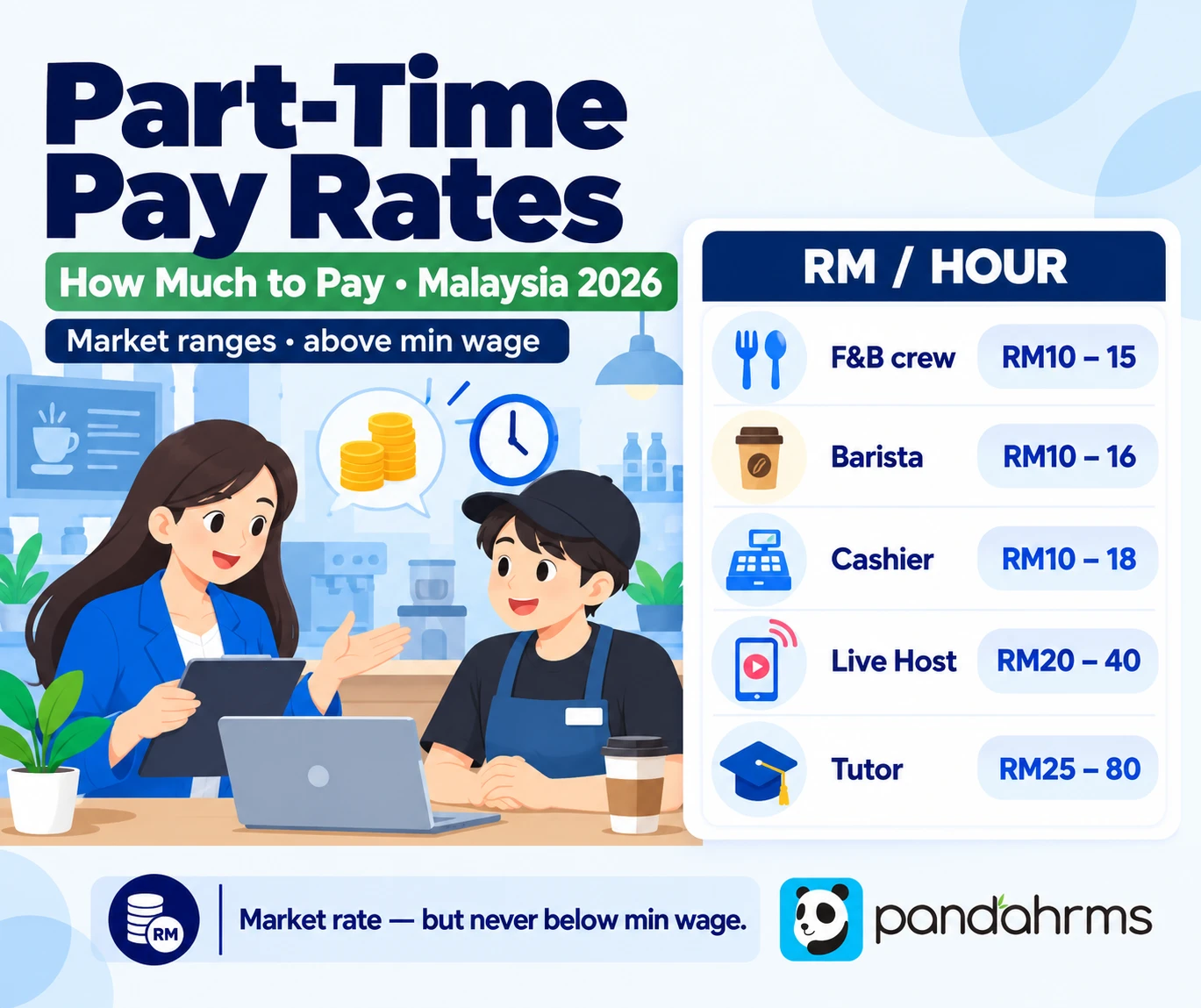
Below are the indicative hourly ranges commonly seen in the Malaysian market for popular part-time roles. Treat these as a market reference, not official figures — actual pay varies by location, experience, hours, and employer:
| Part-time role | Typical range (RM/hour) |
|---|---|
| Promoter | RM10 – 15 |
| Restaurant / F&B service crew | RM10 – 15 |
| Cashier | RM10 – 18 |
| Café barista | RM10 – 16 |
| Bubble-tea / drinks outlet crew | RM10 – 15 |
| Warehouse / packing | RM10 – 15 |
| Customer service | RM12 – 18 |
| Event helper | RM12 – 18 |
| Runner / errand | RM15 – 30+ |
| Content creator | RM15 – 30 |
| Live host | RM20 – 40 |
| Private tutor | RM25 – 80 |
The pattern is clear: skill and scarcity push the rate up. General service roles cluster around RM10–18, while skilled or performance-driven roles (tutoring, live hosting, content) command far more.
The Non-Negotiable: the Minimum Wage Floor
Market rates are a guide — but the law sets a floor you cannot go below. Part-time pay must be at least the pro-rated equivalent of the RM1,700 minimum wage. As a rough reference, RM1,700 a month works out to around RM8–9 per hour (for example, RM1,700 ÷ 26 days ÷ 8 hours ≈ RM8.20). Pay below that hourly equivalent and you’re in breach. (See our guides on the RM1,700 minimum wage and how to calculate the hourly rate.)
The Hourly Rate Isn’t the Whole Cost
A common mistake is thinking the hourly rate is all you pay. Part-time employees are entitled to more:
- EPF, SOCSO & EIS — statutory contributions apply to part-timers too, based on their actual wages.
- Pro-rated leave & public holidays — part-timers earn pro-rated annual leave, sick leave, and paid public holidays.
- Overtime — payable at the part-time rates once they exceed their normal hours.
So the true cost of a part-timer is the hourly rate plus these on-costs. For the full breakdown, see our guide on part-time employees’ rights, pay & entitlements.
How to Set Part-Time Pay the Right Way
- Benchmark to the market — use ranges like the above to stay competitive and actually attract applicants.
- Never go below the legal floor — keep the effective hourly rate at or above the minimum wage equivalent.
- Budget the statutory on-costs — factor EPF, SOCSO, and EIS into your true labour cost.
- Be consistent and put it in writing — a clear rate and terms avoid disputes and unfair-treatment claims.
Where Pandahrms Helps
Part-time payroll is fiddly precisely because it’s hourly and everything is pro-rated. Pandahrms calculates pay from the hourly rate and actual hours worked, applies the correct EPF, SOCSO, and EIS, pro-rates leave and public holidays, and produces a compliant payslip — for part-timers just as cleanly as for full-time staff. You set the rate; the system keeps the maths and the compliance right.
Final Thoughts
Knowing the market rate helps you hire; knowing the rules keeps you compliant. Pay a competitive hourly rate, never dip below the minimum wage equivalent, and remember the statutory on-costs that come with every employee — part-time included. Do that, and you’ll attract good part-timers without any nasty surprises.
Frequently Asked Questions (FAQs)
- How much do part-time jobs pay per hour in Malaysia?
Most general part-time roles pay around RM10–18 an hour, while skilled or performance-based roles (private tutoring, live hosting, content creation) can pay RM20–80+ an hour. These are indicative market ranges, not official figures, and vary by location, experience and employer. - Is there a minimum hourly pay for part-timers?
Yes, indirectly — part-time pay cannot fall below the pro-rated equivalent of the RM1,700 monthly minimum wage, which works out to roughly RM8–9 an hour. - Do employers pay EPF and SOCSO for part-timers?
Yes. EPF, SOCSO and EIS apply to part-time employees based on their actual wages, the same as for full-time staff. - Are part-timers entitled to leave and public holidays?
Yes — they receive pro-rated annual leave, sick leave and paid public holidays under the Employment (Part-Time Employees) Regulations 2010. - How should I decide what to pay a part-timer?
Benchmark against market ranges for the role, make sure the rate stays above the minimum wage equivalent, and budget for the statutory on-costs (EPF, SOCSO, EIS) on top of the hourly pay.



