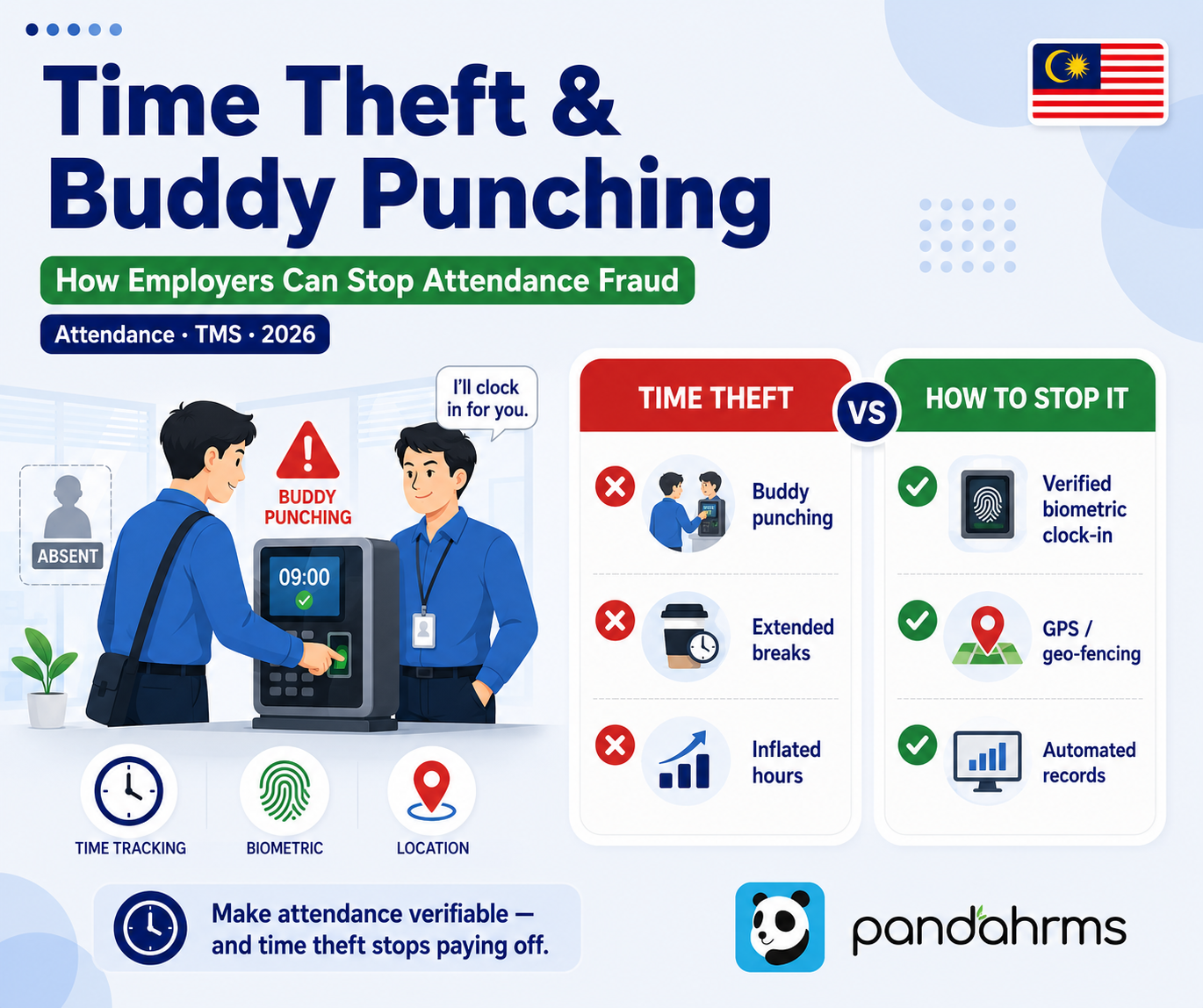
It rarely looks like theft. An employee clocks in for a friend who’s running late. Someone stretches a 15-minute break into 40. A few minutes get shaved off the start and end of every shift. Individually, it seems minor — but across a workforce, month after month, time theft quietly drains real money from a business.
Here’s what time theft looks like in Malaysian workplaces, why it matters, and how employers can stop it — fairly and effectively.
What Is Time Theft?
Time theft is when an employee is paid for time they didn’t actually work. It’s not always deliberate fraud — sometimes it’s habit or a loose system — but the result is the same: hours on the payroll that weren’t really worked. The most common form in Malaysia is “buddy punching” — one employee clocking in or out on behalf of an absent colleague.
Key point: A little time theft per employee doesn’t feel like much — but multiplied across a team and a year, it becomes a significant, invisible payroll cost.
Common Types of Time Theft
| Type | What it looks like |
|---|---|
| Buddy punching | Clocking in/out for an absent or late colleague |
| Extended breaks | Regularly taking longer breaks than allowed |
| Early clock-out / late clock-in | Shaving minutes off the start or end of shifts |
| Inflated hours | Recording overtime or hours that weren’t worked |
| Excessive personal time | Long personal activities on the clock as a routine |
Is Time Theft Misconduct?
Yes — deliberately claiming pay for time not worked (especially buddy punching, which involves dishonesty) can amount to misconduct. But employers should handle it through a fair process, not knee-jerk punishment: have a clear attendance policy, investigate, give the employee a chance to explain, and apply discipline consistently. Vague accusations or inconsistent treatment can backfire. It’s related to, but distinct from, physical or financial theft at work — see our guide on preventing employee theft.
How Employers Can Prevent Time Theft
- Set a clear attendance policy. Define working hours, break rules, and what counts as a violation — and communicate it.
- Remove manual clocking loopholes. Paper timesheets and shared punch cards make buddy punching easy.
- Use verified attendance methods — biometric (fingerprint/face) or mobile clock-in tied to the individual, so no one can clock in for someone else.
- Use GPS / geo-fencing for field and hybrid staff, so clock-ins only count from approved locations.
- Automate the records. Accurate, tamper-resistant time data feeds straight into payroll — no manual fudging.
- Address issues early and fairly before they become a culture.
Where Pandahrms Helps
Time theft thrives on manual, easily-gamed attendance. Pandahrms closes those gaps: employees clock in through verified methods tied to the individual, geo-fencing ensures clock-ins only register from approved locations, and every record flows automatically into payroll — so hours are accurate, buddy punching is blocked, and you pay for the time that was actually worked. Managers get a clear, tamper-resistant view of attendance without chasing paper timesheets.
Make attendance verifiable, and time theft simply stops paying off.
Final Thoughts
Time theft is easy to ignore because each instance is small — but it adds up to a real, ongoing cost, and it’s unfair to the honest majority. The fix isn’t suspicion; it’s a clear policy plus a verifiable attendance system that removes the loopholes. Get both right, and you protect your payroll while keeping trust intact.
Frequently Asked Questions (FAQs)
- What is time theft?
Time theft is when an employee is paid for time they didn’t actually work — through buddy punching, extended breaks, shaving minutes off shifts, or recording hours that weren’t worked. - What is buddy punching?
Buddy punching is when one employee clocks in or out on behalf of an absent or late colleague, so that colleague gets paid for time they weren’t present. It’s the most common form of time theft. - Is time theft illegal or grounds for discipline?
Deliberately claiming pay for time not worked can amount to misconduct, especially where dishonesty (like buddy punching) is involved. It should be handled through a fair, documented process — a clear policy, investigation, and consistent discipline. - How can employers prevent buddy punching?
Use verified, individual attendance methods (biometric or mobile clock-in tied to the person) instead of shared cards or paper timesheets, add GPS/geo-fencing for field staff, and feed accurate records straight into payroll. - How much does time theft cost a business?
Each instance seems minor, but a few minutes per employee per day — multiplied across a workforce over a year — can add up to a significant, often invisible payroll cost.