
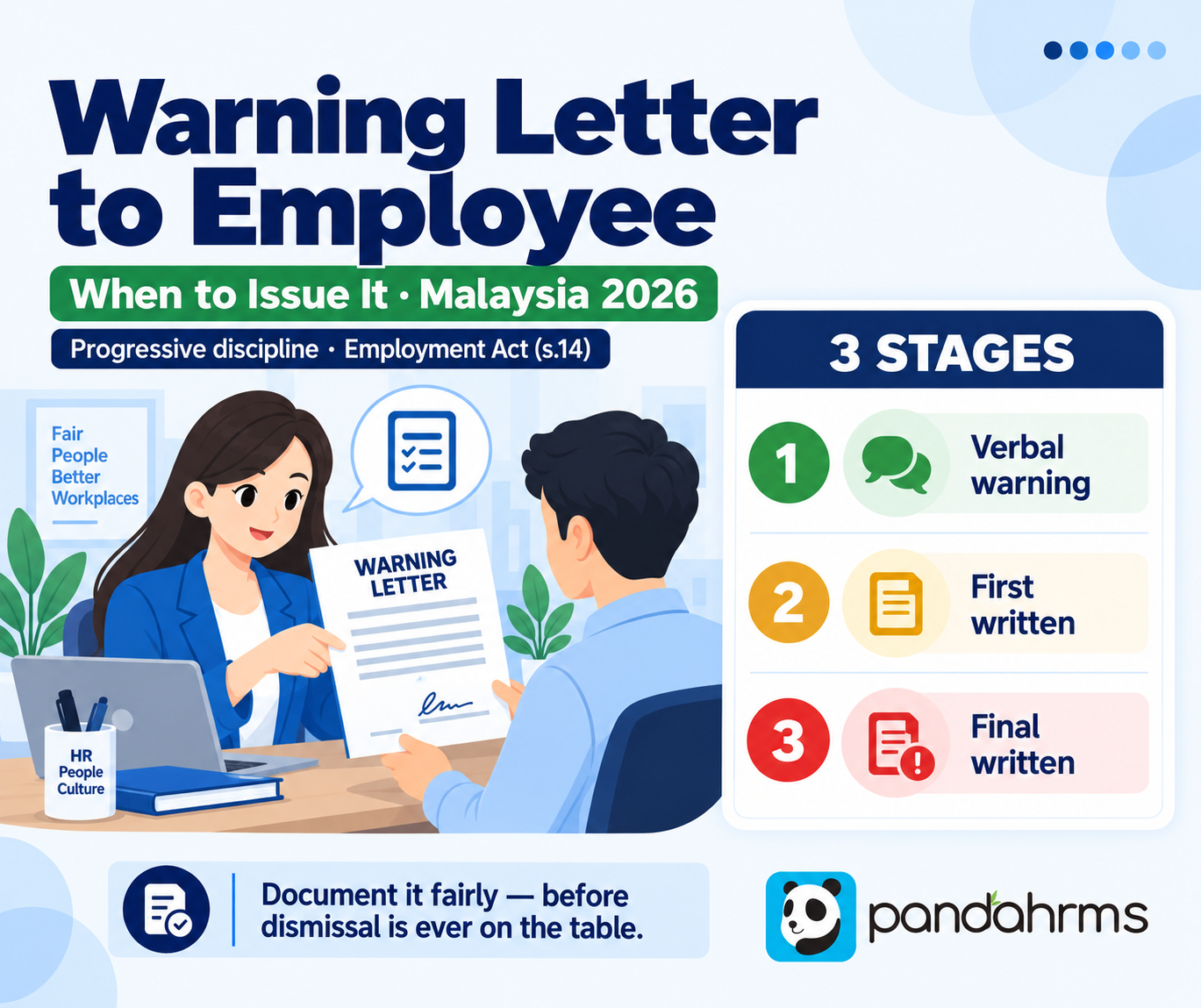
An employee keeps turning up late, ignores a safety rule, or misses targets month after month. What’s the right move? Jumping to dismissal is how employers lose at the Industrial Court. Issuing a proper warning letter — at the right time, saying the right things — is how you correct behaviour fairly and build the record you’ll need if it ever goes further. Here’s when to issue one, what it must contain, and free templates you can adapt.
What Is a Warning Letter?
A warning letter is a formal, written record that tells an employee their conduct or performance falls short, what they must correct, and what happens if they don’t. It’s a core part of progressive discipline — the principle that you act in escalating steps (from lesser to heavier) rather than jumping straight to dismissal.
Warning Letter vs Show Cause Letter
They’re often confused, but they do different jobs:
- A show cause letter asks the employee to explain why disciplinary action should not be taken — it comes before a decision. (See our full guide on the show cause letter.)
- A warning letter is the disciplinary action itself — issued after you’ve established the issue (or after an unsatisfactory show-cause reply), formally warning the employee to improve.
When Should You Issue a Warning Letter?
Typically for issues that don’t (yet) warrant dismissal, such as:
- Misconduct — lateness, absenteeism, insubordination, breaching a company rule.
- Poor performance — persistently failing to meet clear, communicated standards (usually alongside coaching and time to improve).
- Repeat issues — where a verbal reminder or first warning hasn’t worked.
The Stages of Warning
| Stage | When it’s used |
|---|---|
| Verbal warning (documented) | A first, minor issue — noted in the file even if given verbally. |
| First written warning | The issue continues or is more serious — the first formal written notice. |
| Final written warning | Serious or repeated misconduct — the last chance before further action, including dismissal. |
How far you escalate depends on the seriousness — genuinely serious misconduct may move quickly to a show cause and a domestic inquiry, which is required under Section 14(1)(a) of the Employment Act 1955 before a dismissal for misconduct.
What a Warning Letter Must Contain
- Employee details & date — name, position, and the date of the letter.
- The specific issue — exactly what happened, with dates, facts, and the rule or standard breached.
- Reference to earlier warnings — if this isn’t the first.
- The required improvement — what the employee must do, and by when.
- The consequence — that further or repeated misconduct may lead to more serious action, up to dismissal.
- Acknowledgement — a space for the employee to sign receipt.
Free Template — First Written Warning
|
[Company Letterhead]
Date: [DD/MM/YYYY] | To: [Employee Name], [Position] RE: FIRST WRITTEN WARNING Dear [Employee Name], This letter is a formal written warning regarding [state the misconduct / performance issue clearly], which occurred on [date(s)]. This conduct is a breach of [company policy / expected standard]. You are required to [state the specific improvement expected] with immediate effect. Please treat this matter seriously. Please be advised that any repetition of this conduct, or further misconduct, may result in more serious disciplinary action, up to and including dismissal. We are confident you will take the necessary steps to correct this. Yours faithfully, ______________________ Acknowledged received by: ______________ (Employee) Date: __________ |
Free Template — Final Written Warning
|
[Company Letterhead]
Date: [DD/MM/YYYY] | To: [Employee Name], [Position] RE: FINAL WRITTEN WARNING Dear [Employee Name], Despite a previous warning issued on [date of earlier warning], you have again [state the repeated / serious misconduct] on [date(s)]. This is a serious matter and a continued breach of [policy / standard]. This letter serves as your FINAL WRITTEN WARNING. You must [state the required improvement] immediately and maintain it. Please be warned that any further misconduct of any kind may result in disciplinary proceedings, including a domestic inquiry, and may lead to dismissal. Yours faithfully, ______________________ Acknowledged received by: ______________ (Employee) Date: __________ |
Always adapt each letter to the actual facts — a vague, copy-paste warning is far weaker evidence than a specific, factual one.
Do’s and Don’ts
- Do state the specific facts, dates, and rule breached.
- Do document issues when they happen — courts are sceptical of a paper trail clearly created just to justify a dismissal.
- Do give a genuine chance (and reasonable time) to improve, especially for performance.
- Don’t be vague (“bad attitude”) or emotional.
- Don’t skip straight to dismissal for issues that warrant a warning first.
- Don’t forget to keep a signed, dated copy on file.
Where Pandahrms Helps
A warning is only as strong as the record behind it. With Pandahrms, every warning, note, and acknowledgement sits in the employee’s record with a clear date stamp — and for attendance-related issues like lateness or absence, the verified clock-in data is right there as evidence. When discipline is documented contemporaneously and stored in one place, you build a fair, consistent, and defensible history — instead of scrambling to reconstruct it later.
Final Thoughts
A warning letter isn’t about punishing people — it’s about giving a fair, documented chance to improve, and following proper process. Be specific, be timely, escalate reasonably, and keep clean records. Do that, and you protect both your employee’s right to be heard and your company’s position if the matter ever reaches dismissal.
Frequently Asked Questions (FAQs)
- What is the difference between a warning letter and a show cause letter?
A show cause letter asks the employee to explain why action shouldn’t be taken (before a decision). A warning letter is the disciplinary action itself, formally warning the employee to improve after the issue is established. - How many warnings must be given before dismissal in Malaysia?
There’s no fixed legal number. What matters is a fair, progressive process appropriate to the seriousness — and, for dismissal on misconduct, a due inquiry (domestic inquiry) under Section 14(1)(a) of the Employment Act 1955. - What must a warning letter include?
The employee’s details and date, the specific issue with facts and the rule breached, any reference to earlier warnings, the required improvement, the consequence of repetition, and a space to acknowledge receipt. - Can an employee refuse to sign a warning letter?
Yes, but signing only acknowledges receipt, not agreement. If they refuse, note the refusal (ideally with a witness) — the warning still stands as issued. - Can you issue a warning letter for poor performance?
Yes, but performance is best handled with coaching, clear standards, and reasonable time to improve. A warning documents the shortfall as part of a fair progressive process.



