A story recently went viral on Malaysian social media. An IT worker — by his own account, good at his actual job — was failed during his probation. The reason had nothing to do with his work. He left the office at 6pm on Fridays, used his lunch break to rest instead of socialise, and didn’t join the boss’s Friday-night activities.
A senior colleague reportedly told him he’d “wasted the hints,” that “surviving in the workplace isn’t just about being capable,” and that he “might not be suitable for the company.” Probation: failed.
The story struck a nerve — and it raises a question every Malaysian employer should be able to answer: when you fail a probationer, does your reason actually hold up?
Because “not a good fit” is one of the most dangerous phrases in HR. Here’s what counts as a valid reason to fail probation, what doesn’t, and how to do it without landing at the Industrial Court.
What Probation Is Actually For
Probation exists for one purpose: to let the employer assess whether a new hire is suitable for the job. That means their performance, conduct, and ability to do the role — the things the job actually requires.
It is not a trial period for whether someone is likeable, whether they socialise after hours, or whether they play office politics well. Those aren’t job requirements — they’re preferences. And failing someone on preferences rather than performance is where employers get into trouble.
Probationers Are Not “Fire at Will”
The single biggest misconception is that a probationer can be let go for any reason, or no reason. That is not the law in Malaysia.
A probationer enjoys the same protection against dismissal without just cause or excuse as a confirmed employee. Malaysian courts have made this clear for decades (for example, Khaliah bte Abbas v Pesaka Capital Corp Sdn Bhd). If a probationer is failed unfairly, they can file a representation for unfair dismissal — the same route as anyone else.
So “she’s still on probation” does not mean “we can let her go for anything.” You still need a valid, job-related reason.
Valid vs Invalid Reasons to Fail Probation
Here’s the practical line between a defensible decision and a risky one.
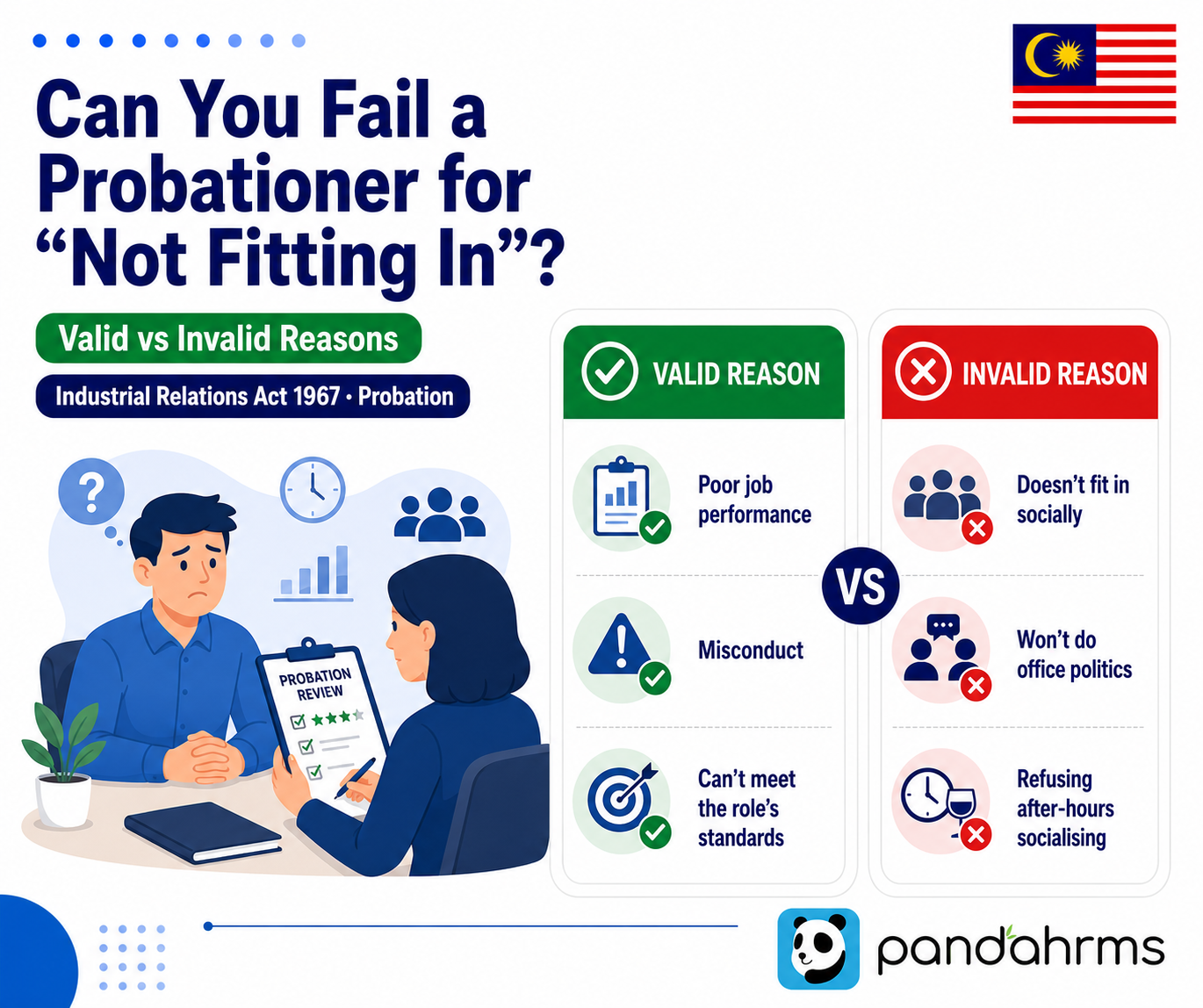
| Valid reasons (job-related) | Invalid reasons (preference / unfair) |
|---|---|
| Poor job performance against clear standards | “Doesn’t fit in” socially |
| Misconduct (e.g. dishonesty, insubordination) | Won’t join after-hours socialising or events |
| Unable to meet the role’s technical requirements | Refusing office politics / not “pleasing” the boss |
| Repeated failure to improve after feedback | Personal dislike or personality clash |
| Poor attendance or reliability | Keeping normal work-life boundaries (leaving on time) |
Notice the pattern: valid reasons are about the job; invalid reasons are about the person. An employee who does their work well but declines to attend the boss’s Friday-night activities has done nothing that justifies failing probation.
The Legal Risk of Getting It Wrong
If a probationer is dismissed without just cause or excuse, they can bring an unfair dismissal claim. A few things employers should know:
- The claim can proceed to conciliation and, if unresolved, the Industrial Court.
- The burden is on the employer to prove the dismissal was fair and for a valid reason.
- If the dismissal is found unfair, remedies include reinstatement or compensation (back wages, generally capped at around 12 months for a probationer).
And here’s the trap: if your documented reason is thin — or worse, if the real reason was office politics dressed up as “not suitable” — you have very little to defend with. Vague grounds like “not a good fit” collapse quickly under scrutiny. Pushing someone out through pressure or freeze-outs can also edge into constructive dismissal territory.
How to Fail Probation Properly
If a probationer genuinely isn’t working out, you can still let them go — you just have to do it the right way.
Step 1: Set clear, job-related expectations from day one
Define the role’s KPIs and standards in writing so “suitability” is measured against the job, not vibes.
Step 2: Give real feedback during probation
Tell the employee where they’re falling short, with specifics, and give them a genuine chance to improve.
Step 3: Document everything
Keep records of feedback, review meetings, and any performance concerns. This is your evidence.
Step 4: Consider extending probation instead of failing
If it’s borderline, a documented extension with clear targets is often safer and fairer than an outright fail.
Step 5: Base the decision on the job — and record why
When you do decide, tie it to performance or conduct, not personality, and put the reason in writing.
Key principle: You can fail a probationer who can’t do the job. You cannot fail one simply because they won’t “please the boss.” Assess the work, document it, and decide on job-related grounds.
Where Pandahrms Helps
The difference between a defensible probation decision and a costly claim is almost always documentation — clear KPIs, recorded feedback, and a dated performance history.
This is exactly what an HR system like Pandahrms is built for. Probation periods are tracked with reminders before each review date, appraisals and feedback are recorded against each employee, and supporting notes stay organised in one place. So when you decide to confirm, extend, or fail a probationer, the reason is backed by real, job-based evidence — not a vague feeling that someone “didn’t fit in.”
Assess fairly, record it properly, and let your system hold the proof.
Final Thoughts
The viral IT-worker story resonated because a lot of people have seen it happen: a capable employee pushed out for reasons that had nothing to do with their work. For employers, the lesson is simple.
Probation is a test of whether someone can do the job — not whether they’ll stay late for social events or play the political game. Fail a probationer on genuine, documented, job-related grounds and you’re on solid ground. Fail them for “not fitting in,” and you may be handing them an unfair dismissal claim.
Judge the work. Document the reasons. Decide fairly. That protects your business and your people.
Frequently Asked Questions (FAQs)
- Can an employer fail a probationer for any reason in Malaysia?
No. Probationers are protected against dismissal without just cause or excuse, just like confirmed employees. There must be a valid, job-related reason, and a fair process. - Is “not a good fit” a valid reason to fail probation?
On its own, no. Vague grounds like “not a good fit” don’t hold up if challenged. The reason must relate to the employee’s performance, conduct, or ability to do the job, and be supported by evidence. - Can you fail a probationer for refusing to work overtime or attend after-hours events?
Refusing to attend non-work social events, or declining unpaid after-hours activities that aren’t part of the job, is generally not a valid reason to fail probation. Failing someone on this basis risks an unfair dismissal claim. - What can a probationer do if they’re unfairly failed?
They can file a representation for unfair dismissal, which may go to conciliation and then the Industrial Court. Remedies include reinstatement or compensation. - How should employers fail probation the right way?
Set clear job-related expectations, give genuine feedback, document everything, consider extending probation if borderline, and base the final decision on performance or conduct — not personality or office politics.
Disclaimer
This article is intended for general informational purposes only and should not be regarded as legal advice. Probation and dismissal outcomes depend on the specific facts, the employment contract, the applicable laws, and individual circumstances. Employers are encouraged to refer to the latest guidance from the Department of Labour (JTKSM) or consult a qualified employment adviser before acting.
Sources
- Industrial Relations Act 1967 (Act 177), Malaysia — Section 20
- Employment Act 1955 (Act 265), Malaysia
- Khaliah bte Abbas v Pesaka Capital Corp Sdn Bhd [1997] 3 MLJ 1
- Department of Labour Peninsular Malaysia (JTKSM) guidance on probation and termination