
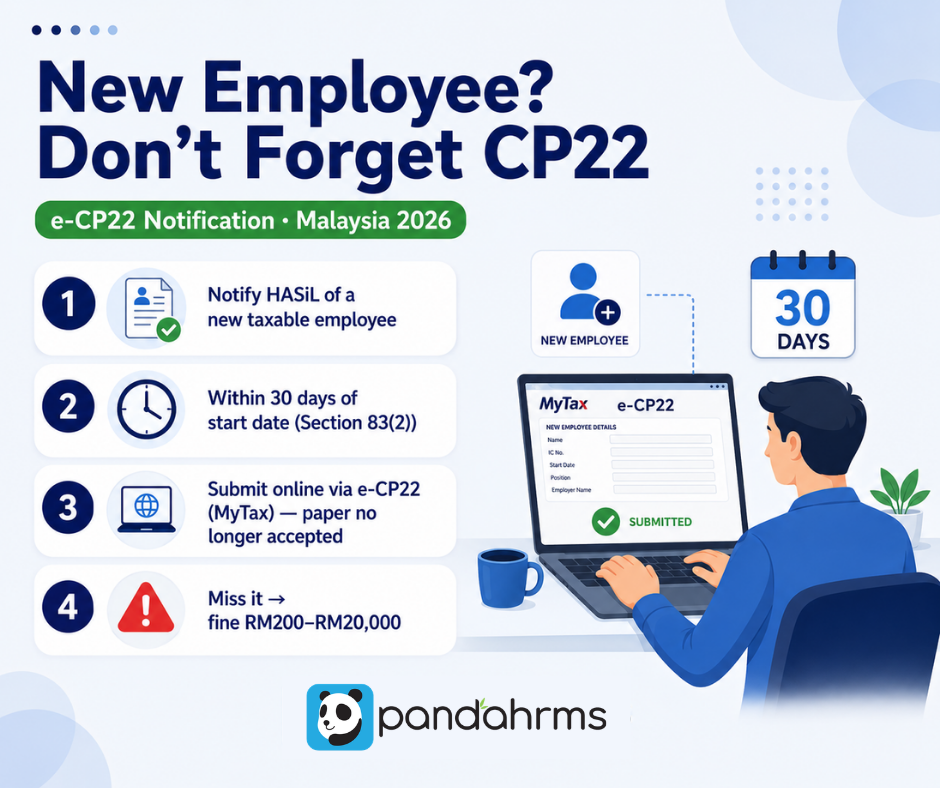
Hiring a new employee? Your onboarding checklist shouldn’t stop at the employment contract. For Malaysian employers, there’s a tax obligation that’s easy to overlook — and missing it can be costly: notifying HASiL (the Inland Revenue Board) that you’ve taken on a new taxable employee.
That notification is Form CP22, now submitted online as e-CP22. Here’s what it is, when it’s required, and how to stay compliant.
What Is CP22?
CP22 is an employer’s notification to HASiL of a new employee who is — or is likely to be — chargeable to tax on their employment income. It exists so the tax authority receives timely information about the start of employment.
The obligation comes from Section 83(2) of the Income Tax Act 1967: where an employer starts to employ an individual who is, or is likely to be, chargeable to tax on employment income, the employer must notify the Director-General in the prescribed form within 30 days of the employment commencing.
Key point: CP22 isn’t just “another HR form to file and forget.” It’s a statutory notification with a hard 30-day deadline — and real penalties for getting it wrong.
CP22 at a Glance
| Question | Answer |
|---|---|
| What is it? | Employer’s notification to HASiL of a new taxable employee |
| Legal basis | Section 83(2), Income Tax Act 1967 |
| Deadline | Within 30 days of the employment start date |
| How to submit | Online via e-CP22 (MyTax) — paper is no longer accepted |
e-CP22: Online Submission Is Now Mandatory
Since 1 September 2024, new-employee notifications must be submitted online through e-CP22 on the MyTax portal. Manual (paper) CP22 is no longer permitted.
The practical implication: whoever handles your payroll or HR needs the right MyTax access and user role to submit e-CP22. The old routine of printing, signing, and mailing a form is gone — the workflow is fully online. (Employers can refer to the e-CP22 User Manual via MyTax > User Guide.)
Important: Not Every New Hire Triggers CP22
This is where careful reading of Section 83(2) matters. The obligation applies to an individual who is “or is likely to be, chargeable to tax” on employment income — so you should not assume every single new hire automatically requires a CP22.
For example, an employee earning around RM1,700 a month who, on their circumstances, is not taxable or likely to be taxable may not require CP22 under Section 83(2). But be careful: the salary figure alone is not a universal exemption test. Personal reliefs, remuneration components, residence status, and other facts all affect whether someone is likely to be taxable.
The practical rule: assess the tax position first, submit correctly, and keep the basis for your conclusion. When in doubt, get advice from a qualified tax professional rather than relying on a salary number in isolation.
The Cost of Non-Compliance
An employer who fails to comply with Section 83(2) without reasonable excuse may, on conviction, face:
- A fine of not less than RM200 and not more than RM20,000; or
- Imprisonment for a term not exceeding 6 months; or
- Both.
The cost of missing a deadline is far higher than the few minutes it takes to build a simple onboarding control.
Don’t Confuse CP22 With Stamp Duty
Two separate compliance questions often get muddled when hiring — keep them distinct:
- CP22 / e-CP22: Is the new employee taxable (or likely taxable) under Section 83(2), and does the notification need to be submitted within 30 days?
- Employment contract stamp duty: Is the employee’s monthly salary RM3,000 or below (and therefore within the exemption)? See our guide: HASiL’s RM3,000 employment contract stamp duty rule.
A stamp duty exemption does not remove the need to assess CP22 — and needing to file CP22 does not automatically mean the contract is subject to stamp duty. Two different questions, two different answers.
Employer’s Quick CP22 Checklist
Before closing a new hire’s onboarding file, ask:
- ✅ What is the employee’s commencement date?
- ✅ Is the employee taxable or likely to be taxable on employment income?
- ✅ If Section 83(2) applies, has CP22 been submitted via e-CP22 within 30 days?
- ✅ Does your payroll/HR team have the right MyTax access and role?
- ✅ Have you retained the e-CP22 submission record and supporting documents?
For the full onboarding picture, see our New Employee Onboarding Compliance Checklist and the complete hiring compliance timeline.
Where Pandahrms Helps
CP22 compliance comes down to knowing each new hire’s start date, assessing taxability, and hitting the 30-day window — exactly the kind of thing that slips through the cracks in manual onboarding. With Pandahrms, every new employee’s commencement date, salary details, and documents sit in one place, so HR can quickly assess who needs a CP22, track the 30-day deadline, and keep the submission records organised. Good onboarding data turns a compliance risk into a routine checkbox.
Capture the details at onboarding, and CP22 stops being something you scramble to remember.
Final Thoughts
The safest employer isn’t the one who panic-submits every form, or the one who assumes every new hire is exempt. It’s the one who assesses each employee’s tax position, submits CP22 through e-CP22 within 30 days when Section 83(2) applies, and keeps proper records — while separately checking the contract’s stamp duty treatment. Know which filing is required, which exemption applies, and why, and your onboarding stays compliant.
Frequently Asked Questions (FAQs)
- What is Form CP22?
CP22 is the employer’s notification to HASiL that they have taken on a new employee who is, or is likely to be, chargeable to tax on employment income. It is required under Section 83(2) of the Income Tax Act 1967. - When must CP22 be submitted?
Within 30 days from the employee’s commencement of employment, where Section 83(2) applies. - Is CP22 still submitted on paper?
No. Since 1 September 2024, the notification must be submitted online through e-CP22 on the MyTax portal. Manual (paper) submission is no longer permitted. - Does every new employee need a CP22?
No. It applies only to employees who are, or are likely to be, chargeable to tax on employment income. You must assess each employee’s tax position — salary alone is not a definitive test, and personal reliefs and other circumstances matter. - What is the penalty for not filing CP22?
Failure to comply with Section 83(2) without reasonable excuse may, on conviction, lead to a fine of RM200 to RM20,000, imprisonment of up to 6 months, or both.



