
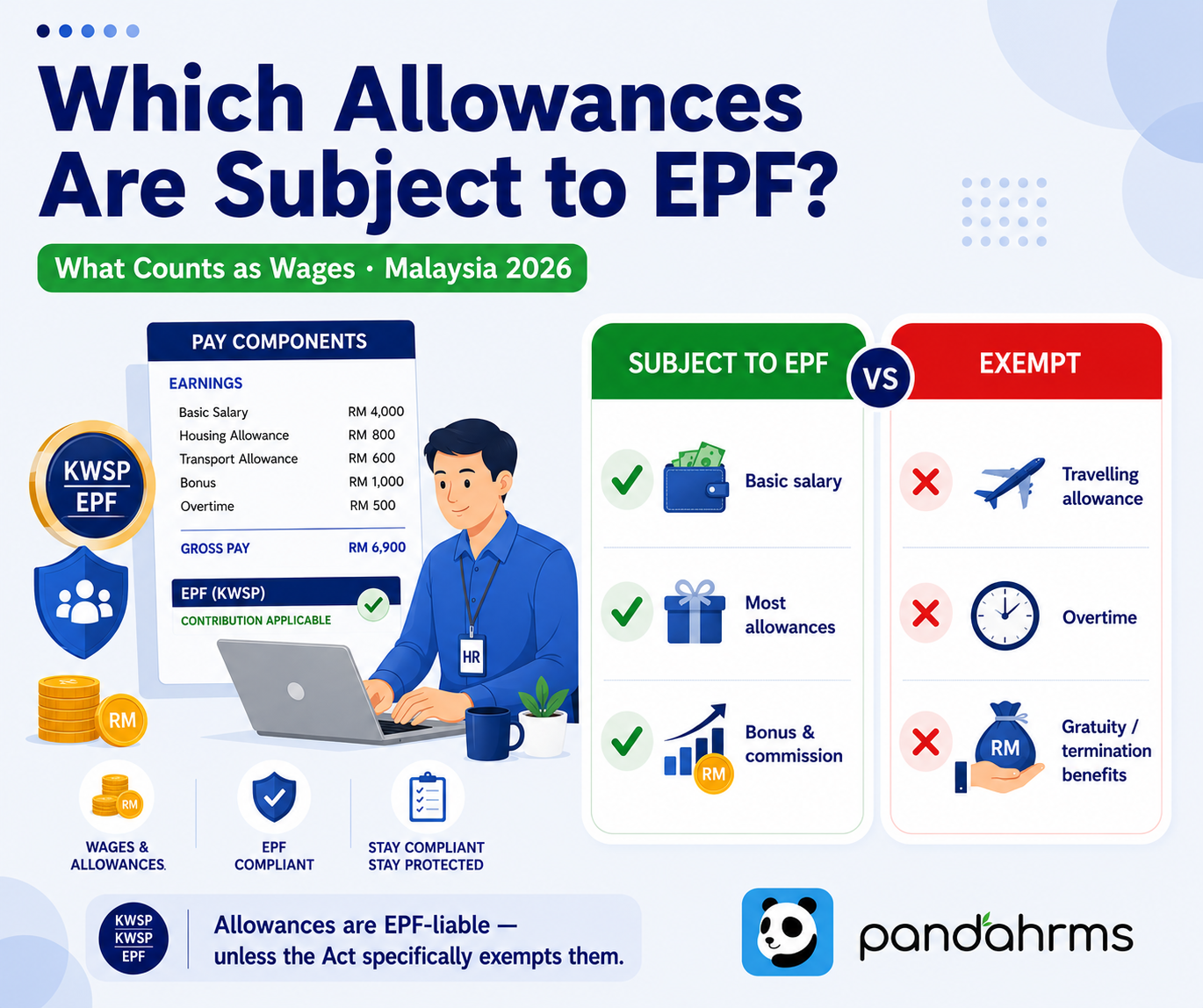
It’s one of the most common payroll questions in Malaysia — and one of the easiest to get wrong: does this allowance need EPF? Add EPF to a payment that’s exempt and you over-contribute; leave it off one that should have it and you under-contribute — which can mean arrears and penalties from KWSP.
The good news: the rules are clearer than most people think. Here’s exactly which allowances and payments are subject to EPF in Malaysia, and which are exempt.
What Counts as “Wages” for EPF?
EPF contributions are calculated on an employee’s “wages” as defined in the Employees Provident Fund Act 1991. Importantly, the definition is broad: wages means all remuneration in money due to an employee under their contract of service — and it expressly includes any bonus, commission, or allowance.
Key point: The starting assumption is the opposite of what many employers think — allowances ARE generally subject to EPF. They’re only exempt if they fall into one of the specific exclusions set out in the Act.
Payments That ARE Subject to EPF
Because the definition of wages is broad, the following are generally subject to EPF:
- Basic salary
- Most allowances — e.g. fixed/monthly allowances such as housing, shift, cost-of-living, or incentive allowances
- Commissions
- Bonuses and incentive payments
- Arrears of wages
- Wages for maternity leave and study leave
Payments That Are EXEMPT from EPF
The EPF Act specifically excludes the following from “wages” — so no EPF is payable on them:
| Exempt from EPF | Examples / notes |
|---|---|
| Service charge | e.g. the service charge collected in F&B/hospitality |
| Overtime payment | Pay for hours beyond normal working hours |
| Gratuity | Payment on discharge or retirement |
| Retirement benefit | Benefits paid on retirement |
| Retrenchment / lay-off / termination benefits | Payments made on ending employment |
| Travelling allowance | Any travelling allowance or travelling concession |
| Payment in lieu of notice | Payment in lieu of termination notice |
(The Minister may also exempt other specific payments from time to time.)
The Common Confusion: Allowances
Here’s where most payroll mistakes happen. Because “allowance” is expressly included in the definition of wages, a fixed monthly allowance — housing, shift, cost-of-living, incentive — is generally subject to EPF. The main allowance-type exception is a travelling allowance, which is exempt.
So the safe mental model is: an allowance is EPF-liable unless it’s specifically excluded (like travelling allowance) — not the other way around. Don’t assume all allowances are EPF-free.
Why Getting This Right Matters
- Under-contributing (missing EPF on a payment that should have it) can lead to arrears, dividends on arrears, and penalties from KWSP.
- Over-contributing (adding EPF to an exempt payment) needlessly increases cost for both employer and employee.
- Both erode trust — employees notice when their EPF looks wrong.
For the current rates, see our EPF (KWSP) Contribution Rates 2026 guide, and for the broader employer duties, our EPF employer responsibilities guide.
Where Pandahrms Helps
Applying EPF to the right wage components — and correctly excluding the exempt ones — is exactly what a proper payroll system should handle for you. With Pandahrms, each pay component is configured as EPF-liable or exempt, so contributions are calculated correctly every payroll run: allowances that should attract EPF do, travelling allowance and overtime don’t, and you’re never guessing per employee. Accurate contributions, no arrears surprises, and a clean audit trail.
Set each pay item up once, and EPF is calculated right every month.
Final Thoughts
The rule for EPF is simpler than it feels: wages are broadly defined and include allowances, bonuses and commissions — so most of what you pay is EPF-liable, except a specific list (service charge, overtime, gratuity, retirement/termination benefits, travelling allowance, and payment in lieu of notice). Get each pay component classified correctly, and you stay compliant without over- or under-paying. When a payment is genuinely unclear, confirm with KWSP.
Frequently Asked Questions (FAQs)
- Are allowances subject to EPF in Malaysia?
Generally yes. The EPF Act’s definition of “wages” expressly includes allowances, so most fixed allowances (housing, shift, cost-of-living, incentive) are subject to EPF. The main exception is a travelling allowance, which is exempt. - Which payments are exempt from EPF?
Service charge, overtime payment, gratuity, retirement benefit, retrenchment/lay-off/termination benefits, any travelling allowance or travelling concession, and payment in lieu of notice of termination — plus any other payment specifically exempted by the Minister. - Is overtime pay subject to EPF?
No. Overtime payment is specifically excluded from “wages” under the EPF Act, so EPF is not payable on overtime. - Is bonus subject to EPF?
Yes. Bonuses are included in the definition of wages and are subject to EPF contributions. - Is travelling allowance subject to EPF?
No. Any travelling allowance or the value of a travelling concession is expressly excluded from wages, so it is exempt from EPF.



